
Could voltage be a fundamental component of the universe?
Could voltage be a fundamental part of the universe?
Voltage is essential to electrical physics, but it is not an independent ingredient of the universe. It is neither a substance nor an additional fundamental force. Its value lies in describing a relationship: under suitable conditions, a potential difference tells us how electrical potential energy changes per unit charge.
Start with two points, not a cosmic substance
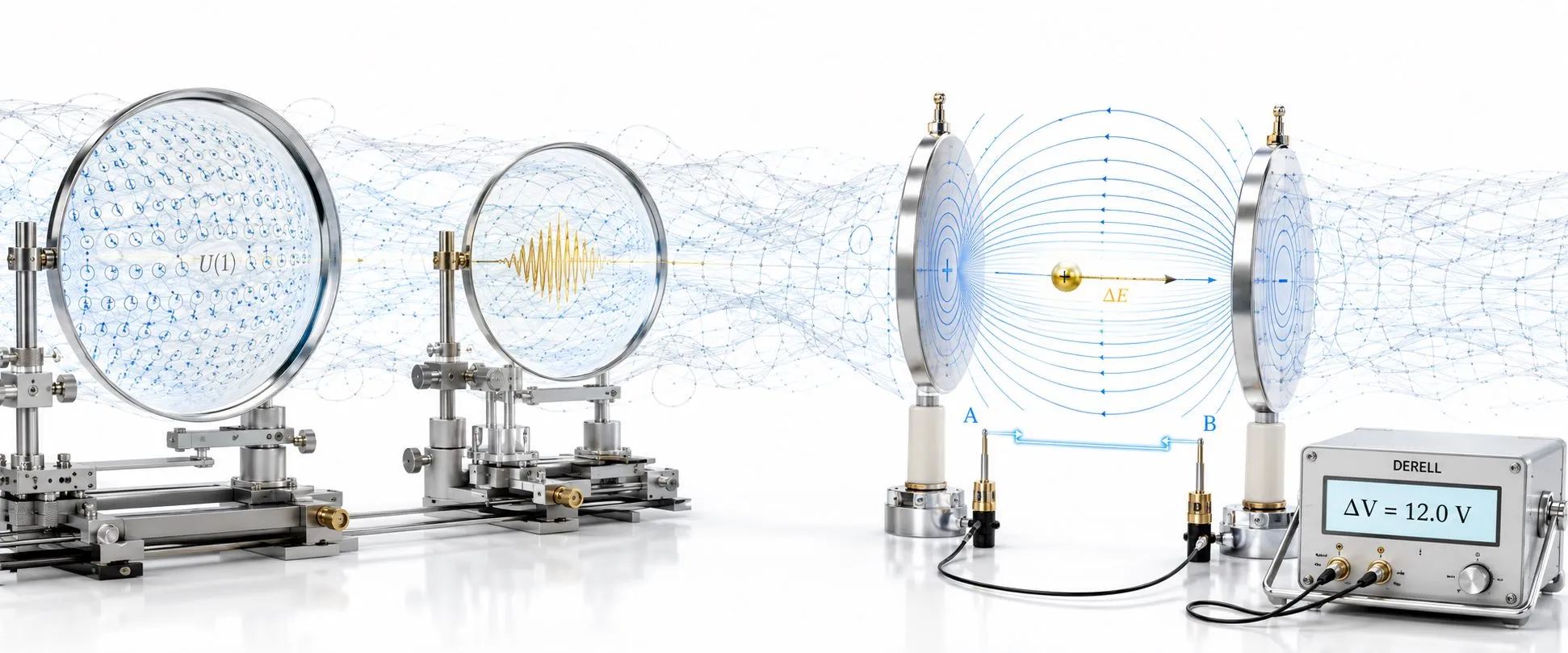
The practical meaning of voltage comes from comparing electrical potentials. One volt is one joule per coulomb. In an electrostatic situation, the change in a charge’s potential energy is ΔU = q × ΔV. Moving a positive 1 C test charge to a potential 12 V higher increases its potential energy by 12 J.
The reference level is a choice; the difference is what matters. Suppose point A is at 5 V and point B at 17 V relative to a chosen reference. B is 12 V above A. Shifting both assigned values by 100 V gives 105 V and 117 V, with exactly the same difference. Asking for a voltage at a location therefore requires a reference. It also helps to distinguish voltage from current: a potential difference does not itself describe a rate of charge flow.
Where voltage fits into fundamental physics
The four established fundamental interactions are gravity, electromagnetism, the strong interaction and the weak interaction. Voltage belongs within our description of electromagnetic systems; it does not add a fifth interaction. Electromagnetism helps explain atomic structure, chemical bonding and the interaction of light with matter. An atom, however, needs a quantum description rather than a simple battery analogy.
Quantum electrodynamics, or QED, describes electromagnetic interactions at the quantum level. The role of photons in that theory does not turn voltage into a particle or a separate force. References to virtual photon exchange are not evidence for an undiscovered cosmic substance called voltage.
Space is an electrical environment
In a plasma, free electrons and ions respond to electric and magnetic fields. The solar wind and the space environment around Earth provide real settings in which these interactions can be studied. Researchers examine field strength, charge distribution, particle motion and energy transfer. A potential difference can be useful within an appropriate model, but one voltage reading cannot capture every aspect of a space plasma.
A magnetic field alone does not establish an electrical potential difference. Changing magnetic flux can induce an electric field. The induced electromotive force around a loop must be described with the loop or path specified. A transformer provides a familiar engineering example of this relationship.
Why “the voltage of the universe” needs a definition
There is no single numerical answer without specified comparison points and a physical model. The universe is not defined as a battery with two common terminals. Likewise, an account of the early universe cannot replace physical mechanisms and observational evidence with a claim that a universal voltage directed the formation of matter.
Bring the question back to the workbench
Measuring voltage requires an appropriate multimeter connected between two points. An ammeter measures current, while an oscilloscope reveals how a voltage signal changes over time. Each instrument answers a different question, and the measurement arrangement helps define the result.
Capacitor voltage, capacitance and polarity offer a concrete way to examine stored charge and electrical energy. Electrostatic damage to circuit boards shows why a brief transfer of charge can matter. Voltage is useful information, but charge quantity, stored energy and the duration of an event also belong in the explanation.
For a working circuit, resistance, voltage distribution and the relationship between voltage and power connect the measurement to a physical model. For equipment in service, the relevant questions concern operating voltage, supply fluctuations and voltage drop along conductors. This is where the concept earns its place: as a measurable quantity that supports calculation, diagnosis and design.