
FAQ For Humidity Control
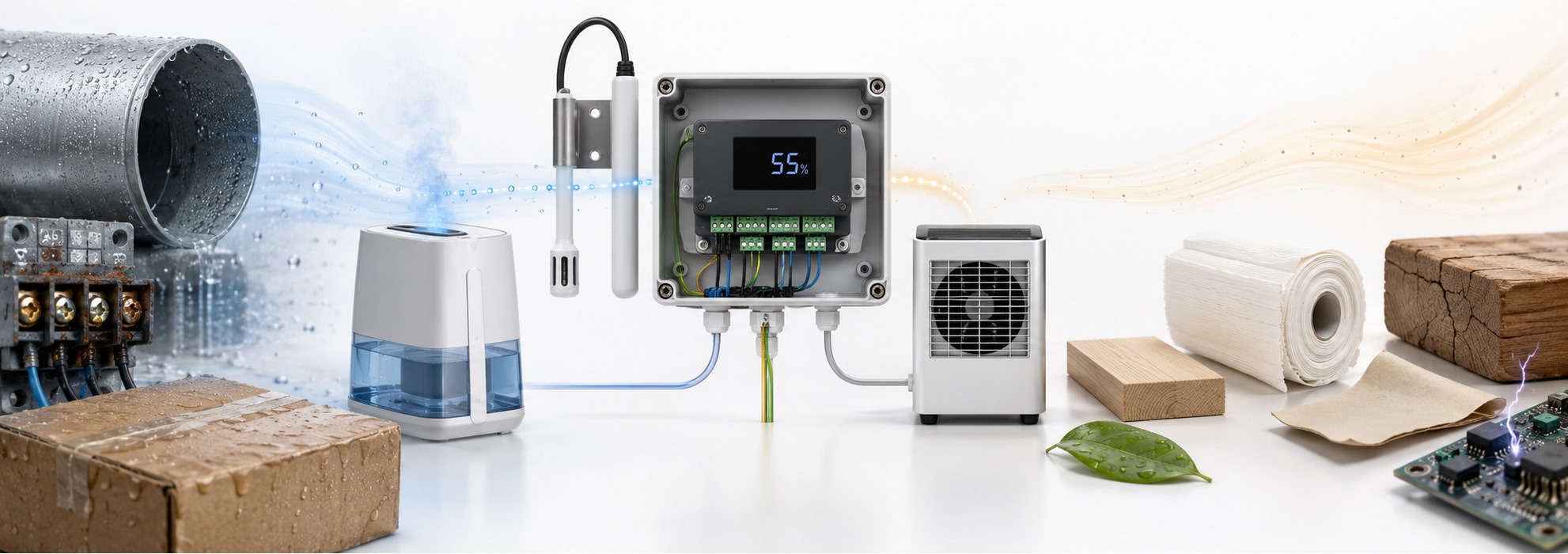
From reliable measurement to stable humidity control
Hello everyone. Humidity control means measuring humidity in a space or process air, comparing it with a target range and correcting it using suitable equipment. A humidity sensor provides the measurement; the controller operates a humidifier, dehumidifier or suitable ventilation system. A control relay alone neither adds water to the air nor removes it. Results depend on equipment capacity and moisture load as well as measurement accuracy.
Relative humidity (%RH) is the ratio of water-vapor partial pressure to saturation vapor pressure at the same temperature. Assessing humidity without considering temperature can therefore be misleading. The questions below explain key distinctions for homes, warehouses, production areas and sensitive materials. Each question links to its detailed page.
Editor's note: Heating air can lower relative humidity without removing water vapor. This is different from dehumidification. Even when the room average appears acceptable, condensation can form on a surface below the dew point. Consider temperature, surface conditions and moisture sources alongside the displayed percentage.
Basic principles and applications
What is humidity control and why is it important?
Humidity control includes humidification when required, as well as removing excess moisture. Its purpose is to maintain conditions appropriate to the application. An electronics warehouse, woodworking area and drying process may require different targets; one percentage is not suitable for every application.
How does humidity control work at home?
High humidity may require a suitable dehumidifier or ventilation when conditions allow; low humidity may require controlled humidification. Showers, cooking, indoor laundry drying and water leaks can increase the moisture load. Reducing moisture at its source should be considered before relying on continuous equipment operation.
How does humidity control work in professional or industrial environments?
The sensor, controller and equipment form a feedback loop. On/off, staged or proportional control may be used to suit the process. In large spaces, air distribution, door openings and moisture released by production matter; a measurement at one location may not represent the entire area.
What are the benefits of a humidity control system?
Appropriate control can improve product consistency, storage conditions and process repeatability. It can reduce problems associated with condensation, corrosion or materials absorbing and releasing moisture. The benefits depend on the material's requirements; unnecessarily tight tolerances can increase costs.
Faults, installation and indoor conditions
How can I tell whether the humidity control system is malfunctioning?
Investigate a frozen reading, continuous output operation or failure to reach the target. First compare the sensor reading with a reference instrument, then check the command and actual equipment operation. A dirty filter, blocked drain, open door or insufficient capacity can resemble a controller fault.
How is a humidity control system installed or repaired?
Place the sensor where it represents the air being controlled; positions close to a heat source or moisture outlet can be misleading. Match the input type, supply, output capacity and control direction. If the relay rating is unsuitable, operate the load through an appropriately rated contactor or drive.
What are the health implications of proper humidity control?
Limiting moisture sources and mold growth can help improve indoor conditions. The CDC notes that mold can be associated with respiratory and allergic symptoms in some people. Humidity management should be combined with repairing leaks, providing suitable ventilation and addressing existing mold problems.
How can I maintain an appropriate humidity level at home?
The EPA recommends keeping indoor relative humidity below 60%, ideally between 30% and 50% where possible. This is not an unchanging setting for every building; condensation on cold windows and walls must also be monitored. Residential guidance is not automatically an industrial process specification.
Energy use and control methods
How does humidity control affect energy consumption?
Dehumidification, humidification, fans and any reheating consume energy. Reducing leakage, maintaining equipment and avoiding unnecessarily strict settings can reduce consumption. Lowering temperature with air conditioning does not always provide sufficient moisture removal; simply lowering the thermostat further can cause overcooling.
What is the difference between automatic and manual humidity control?
Manual control depends on a person checking readings and intervening; automatic control makes adjustments continuously. Hysteresis reduces rapid switching: purely as an illustration, dehumidification might start at 55% RH and stop at 50% RH. The difference is 5 percentage points; suitable thresholds depend on the application.
How can poor humidity control affect comfort and quality of life?
High humidity can make hot conditions feel more oppressive, while cold surfaces may develop dampness and condensation. Very dry conditions can also reduce comfort. Assess temperature, air movement and ventilation together; comfort cannot be determined from the humidity percentage alone.
Which technologies are used in humidity control systems?
Dehumidification can use refrigeration-based condensation or desiccant/adsorption systems; humidification can use steam, evaporative or ultrasonic methods. Consider refrigeration-based capacity at low temperatures and the regeneration energy needed by desiccant systems. Selection should reflect the target dew point and actual operating conditions.
Settings, sensitive materials and measurement
How do humidity settings affect a building's indoor environment?
A new setting can change operating time, temperature and surface-condensation risk. For example, air at 20 °C and 60% RH has a dew point of approximately 12 °C; condensation can form on a surface at 10 °C. This illustrates why room readings and surface conditions must be assessed together.
How does humidity control help preserve artworks and other sensitive items?
Wood, paper, paint layers and metals respond differently to humidity. The average level matters, but so do the rate and magnitude of changes. Select the target range according to the material, its history and a conservation assessment; one fixed value does not suit every collection.
How can I assess and monitor humidity around me?
Record temperature and humidity together. Keep sensors away from sunlight, heat-producing electronics and direct steam flow. Compare several locations in large spaces, and note events such as door openings and shift changes. When comparing two instruments, place them together and allow their temperatures to stabilize.
How should humidity be managed in different climates?
Outdoor relative humidity alone does not show whether ventilation will dry a space. Compare dew point or humidity ratio. Cold outdoor air can have high relative humidity yet provide drying when brought indoors and heated; warm, humid outdoor air may instead add to the indoor moisture load.
Equipment selection, environmental impact and mold
How do I choose a suitable humidity control system?
Consider more than room volume: assess moisture load, air exchange, temperature, target tolerance and door traffic. Compare dehumidification capacity at the actual temperature and humidity. A catalog's liters-per-day rating may refer to different test conditions; humidification output must also be sized separately.
Which brands and models of humidity control equipment should I consider?
Define the equipment class and technical requirements first. Compare accuracy, operating temperature, condensation tolerance, output type, calibration and service. A sensor intended for ordinary room conditions may be unsuitable for a continuously condensing process. A brand name alone does not establish suitability or compatibility.
What are the environmental impacts of humidity control systems?
Assess electricity and water consumption, refrigerant use, maintenance and equipment life together. Correct sizing and avoiding unnecessary humidification–dehumidification cycles can reduce resource use. Compare energy performance at the same temperature and target humidity; nameplate power alone is insufficient.
Can a humidity control system help prevent mold and mildew growth?
Yes, appropriate humidity management can reduce the risk, but it cannot by itself eliminate water leaks, wet building materials or thermal bridges. Local surfaces may remain wet even when room humidity appears acceptable. A lasting solution addresses the moisture source and existing contamination appropriately.
Related equipment and technical topics
Humidity and temperature controllers, humidity sensors, PID humidity control and how analog signals work.
Technical references
EPA — Residential humidity, condensation and mold prevention
Sensirion — Humidity and temperature sensor placement, thermal effects and measurement design
Munters — Comparing refrigerant-based and desiccant dehumidification
U.S. Department of Energy — HVAC humidity control in hot, humid climates
Canadian Conservation Institute — Relative humidity and fluctuations affecting sensitive materials
Refine Search
- Can a humidity control system help to prevent mold and mildew growth?
- How can a humidity control system be installed or repaired?
- How can I assess and monitor the level of humidity in my environment?
- How can I choose the right humidity control system for my needs?
- How can I tell if the humidity control system is malfunctioning?
- How does a lack of humidity control affect the comfort and quality of life?
- How does changing humidity control settings affect the environment within a building?
- How does humidity control affect energy consumption?
- How does humidity control work in a professional or industrial environment?
- How does humidity control work in a residential environment?
- What are the benefits of using a humidity control system?
- What are the best practices for managing humidity levels in different climates?
- What are the considerations for maintaining the optimal humidity level at home?
- What are the environmental impacts of humidity control systems?
- What are the health implications of proper humidity control?
- What brands and models of humidity control systems do you recommend?
- What is humidity control and why is it important?
- What is the difference between automatic and manual humidity control?
- What technologies are used in humidity control systems?
- What's the impact of humidity control in preserving artworks or other sensitive items?