
ISO 15118: The Conversation Behind an EV Charging Session
A charging connector establishes the physical connection. Before and during energy transfer, the vehicle and charging equipment may also need to identify services, authorize a session and exchange operating limits. ISO 15118 provides a family of specifications for this high-level communication.
It belongs to the broader set of electric vehicle charging standards. Its best-known applications include Plug & Charge, coordinated charging and bidirectional power transfer. Which capabilities are available depends on the particular part of the standard and the features actually implemented.
Three Layers That Should Not Be Confused
The physical connection: IEC 62196 addresses charging accessories and interfaces. Names such as CCS and SAE J1772 help identify connection systems, but do not establish every digital feature available through them.
Basic charging control: The functions associated with IEC 61851 include basic signalling and charging control. A pilot PWM waveform is not equivalent to the complete digital message exchange used by ISO 15118.
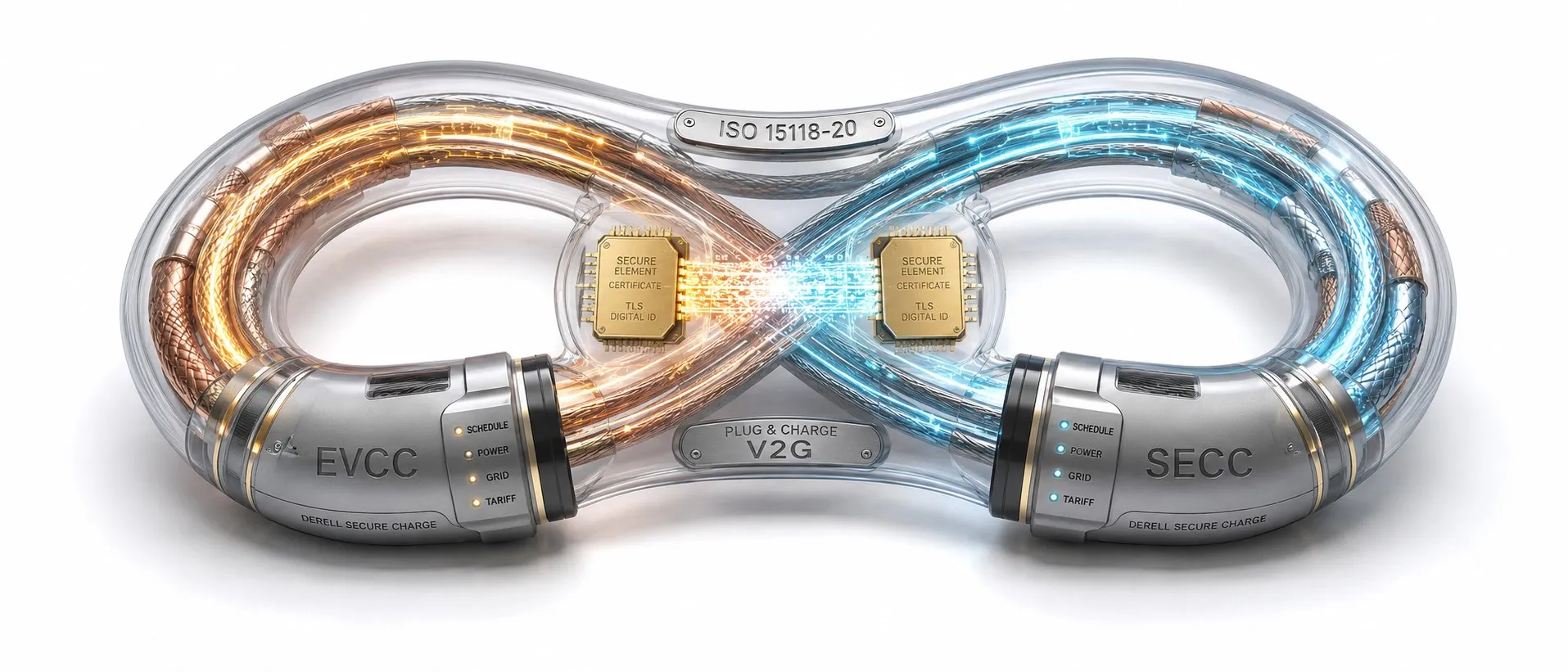
High-level communication: The vehicle’s communication controller, EVCC, exchanges messages with the supply equipment’s controller, SECC. Common conductive implementations use PLC, meaning Power Line Communication. In this context, PLC does not mean a programmable logic controller. Establishing a data connection is one stage of the process; the conditions for power delivery still have to be satisfied.
Plug & Charge Is an Authorization System
With a compatible vehicle, station and service arrangement, Plug & Charge can authorize charging automatically after connection. The driver may no longer need to present an RFID credential or start every session through an app.
The underlying mechanism uses digital certificates and a public key infrastructure, or PKI. A contract certificate associated with the vehicle participates in identifying and authorizing the charging relationship. Successful operation depends on more than the car: charging operators, service providers and certificate infrastructure must support the arrangement too.
Automatic authorization does not mean free charging. The session can be billed under the relevant contract. ISO 15118 does not replace every commercial agreement, payment-processing service or roaming arrangement involved in delivering that service.
Autocharge is a different approach. It can produce a similar experience by recognizing a vehicle identifier linked to an account. ISO 15118 Plug & Charge uses a certificate-based model. An automatic start is therefore not enough to identify which technology a station is using.
Which Parts of ISO 15118 Matter?
ISO 15118-2:2014 specifies network and application protocol requirements. Its original application messages are designed for energy transfer from charging equipment to a vehicle. ISO lists this published edition as confirmed in 2024, with a revision under development.
ISO 15118-20:2022 introduces second-generation network and application requirements, including communication messages and sequences for bidirectional power transfer. Support for the document does not establish that a product implements every service it describes.
ISO 15118-3:2015 covers physical and data-link requirements for wired high-level communication. ISO 15118-8:2020 addresses those layers for wireless communication. A wireless data link must not be confused with wireless transfer of charging energy.
The 2026 amendment: ISO published ISO 15118-20:2022/Amd 1:2026 in July 2026. Its stated subjects include AC distributed-energy-resource service, MCS service and an improved security concept. Procurement documents should identify the applicable part, edition and amendment level instead of relying on a general “ISO 15118 ready” claim.
Smart Charging Needs Information and a Decision-Maker
Depending on the supported service, the vehicle and charging system can exchange information about energy needs, departure time, limits or schedules. An energy management system can use that information alongside site demand, tariffs and available generation. ISO 15118 enables the conversation; it does not independently choose the cheapest tariff or guarantee a particular saving.
Planning also requires a clear distinction between power in kW and energy in kWh.
Example: Adding 20 kWh to a battery over four hours requires an average battery charging power of 5 kW. The grid-side requirement is higher once conversion losses and auxiliary loads are included. A feasible schedule must also respect vehicle limits and the capacity available at the site.
A station marked 7.4 kW, 11 kW or 22 kW will not necessarily deliver that power throughout a session. The conversion hardware and constraints also differ between AC and DC charging. Better communication cannot increase a component’s physical rating.
Where OCPP Fits into the System
ISO 15118 connects the vehicle’s communication functions to the charging equipment. OCPP connects the charging station to its management system. A networked wallbox or DC station may use both, serving different parts of the charging process.
OCPP 2.0.1 includes ISO 15118-related support. OCPP 2.1 adds support for ISO 15118-20 and further bidirectional charging functions. However, an OCPP certificate must be read by scope: OCPP 2.0.1 Core certification alone does not certify the optional ISO 15118 Support profile.
Bidirectional Communication Is Not Bidirectional Hardware
Vehicle-to-grid, or V2G, involves exporting energy from the vehicle to the electrical grid. Vehicle-to-home, V2H, concerns supplying a home; vehicle-to-load, V2L, supplies external loads. These capabilities are not interchangeable. A vehicle with a V2L outlet is not automatically approved or equipped for grid-parallel operation.
Bidirectional service requires compatible vehicle and charging power electronics, control functions and protection, as well as the applicable grid-connection arrangements. A communication protocol cannot turn a unidirectional converter into a bidirectional one. Nor does protocol support prove that a home will remain powered during an outage.
Security Depends on Correct Implementation
Certificate validation, protected communication and private-key management support authentication and data security. Practical operation also depends on certificate validity, trusted certificate chains, correct time information and maintained software. A rejected certificate can prevent authorization even when the charging power hardware is healthy.
Cybersecurity and electrical protection remain separate responsibilities. Digital credentials do not replace protective earthing, correct wiring or appropriate residual-current protection. A successful authorization message is not evidence that the installation has passed its electrical checks.
What to Check When a Session Will Not Start
Identify the protocol and service supported by both ends, then check whether Plug & Charge is enabled and accepted by the operator. Contract status, certificate handling and communication logs can help distinguish an authorization failure from a power-system fault. Two products bearing the same broad standards label may still lack a common enabled service.
When selecting equipment for charging at home, request a written description of supported versions, services and tested vehicle compatibility. Our EV charging FAQ provides related explanations of connections, power limits and everyday charging arrangements.
Technical references: ISO 15118-2:2014 · ISO 15118-20:2022 · ISO 15118-20 Amd 1:2026 · ISO 15118-3 · ISO 15118-8 · CharIN — Plug & Charge · Open Charge Alliance — OCPP