
CHAdeMO
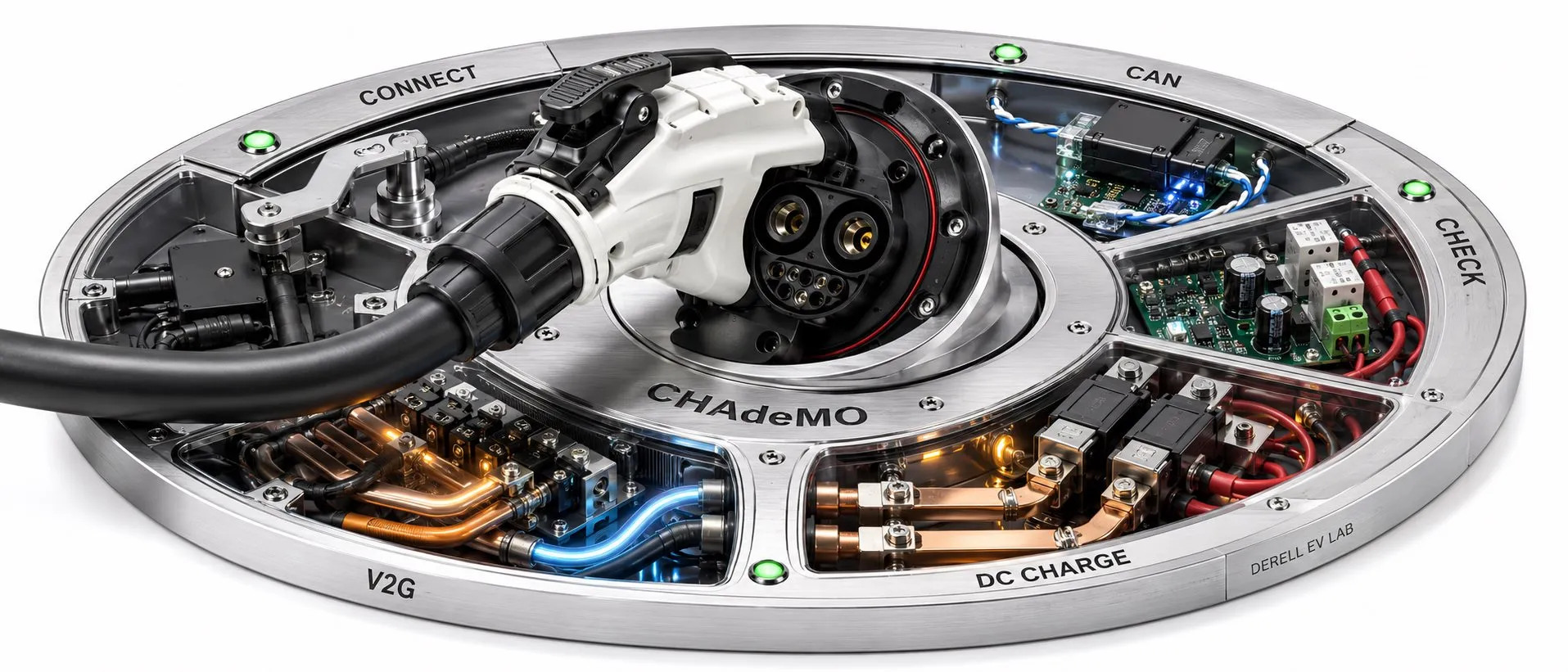
Power, communication and vehicle compatibility in DC fast charging
Hello everyone. CHAdeMO is a DC fast-charging interface and protocol family developed in Japan for electric vehicle charging. It defines more than a plug shape: it also covers communication between the vehicle and station and the management of energy transfer. When comparing charging standards, consider the connector, communication system and power limits together.
Editor's note: A station labelled “150 kW” does not necessarily provide 150 kW through its CHAdeMO connector. It may have different outputs, individual output limits or shared power. Check the station's total rating, the CHAdeMO output rating and the vehicle's charging capability separately.
How does it differ from AC charging?
The key difference between AC and DC charging is where conversion to battery-compatible direct current takes place. During AC charging, this is normally performed by the vehicle's onboard charger. With CHAdeMO DC charging, the station's power supply and power electronics perform that conversion. Energy then passes through the vehicle's control and protection system to the battery; the onboard AC charger's rating does not directly define the DC charging limit.
Consequently, 7.4 kW, 11 kW and 22 kW AC charging ratings should not be treated as CHAdeMO DC ratings. A wallbox used for home charging does not become a CHAdeMO charger simply because it has a high output. A CHAdeMO-equipped vehicle may also have a separate AC inlet; whether it uses SAE J1772 or another arrangement depends on the model and market.
How do the vehicle and charger communicate?
Conventional CHAdeMO uses CAN-based communication. The vehicle controller manages charging requests according to the limits permitted by the battery management system (BMS), while the station adjusts its output within its own limits. Charging therefore does not consist of applying uncontrolled, constant power to the battery. Voltage, current, connection status and fault information are all part of the process.
The IEC 62196 family provides a framework for connecting hardware, while IEC 61851 covers relevant requirements for conductive charging systems. An “IEC compliant” description alone does not establish compatibility between different interfaces. The PLC communication used by CCS and communication standards such as ISO 15118 differ from conventional CHAdeMO's CAN-based arrangement. Here, PLC means power line communication.
What do 62.5 kW, 400 kW and 900 kW mean?
CHAdeMO cannot be defined by one power rating. For example, 500 V × 125 A = 62.5 kW describes an operating point at which both values are present simultaneously. At the same current with a 400 V battery, power is 50 kW. Multiplying a maximum voltage by a maximum current therefore does not establish the continuous power every vehicle will receive.
CHAdeMO 2.0 specifies high-power capability up to 400 kW. The development of CHAdeMO 3.0/ChaoJi defines a 900 kW level using limits of 600 A and 1,500 V. These describe the capability of the relevant protocol and hardware generation; they do not upgrade an older vehicle or every existing CHAdeMO station to those ratings.
Why do actual power and charging time vary?
Actual power depends on the station output, cable and connector limits, vehicle current capability, battery voltage, state of charge (SOC) and battery temperature. The characteristics and cooling system of the vehicle's battery also matter. Power may be reduced as charge level rises or battery protection limits are approached. This does not, by itself, indicate a faulty charger.
As a simple example, increasing a battery with 60 kWh usable capacity from 20% to 80% requires approximately 36 kWh of added energy. Ignoring losses and assuming an average power of 45 kW over that interval gives 36 ÷ 45 = 0.8 hours, or about 48 minutes. This is not a charging-time promise for a particular vehicle. The calculation uses average power over the session, rather than the station's peak rating.
Compatibility with CCS, Type 2 and adapters
CHAdeMO, CCS and Type 2 connections are not identical interfaces. A passive adapter that only changes the plug shape cannot resolve the communication differences between CCS and CHAdeMO. A solution for that purpose must also provide protocol conversion, the necessary safety functions and the correct direction of energy transfer. Verify explicitly stated compatibility for the vehicle model, model year, software, station and adapter together.
Saying that a particular brand uses CHAdeMO is also insufficient: inlets can change between generations and markets. Check the charging-port label and the vehicle owner's manual. A station offering both CCS and CHAdeMO does not make its two cables interchangeable for every vehicle.
Is ChaoJi the same as the original CHAdeMO inlet?
No. ChaoJi is a next-generation high-power charging development by the CHAdeMO Association and the China Electricity Council, also connected with the GB/T ecosystem. CHAdeMO 3.0 was first announced in 2020; describing it as a future 600 kW version still awaiting release is outdated. Its new connecting hardware is not identical to the conventional CHAdeMO plug.
The backward-compatibility objective should not be interpreted as every plug fitting directly into every inlet. A suitable adapter or multi-standard equipment may be needed, depending on the vehicle and station implementation. ChaoJi's power capability does not automatically give an existing CHAdeMO vehicle new charging capabilities.
What is required for V2G and V2H?
CHAdeMO supports bidirectional energy-transfer applications. V2H uses vehicle energy in a home, while V2G exports it to the grid through a suitable system. This requires vehicle support as well as compatible bidirectional charging equipment, electrical installation and controls. An ordinary CHAdeMO fast charger does not become bidirectional merely by having the same connector.
Grid-connected operation and powering a home during an outage are also different functions. V2G support alone does not establish that the house will remain powered during a grid outage; backup operation and grid-isolation capabilities must be specified separately.
Safety and station selection
Charging safety involves connection checks, locking, insulation monitoring, appropriate earthing, temperature supervision and stopping energy transfer when a fault occurs. The station's DC fuses and contactors must also suit their DC operating and interruption conditions. These requirements cannot be assessed from connector shape alone.
Before travelling, check the operator's current information for CHAdeMO connector availability, operating status and output rating. Actual access along your route is more useful than an old worldwide station count. For other practical questions, see the electric vehicle charging FAQ.
Related topics
Within the charging family, explore electric vehicle charging standards, IEC 62196, IEC 61851, CCS connectors and GB/T. In related fields, battery management systems, electric vehicle batteries, earthing, DC fuses and contactors explain the control and protection aspects of energy transfer.
Technical references
CHAdeMO Association — protocol versions and power capability
CHAdeMO Association — V2G, V2H and bidirectional applications
U.S. Department of Energy, AFDC — charging equipment, connectors and charging-time factors
CharIN — CCS communication and the protocol limitations of passive adapters
Nissan — model-specific guidance on DC charging power and battery temperature limits