
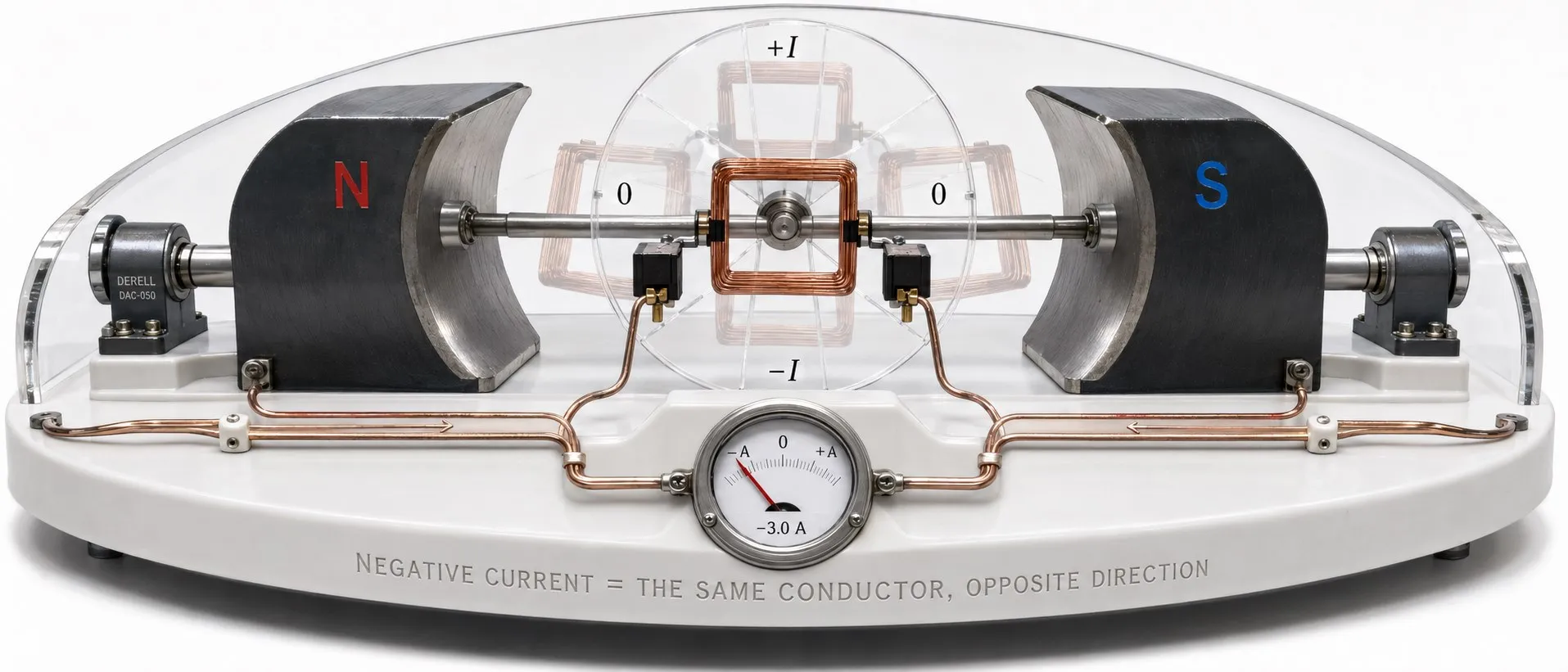
Can amperage be negative? Understanding the minus sign
Yes. A current reading can be negative. If a meter displays −2 A, the current has a magnitude of 2 amperes and flows opposite to the direction defined as positive. The minus sign alone does not identify a fault.
The signed quantity is electric current; the ampere is its unit. To interpret the reading, start with one question: Which direction does this circuit or instrument treat as positive?
The sign follows the reference direction
Suppose the positive current direction in a circuit branch is defined as from point X to point Y. A result of I = +3 A means 3 A flows from X to Y. A result of I = −3 A means 3 A actually flows from Y to X.
When analysing a circuit, you can choose a reference direction before knowing the actual direction. A negative answer resolves that uncertainty: the current opposes the arrow you selected. Redrawing the reference arrow changes the sign used to describe the current, without changing the physical circuit.
Why does a multimeter display negative amps?
In DC current mode, a multimeter detects current direction relative to its input terminals. A typical instrument displays a positive value when conventional current enters the A or mA terminal and leaves through COM. Flow in the opposite direction produces a negative reading. Check the instrument manual for its convention.
Reversing the measurement connections in an otherwise unchanged, correctly arranged circuit can turn a reading of +0.50 A into −0.50 A. The load is still operating at the same current magnitude; the measurement reference has changed. Our guide to measuring current with a multimeter explains the connection method.
DC clamp meters: orientation and zero offset
On a DC-capable clamp meter, an arrow may identify the positive measurement direction. Reversing the clamp around the same conductor can reverse the displayed sign. A load-current measurement should enclose the relevant single conductor.
A small negative reading near zero deserves a different check. Sensor offset, external magnetic fields and measurement uncertainty may account for it. Follow the manufacturer’s DC zeroing procedure under the specified conditions. Zeroing while real current is flowing can hide that current from subsequent readings.
Does negative battery current mean charging or discharging?
That depends on the monitor’s sign convention. A battery monitor may define current entering the battery as positive and current leaving it as negative. Under that convention, charging produces a positive reading and discharging produces a negative one. Check the documentation before applying this interpretation to another device.
Consider a battery whose terminal voltage is 24 V at the measurement instant. Define voltage from its positive terminal relative to its negative terminal, and define positive current as entering the positive terminal. With these references, P = V × I gives the following results:
| Current | Electrical power | Interpretation |
|---|---|---|
| +5 A | +120 W | The battery receives electrical power; current flows in the charging direction. |
| −5 A | −120 W | The battery supplies electrical power to the circuit; current flows in the discharging direction. |
Negative power in this example means that energy leaves the battery under the selected references. For a general circuit, current sign alone cannot establish power direction: voltage polarity must also be known.
Negative instantaneous current is normal in AC
An alternating current can have positive and negative instantaneous values. During the negative half of a sinusoidal waveform, current flows opposite to the reference direction. This is part of normal AC operation.
The mathematical RMS current value is always non-negative. For example, an ideal sine wave reaching +2 A and −2 A has an RMS value of approximately 1.414 A. An instantaneous sample and an RMS measurement describe different aspects of the same waveform. Our True RMS guide explains the measurement in more detail.
Some instruments may add a direction indicator to an RMS magnitude. Interpret that indicator using the instrument’s definitions; it does not make the underlying RMS calculation negative.
Does a negative current prove that power is being exported?
No. AC power direction requires voltage and current to be evaluated together. A reversed current clamp or an incorrect voltage-to-current phase pairing can also produce a misleading power-flow indication.
Regeneration in motor drives
A motor driven by its load, or decelerating under suitable conditions, can operate as a generator and transfer energy into the drive’s DC bus. This is a case of regenerative energy flow.
Returning energy to the DC bus does not mean that every drive can return it to the mains. Grid regeneration requires a suitable regenerative supply arrangement. Depending on the system, energy may be used by other loads or dissipated as heat through a brake chopper and braking resistor. When interpreting a signed drive display, first identify whether its parameter represents current, torque or power.
Three concepts that need separate explanations
Negative charge carriers
In metals, electron drift is opposite to conventional current direction. Electrons carrying negative charge does not mean that every ammeter reading must be negative. Carrier charge and measurement reference are separate concepts. See our introduction to electric current for the physical explanation.
For a diode, choosing anode-to-cathode current as positive makes reverse leakage current negative. The sign follows the chosen direction, rather than simply identifying electrons as the charge carriers.
Negative differential resistance
Some devices, including tunnel diodes, have an operating region in which current decreases as voltage increases. The local slope of the current–voltage curve is negative: dI/dV < 0. This is negative differential resistance behaviour.
The current itself can remain positive throughout that region. A negative current value and a negative slope on an I–V curve are different statements. One concerns direction; the other concerns how current responds to a change in voltage.
Negative process values in a PLC
A 4–20 mA signal can represent a temperature or pressure below zero. The physical loop current does not have to reverse to communicate a negative engineering value.
Example: configure a temperature transmitter to map −50 to +50 °C linearly onto 4–20 mA. It then produces 8 mA at −25 °C and 12 mA at 0 °C. The PLC can display a negative temperature while current continues to flow in the normal positive measurement direction.