
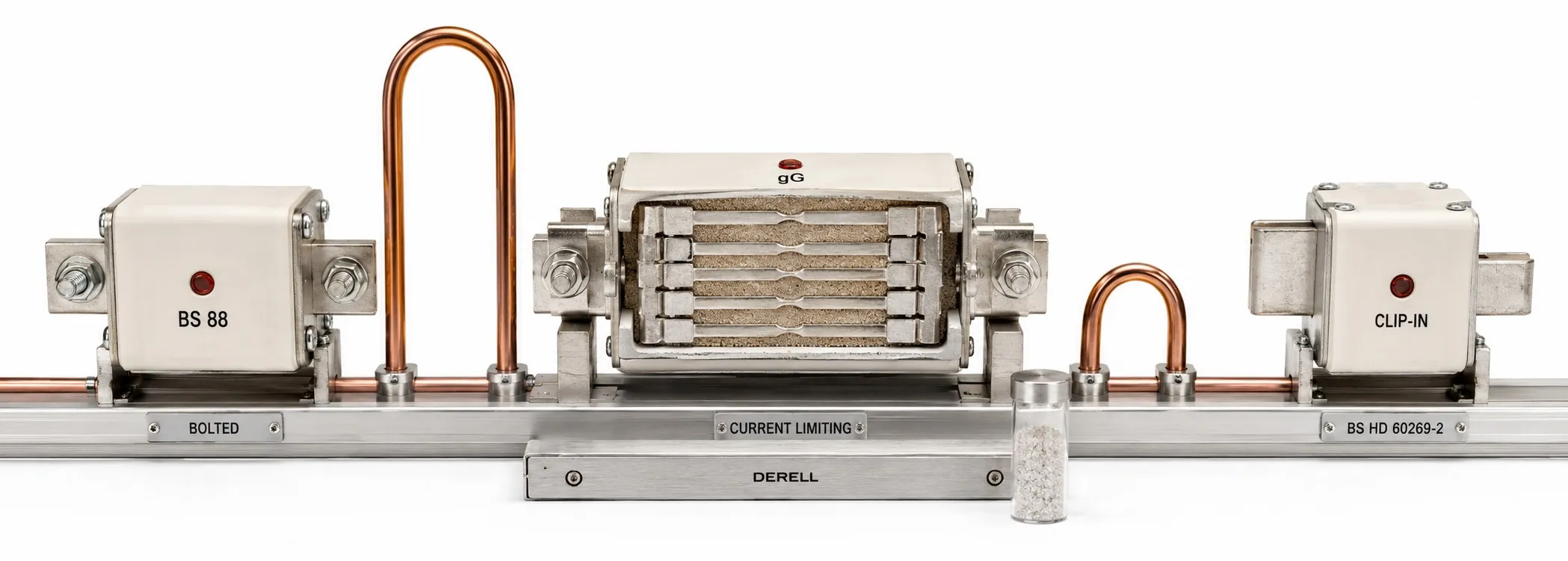
BS 88 Fuses: What the Standard Reference Tells You
A maintenance record that says “replace with a BS 88 fuse” leaves several questions unanswered. Which part of the standard applies? What is the utilization category? Does the replacement match the circuit voltage, fault level and holder? BS 88 identifies a standards reference; it does not specify a complete replacement part.
These British fuse standards are closely associated with the IEC 60269 low-voltage fuse series. They address the construction and performance of electrical fuses, including the replaceable fuse-link that interrupts an overcurrent. Industrial distribution is a familiar application, but the family also includes household fuse systems and semiconductor protection.
Understanding the Main BS 88 References
| Reference | Main subject | Related IEC part |
|---|---|---|
| BS 88-1 | General requirements, ratings and test principles for low-voltage fuses. | IEC 60269-1 |
| BS 88-2 | Additional requirements for fuse systems operated by authorized persons, mainly in industrial applications. | IEC 60269-2 |
| BS 88-3 | Additional requirements for fuse systems intended for use by unskilled persons, mainly in household and similar applications. | IEC 60269-3 |
| BS 88-4 | Additional requirements for fuse-links used to protect semiconductor devices. | IEC 60269-4 |
This is a guide to scope, not a list of the latest editions. Depending on the document date, associated publications may carry BS HD or BS EN IEC designations. Check the complete reference and amendments when specifying fuse standards. Application guidance within the IEC family is covered by IEC TR 60269-5; Part 4 concerns semiconductor fuse-links.
Breaking Capacity Is Only One Part of the Specification
HBC means high breaking capacity; HRC means high rupturing capacity. Both descriptions concern the ability to interrupt substantial fault currents under specified conditions. They are common in discussions of industrial fuse-links, but neither term supplies a universal kA rating.
The current rating in amperes and the breaking capacity in kiloamperes answer different questions. One concerns normal service; the other concerns fault interruption. Neither replaces the time-current curve. Likewise, describing a fuse as HRC does not establish whether it has the operating behavior required from a fast-acting or time-delay fuse.
Match the Utilization Category to the Protection Job
General distribution: A gG fuse provides full-range protection, covering overload and short-circuit conditions when correctly selected. Its suitability still depends on the cable, load and installation requirements.
Motor circuits: An aM fuse provides partial-range protection and must be used with suitable overload protection. For an electric motor, selection must account for starting current and acceleration time. The fuse, contactor and overload relay should form a coordinated combination supported by the manufacturer's data.
Power electronics: Categories aR and gR serve semiconductor protection, with partial-range and full-range coverage respectively. Selecting semiconductor fuses involves total clearing I2t, arc voltage and the protected equipment's limits. For a variable frequency drive or servo drive, use the equipment manufacturer's specified fuse arrangement.
What Makes a Replacement Suitable?
Start with the duty. Establish the normal load, temporary overloads, starting conditions and enclosure temperature before deciding on the fuse current rating. A rating printed on the old fuse is useful identification, but it does not prove that the original selection was correct.
Check AC and DC ratings separately. A fuse may have different voltage and breaking-capacity ratings for each. An AC marking alone is insufficient evidence for use on a battery circuit or DC bus. Consult the declared DC fuse ratings and any applicable circuit restrictions.
Verify the fault duty. The breaking capacity must cover the prospective short-circuit current at the installation point. Selectivity with other protective devices requires time-current curves and, where applicable, manufacturer coordination tables.
Confirm the physical and thermal match. Body size, tag position, fixing centres and holder compatibility all matter. The holder must also suit the fuse-link's power dissipation and installation conditions. These checks belong in the fuse selection process, alongside the electrical ratings.
Common Questions About BS 88 Fuses
Can I change brands?
Yes, where a verified equivalent is available. Check the complete electrical specification, operating characteristics, dimensions and approved holder combination. The shared BS 88 reference is only part of that comparison.
Does a higher breaking capacity mean a higher operating current?
No. Increasing the kA capability does not increase the continuous current rating. The two values describe separate aspects of fuse performance.
What if the replacement keeps operating?
Investigate the load, circuit condition, starting duty and holder connections. Understanding why a fuse blows comes before considering a rating change. Installing a larger fuse without checking the protection design can leave conductors or equipment inadequately protected.
Does “for use by unskilled persons” permit live replacement?
No. That wording describes the intended fuse system and its requirements. It does not authorize work on exposed live equipment. Follow the equipment instructions and appropriate safe fuse replacement procedures, including isolation and verification that the relevant circuit is dead.