
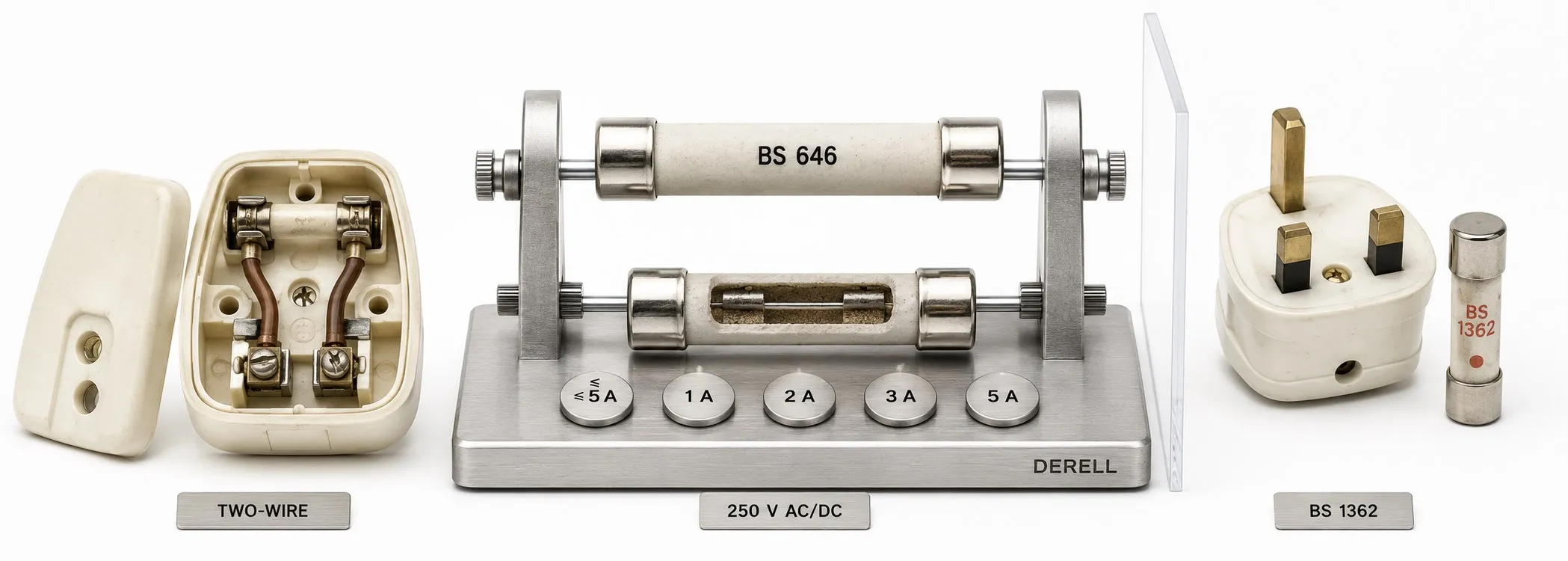
BS 646 Fuses: Understanding the Standard Before Choosing a Replacement
BS 646 covers cartridge fuse-links rated up to 5 A for specified plugs and socket-outlet adaptors. Its scope addresses two-wire circuits up to 250 V AC at 50 Hz or 250 V DC. Here, “adaptor” means an electrical connection accessory, rather than an electronic power supply that converts mains voltage.
Within the wider range of British fuse standards, BS 646 has a specific role. It is not a general designation for every small electrical fuse found inside consumer electronics or control equipment.
Is BS 646 Still Current?
BSI currently lists BS 646:1958+A2:2013 as current. The old base year can be misleading when reading a parts list: it does not, by itself, indicate an obsolete standard. When checking fuse specifications, retain the full designation, including amendments.
Where BS 646 Fits Among Other Fuse Standards
| Reference | Principal scope | Replacement implication |
|---|---|---|
| BS 646 | Fuse-links for the plugs and socket-outlet adaptors within its scope. | Check the accessory's specified fuse. |
| BS 1362 | General-purpose cartridge fuse-links up to 13 A, primarily for BS 1363 plugs. | A separate specification from BS 646. |
| IEC 60127 series | Miniature fuses for appliances, electronic equipment and their component parts. | Covers several constructions and operating characteristics. |
| BS 88 / IEC 60269 | Low-voltage fuse systems, including distribution and industrial applications according to the relevant part. | Does not establish interchangeability with an accessory fuse. |
This distinction matters at the repair bench. A drawer containing several types of cartridge fuse may contain parts that look almost identical but behave differently during a fault.
Read the Ratings as a Set
Current: The ampere rating describes current-carrying performance under defined conditions. It is not an instantaneous trip threshold. The operating time depends on the magnitude and duration of the overcurrent.
Voltage and supply type: Confirm the actual product's AC or DC rating. A standard covering both types of supply does not remove the need to check the manufacturer's declared ratings. For battery circuits and other DC applications, use the relevant DC fuse data.
Breaking capacity: This must cover the prospective fault current at the fuse location. A low-power appliance can still be connected to a source capable of delivering a substantial short-circuit current. Normal load current and available fault current are different design quantities.
Operating characteristic: A fast-acting fuse and a time-delay fuse cannot be treated as equivalent simply because their ampere ratings match. Use the specified characteristic and relevant time-current data.
Mechanical and thermal compatibility: Check cartridge dimensions, end caps, contact engagement and the holder's allowable power dissipation. Enclosure temperature also affects performance. These are part of proper fuse selection, rather than details to check only after buying the replacement.
When a Fuse Has Operated
Investigate why the fuse opened before fitting another. Possible causes include a faulty load, sustained overload, unsuitable replacement or excessive heating around the contacts. A new fuse cannot correct the underlying defect.
Appearance alone may not establish whether a fuse needs replacement. Continuity can be checked after the supply has been isolated and the fuse removed from the circuit. A continuity result only establishes an electrical path; it does not verify the fuse's identity or protective performance.
Follow appropriate fuse replacement precautions and inspect the holder for heat damage or loose contacts. Never bridge a cartridge with wire or foil, and do not increase its rating to stop repeated operation.
Questions That Come Up During Replacement
Can any 5 × 20 mm fuse replace a BS 646 fuse?
No. Dimensions describe the package. They do not establish the standard, breaking capacity or time-current characteristic. Start with the specified fuse type and compare the complete product data.
Does a ceramic body prove that the fuse is suitable?
No. Body material alone does not identify its performance or compliance. The manufacturer's part number and technical documentation provide the meaningful comparison.
Can a resettable device be used instead?
A resettable protection device behaves differently from a one-time cartridge fuse. Substitution requires a design assessment; it is not a routine maintenance replacement.
What information helps identify the correct spare?
Record all legible markings, the original part number, current and voltage ratings, cartridge dimensions and the accessory model. When comparing replacement fuse products, this information is more useful than a photograph of the body alone.