
What is NiMH (Nickel-Metal Hydride) battery?
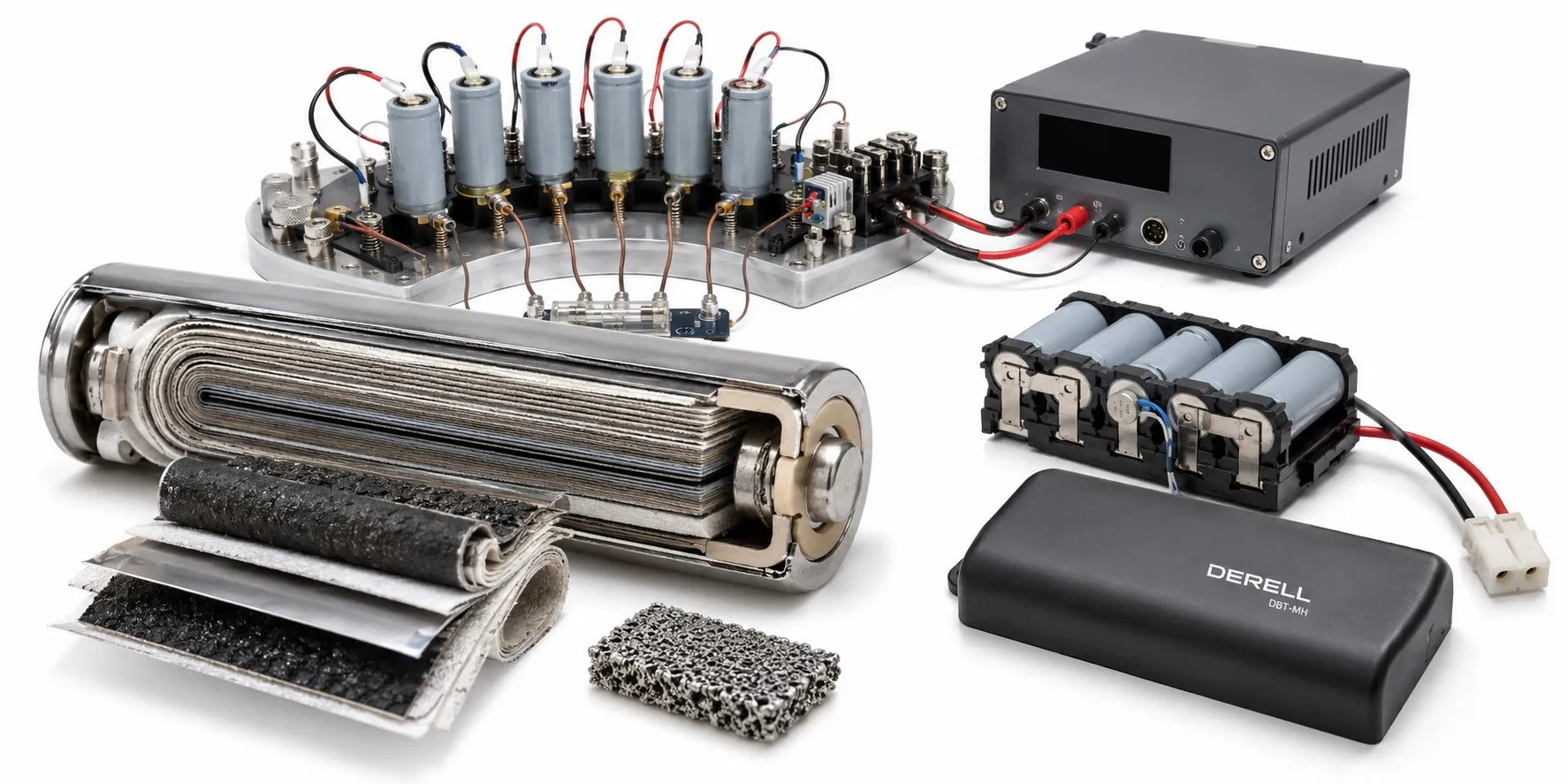
Rechargeable cell technology with a 1.2 V nominal voltage
NiMH (nickel-metal hydride) is a rechargeable battery technology that stores electrical energy chemically. Its positive electrode uses the nickel hydroxide/nickel oxyhydroxide couple, while its negative electrode contains a hydrogen-storing metal alloy. The electrolyte is alkaline. AA and AAA formats are common, alongside other cell sizes and purpose-built industrial packs.
What does the 1.2 V rating mean?
A NiMH cell has a nominal voltage of 1.2 V. This does not mean its voltage is constant or that charging should stop at 1.2 V. The difference between 1.2 V rechargeable cells and 1.5 V alkaline cells must be considered against the device’s operating range. Some equipment works normally with NiMH; other equipment may report low battery early. Manufacturer compatibility requirements take priority.
Capacity, energy and series connections
mAh, Ah and Wh describe different quantities. A cell rated at 2,000 mAh = 2 Ah has an approximate nominal energy of 1.2 V × 2 Ah = 2.4 Wh. Four matched cells connected in series give approximately 4.8 V, 2 Ah and 9.6 Wh. Usable energy depends on discharge current, temperature and the equipment’s cutoff voltage.
Can NiMH deliver high current?
Suitably designed NiMH cells can support high-current applications. Describing the entire chemistry as having low power output is therefore misleading. Energy density is generally higher than that of NiCd cells, but this does not establish higher current capability or longer cycle life for every model. Comparisons with lithium-ion batteries should consider energy density, power capability and operating conditions separately. A capacity rating in mAh is not a maximum-current rating.
Why the charging method matters
The battery charger must support NiMH chemistry, the cell count and the capacity range. NiMH charging requires current control and suitable termination. Depending on the design, this can involve peak-voltage detection, negative voltage change (−ΔV), temperature limits and time limits. The appropriate method depends on charging rate and cell characteristics. An ordinary power adapter does not replace a compatible battery charger, and a lithium-ion charging profile must not simply be applied to NiMH.
For a 2 Ah cell, 1C corresponds to 2 A. This defines the C-rate; it does not mean the cell is approved for charging at 2 A. Overcharging can increase heating and ageing. Continuous low-rate maintenance charging is also acceptable only under conditions approved by the manufacturer.
Memory effect and complete discharge
Voltage depression or memory effect cannot be ruled out entirely in NiMH, although it is not a major everyday limitation for many modern consumer cells. There is no need to discharge a cell to zero before every recharge. In a series pack, a weak cell can suffer over-discharge and polarity reversal. A controlled charger refresh function is different from forcing a device to keep running until its batteries are exhausted.
Self-discharge, temperature and cycle life
Low-self-discharge (LSD) NiMH cells can retain stored energy better than conventional models. Retention depends on the product and storage temperature. Charging, discharging and storage temperature limits may differ. Specifications for special high-temperature series should not be applied to all NiMH cells. Cycle-life claims also depend on test methods and operating conditions; NiMH does not universally outlast NiCd.
Applications and selection
NiMH is used in toys, camera flashes, portable measuring equipment and compatible industrial packs. It also appears in some hybrid vehicles; vehicle battery chemistry depends on the vehicle architecture. Check cell dimensions, terminals, capacity, permissible current and temperature. Assess battery holders and other accessories and battery standards against the requirements of the application.
Maintenance and end-of-life handling
Measuring voltage with a multimeter is useful, but does not establish remaining capacity by itself. If runtime becomes unusually short, inspect contacts, the charger and cell condition together. Stop using cells with leakage or physical damage. Not using cadmium as an active electrode material does not make NiMH environmentally harmless. Send used cells to appropriate battery collection and recycling channels, and prevent terminal short circuits during transport.
Editor’s note: A 1.2 V NiMH AA cell, a 1.5 V alkaline AA cell and a similarly sized 3.6/3.7 V lithium-ion cell are not automatically interchangeable. Fitting inside the compartment does not establish electrical compatibility. Do not mix cells of different chemistries, capacities, ages or charge levels in one pack; use the battery type specified for the equipment.
Related battery topics
What is an alkaline battery?
What is a lithium battery?
What is a lead-acid battery?
Standards for batteries and accumulators
Battery accessories
Supporting topics from other categories
Alkaline, zinc-carbon and rechargeable batteries compared
Direct current and DC voltage
Why are rechargeable cells rated at 1.2 V?
What do mAh, Ah and Wh mean?
Series and parallel battery connections
Battery types main page
Batteries and battery chargers
References
Energizer: Nickel Metal Hydride Handbook and Application Manual
Panasonic Energy: Rechargeable Battery and Charger FAQ
Texas Instruments: NiCd/NiMH Charge Termination and Control
GP Batteries: NiMH Endurance and Longer Life Series