
What is A Lithium-Ion (Li-ion) battery?
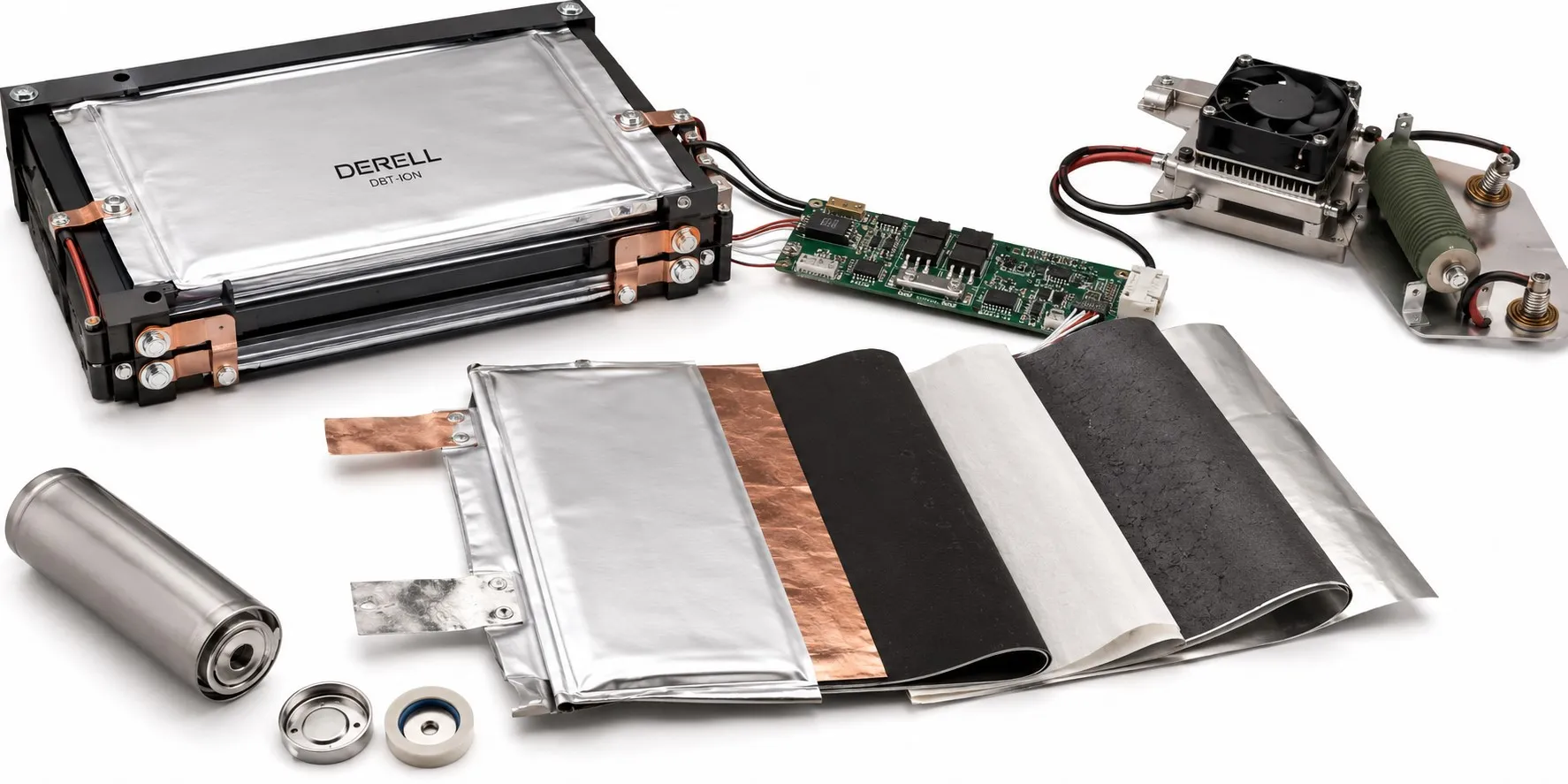
Chemistry and operation in rechargeable energy storage
Lithium-ion (Li-ion) describes a family of rechargeable battery technologies that store energy electrochemically. During charging, lithium ions move from the positive electrode to the negative electrode; during discharge, they move in the opposite direction. Ions travel through the electrolyte, while electrons flow through the external circuit. This coordinated movement underlies battery operation. Li-ion cells are used in portable electronics, electric vehicles, automation equipment and stationary energy storage.
What is inside the cell?
The main components are the positive electrode, negative electrode, electrolyte and separator. Common cells use a graphite-based negative electrode; silicon-containing and other designs are also available. LCO, NMC, NCA and LFP identify different positive electrode materials. Lithium cobalt oxide and lithium iron phosphate should therefore not be described as typical Li-ion anode materials. The separator prevents direct contact between the electrodes while allowing ions to pass.
LiFePO₄, or LFP, is also part of the Li-ion family. A commercial Li-ion versus LiFePO₄ comparison usually contrasts LFP with other Li-ion chemistries such as NMC or NCA. LFP can generally offer greater thermal stability and long cycle life, with different energy density and cell voltage. Actual results depend on cell design and operating conditions. Li-Po alone does not specify a distinct positive electrode chemistry; the term relates to polymer or gel electrolyte construction and is often associated with pouch cells.
Li-ion and non-rechargeable lithium batteries are different
The term lithium battery can also describe non-rechargeable primary batteries using lithium metal. Li-ion is a rechargeable system. Most conventional alkaline batteries are primary batteries too. A “lithium” label alone does not mean a battery can be recharged using a suitable-looking charger. Its chemistry and rechargeability must be explicitly verified.
What do voltage, mAh and Wh mean?
Some common graphite-based Li-ion cells have a nominal voltage of 3.6–3.7 V and an end-of-charge voltage of approximately 4.2 V. Typical LFP cells are rated at 3.2 V nominal, with a charging limit around 3.65 V for some models. These are examples, not universal settings. Charging voltage, current and temperature limits must come from the manufacturer’s datasheet.
mAh or Ah describes charge capacity; Wh describes energy. Approximate nominal energy is calculated as Wh = V × Ah. A 3.6 V, 3,000 mAh cell therefore stores approximately 3.6 × 3 = 10.8 Wh. Ideally, that corresponds to 5.4 hours at a 2 W load; actual runtime depends on conversion losses, cutoff voltage, temperature and load behaviour. Measuring voltage with a multimeter alone does not determine remaining capacity or cell health.
Cells, battery packs and current capability
A cell is the basic electrochemical unit. A battery pack contains one or more cells, connections and, depending on its design, protection, monitoring and enclosure components. Series connections increase voltage; an appropriate parallel arrangement increases capacity. Cells with different chemistries, capacities or ageing histories must not be combined arbitrarily. A high mAh rating does not imply high current capability. Continuous and short-duration discharge limits must be checked separately. For a 3 Ah cell, 1C corresponds to 3 A; that does not automatically mean the cell permits charging at 1C.
The charger and BMS have different roles
The battery charger applies the correct charging profile. A common approach is constant current followed by constant voltage, or CC/CV, with precharge and charge termination where required. Once the voltage limit is reached, charging current decreases. A fast initial charging stage does not mean the final portion will charge at the same rate. Not every Li-ion cell supports fast charging. Permitted current and temperature conditions determine what is acceptable.
Depending on its design, a BMS or protection circuit monitors cell voltages, current and temperature, can disconnect the battery when limits are exceeded, and may provide balancing in multi-cell packs. NTC temperature sensing, suitable DC fuses and connection design also form part of the system. A BMS does not replace a suitable charger. Protection functions can be built into the pack or the equipment; a separate external BMS board is not required in every single-cell product.
Advantages, ageing and operating limits
Li-ion technologies can provide higher energy density than many NiMH, NiCd and lead-acid solutions, but no chemistry is superior in every respect. Self-discharge is generally low, although pack electronics also consume energy. Complete discharge is not required to prevent the classic memory effect associated with NiCd batteries. Partial charging does not eliminate capacity degradation.
Cycle ageing progresses with use, while calendar ageing progresses with time. Connecting a charger does not count as a complete cycle; for example, using 50% of capacity twice represents approximately one equivalent full cycle. High temperature, prolonged storage at a high state of charge and demanding operation can affect service life. Permitted charging temperatures are not necessarily the same as discharge or storage temperatures. For extended storage, follow the manufacturer’s recommended state of charge and inspect the pack periodically. A claim of “thousands of cycles” is incomplete without depth of discharge, temperature, current and the capacity-based end-of-life criterion.
Safety, applications and recycling
Short circuits, overcharging, mechanical damage or excessive temperature can cause dangerous heating and thermal runaway, a self-accelerating temperature rise. LFP’s greater thermal stability does not make it risk-free. Swollen, damaged or unusually hot batteries must not be used or charged; do not puncture them or bypass their protection circuits.
For UPS and solar energy storage, charging equipment, communication, thermal management and pack suitability matter alongside chemistry. Similar nominal voltage alone does not make a Li-ion pack a replacement for an existing lead-acid battery. Battery and accumulator standards have different scopes: IEC 62133-2 addresses portable lithium systems, while IEC 62619 addresses industrial applications. A cell test report alone does not establish compliance of the complete pack.
End-of-life Li-ion batteries must not go into household rubbish or mixed recycling bins. Use an appropriate battery collection and recycling service. Insulating exposed terminals on undamaged portable waste cells reduces short-circuit risk; follow the receiving organization’s specific instructions for damaged packs. Recoverable materials depend on chemistry: not every Li-ion battery contains nickel or cobalt.
Editor’s note: “18650”, “3,000 mAh” or “Li-Po” alone does not identify an equivalent replacement. Check cell format, chemistry, maximum current, charging limits, protection and connections together. Two batteries of the same size may not be interchangeable in the same application.
Related topics
Battery families and comparisons: What is a battery?, What is a lithium battery?, NiMH batteries, NiCd batteries, Lead-acid batteries.
Related system components: BMS and protection, DC fuses, NTC sensors, UPS systems, Solar panels.
Battery types, Battery accessories, Batteries and chargers, Power supplies main page.
References
U.S. Department of Energy: Li-ion operation, chemistries and cell construction
Texas Instruments: LFP voltages, charging profiles and thermal characteristics
Texas Instruments: an example of cell monitoring, protection and balancing functions
Murata: electrode, electrolyte and polymer cell design
Apple: partial charging and charge-cycle explanation
Apple: temperature and long-term storage considerations
U.S. EPA: separate collection and terminal insulation for used Li-ion batteries
IEC: IEC 62133-2, safety of portable lithium cells and batteries
IEC: IEC 62619, safety of industrial lithium cells and batteries