
What is NiCd (Nickel-Cadmium) battery?
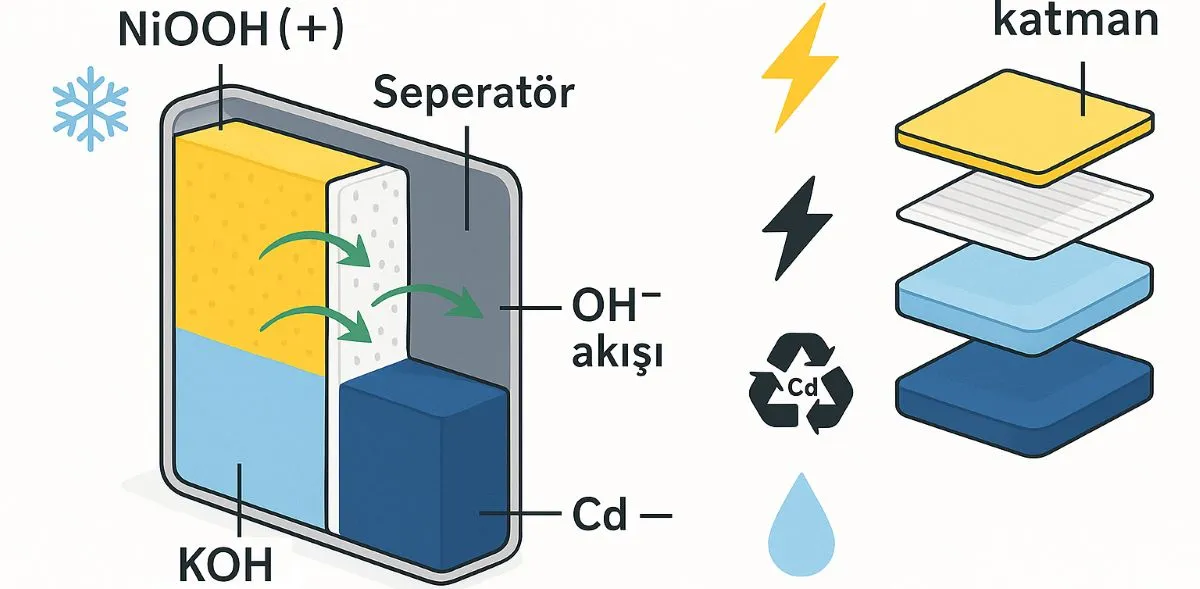
How it works when the load demands high current
A NiCd battery is a battery with nickel-based and cadmium-based electrodes that can be recharged. Its nominal cell voltage is about 1.2 V. Familiar applications include older power tools, two-way radios and emergency lighting. Among different battery types, its strengths include high current capability, robust construction and, in suitable designs, good low-temperature performance.
Electrodes, electrolyte and energy conversion
In a charged cell, the positive active material is nickel oxyhydroxide (NiOOH) and the negative active material is cadmium (Cd). The electrolyte is usually a potassium hydroxide (KOH) solution. During discharge, NiOOH changes to Ni(OH)₂ and Cd changes to Cd(OH)₂, producing electric current in the external circuit. A charger supplies energy to reverse these reactions.
The diagram shows discharge. Electrons travel through the external wire and load; ions carry charge within the cell. The separator keeps the electrodes from touching while allowing ion transport. Small sealed cells and large industrial batteries should not be assumed to share the same maintenance and charging requirements.
What do 1.2 V, 2 Ah and the C-rate mean?
Ten 1.2 V cells in series form a nominal 12 V battery pack. If each cell has a capacity of 2 Ah, the series pack remains 2 Ah. An ampere-hour expresses charge capacity in relation to current and time; it is different from an instantaneous ampere reading. For a 2 Ah cell, 0.1C means 200 mA and 1C means 2 A.
12 V × 2 Ah gives about 24 Wh of nominal energy. At a 1 A load, 2 Ah / 1 A = 2 hours is only an ideal estimate: temperature, cell condition and the equipment cutoff voltage affect runtime. This also illustrates the difference between current and voltage: a nominal rating does not mean the voltage stays fixed under all conditions.
Strengths and limitations
Low internal resistance helps suitable NiCd cells supply demanding loads. However, not every NiCd cell supports fast charging or the same discharge current. Cycle life depends on temperature, charging conditions and depth of discharge. It is inaccurate to claim that all NiCd batteries charge faster than other chemistries.
Energy density is generally lower than that of NiMH and lithium-ion alternatives, so storing the same energy may require a heavier pack. Self-discharge also reduces the charge remaining during storage, and the loss can increase at higher temperatures. Do not assume that a charged NiCd battery will retain its charge for months.
Charging requires more than a voltage setting
A suitable battery charger must support the chemistry, cell count and permitted current. Current-controlled charging is common for sealed NiCd cells. Fast chargers may use negative delta voltage (−ΔV), the small voltage drop after the peak, along with temperature and time limits. Settings depend on the particular cell specifications.
Connecting an ordinary power adapter is not equivalent to controlled charging. Continuous low-current charging is appropriate only for cells designed for that duty, within their specified limits. Rechargeable does not mean tolerant of indefinite overcharging.
Editor’s note: Do not label every early shutdown as “memory effect.” Certain repeated cycles or prolonged unsuitable charging can cause voltage depression and shorter usable runtime in some cells; ageing and weak cells can produce similar symptoms. Discharging a pack to zero volts is not a remedy. A weak cell in a series pack can be driven into reverse polarity. Controlled capacity testing and any permitted reconditioning cycle must follow the manufacturer’s cutoff specifications.
Workshop checks and replacement
First identify the chemistry, cell count, capacity and wiring. An open-circuit reading from a multimeter does not establish remaining capacity. Voltage under an appropriate load and measured runtime are more informative. Contact resistance or increased internal resistance can also increase voltage drop, as described by Ohm’s law. Never short the terminals as a test.
Check the connector, polarity, temperature sensor and charger compatibility before replacement. A same-size NiMH or Li-ion cell is not automatically interchangeable. The term lithium battery alone does not establish rechargeability either. Lead-acid batteries used in backup power and UPS systems also have different charging requirements.
Cadmium content and collection
Because NiCd batteries contain cadmium, keep them out of household rubbish and mixed recycling bins. Insulate the terminals against short circuits and use an appropriate battery collection service. Do not open a leaking cell or touch its alkaline electrolyte.
Related pages: Batteries and chargers / Battery accessories / Battery types
Sources: The manufacturer handbooks are archival documents; use the current data sheet for a particular cell.
Energizer / Eveready: Nickel Cadmium Batteries Application Manual (2001)
Panasonic: Nickel Cadmium Batteries Technical Handbook (2002/2003, DigiKey)