
What is ROM and what types exist?
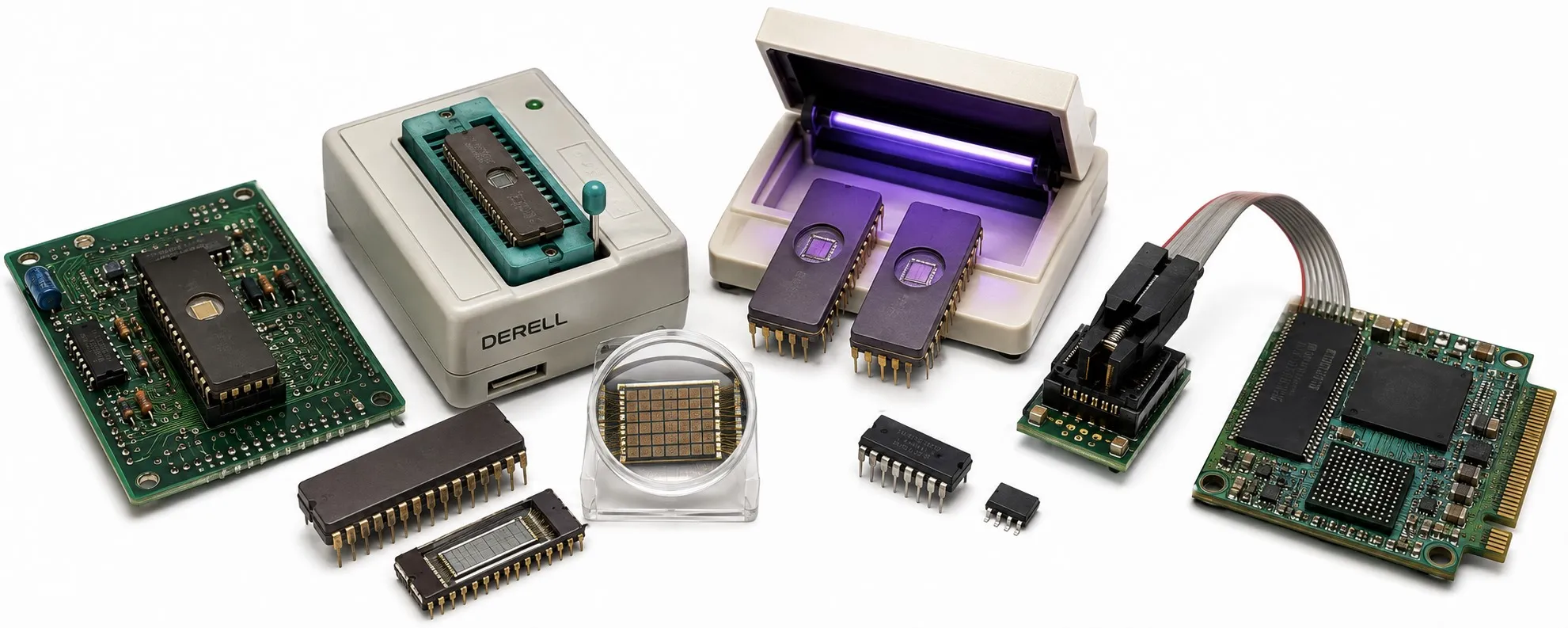
Where a device keeps its instructions when the power is off
ROM stands for Read-Only Memory. In its original sense, it holds fixed instructions or data that a processor can read but cannot rewrite during normal operation. It is nonvolatile: the stored information remains when power is removed.
The naming needs care. Mask ROM is fixed during manufacture, while PROM is programmed once. EPROM and EEPROM retain the historical “ROM” name even though they can be erased and programmed again using the appropriate procedure. Modern firmware is often stored in rewritable Flash memory. Read-only behaviour and nonvolatile storage are separate properties.
The main families, compared by how they are programmed
| Type | How contents are set | Can they be changed? |
|---|---|---|
| Mask ROM | Defined during chip manufacture. | Not erasable and reprogrammable by the user. |
| PROM | Written after manufacture with suitable programming equipment. | Intended for one-time programming; cannot be erased for reuse. |
| UV EPROM | Programmed electrically. | A windowed package can be erased with the specified ultraviolet process and programmed again. |
| OTP EPROM | Programmed electrically in a package without a UV erase window. | One-time programmable in normal use. |
| EEPROM | Electrically erased and programmed. | Rewritable, generally with byte-level or small-unit updates; details depend on the device. |
| Flash | Electrically programmed, usually erased in pages, sectors or blocks. | Rewritable; widely used for firmware and larger data areas. |
OTP means One-Time Programmable. It is not limited to EPROM packages: other chips can include OTP regions. Similarly, the Flash–EEPROM distinction affects erase/write granularity, operation time and endurance rather than merely the product name.
ROM holds the instructions; RAM provides working space
RAM commonly holds changing variables, calculation results and temporary buffers. Ordinary DRAM and SRAM do not preserve that information without suitable power. ROM and other nonvolatile memories keep instructions or stored records while the equipment is switched off. The distinction is about the job each memory performs as well as its retention behaviour.
Not every nonvolatile memory is ROM. NVRAM is a broader term. Technologies such as FRAM and MRAM support repeated writes while retaining data without power; they do not have the same restrictions as traditional read-only ROM.
What happens at startup?
Consider an embedded control board. On power-up, the processor begins executing startup code from ROM or another nonvolatile region, depending on its architecture. That code performs initial setup and transfers control to the application, or loads it from another memory. The running program can then use RAM for variables and calculations.
Boot ROM and updateable firmware are not necessarily the same storage. Some microcontrollers have fixed startup code in ROM and application code in Flash. Updating the application does not rewrite that fixed Boot ROM. Other architectures put startup code in protected Flash instead. There is no single boot arrangement shared by every device.
NOR Flash can support XIP—Execute in Place with a suitable processor and interface, allowing instructions to run directly from nonvolatile memory. NAND Flash generally serves larger data-storage workloads and has a different access arrangement. An application does not always have to be copied into RAM before it can run.
Recognising the roles on industrial hardware
Older controller boards may carry EPROMs; newer microcontrollers often use program Flash, and some processors contain a fixed boot ROM. The location of a PLC's user program depends on the product architecture. Calibration values, device identity and settings may live in EEPROM, Flash or another persistent region. These different memory applications explain why a board can contain several memory technologies.
For a data logger, firmware storage and measurement storage are different requirements. The program may occupy program memory while historical readings use a separate nonvolatile area. Even when both reside on one chip, code and data can have separate regions.
Nonvolatile does not mean unlimited life
Data retention has specified conditions. Technology, temperature and manufacturer limits matter. Rewritable parts also have programming/erase endurance requirements. Evaluating endurance and reliability involves more than capacity; incorrect programming, supply problems and physical damage can all contribute to data loss.
Choose around update frequency, capacity, access speed, interface and operating temperature. The capacity–speed balance and energy budget belong to the same design decision. Fixed instructions, frequently changed settings and continuous measurement records may need different solutions.
What do “phone ROM” and “ROM image” mean?
A phone specification advertising “128 GB ROM” usually means internal Flash storage capacity, not an unchangeable Mask ROM. A “ROM image” is a file containing a copy of stored instructions or data. The filename does not tell you which physical memory technology holds the contents.
Technical references: Microchip: MCU memory · Infineon: NOR Flash · ST: M27C256B UV/OTP EPROM