
What is PROM and how is it programmed?
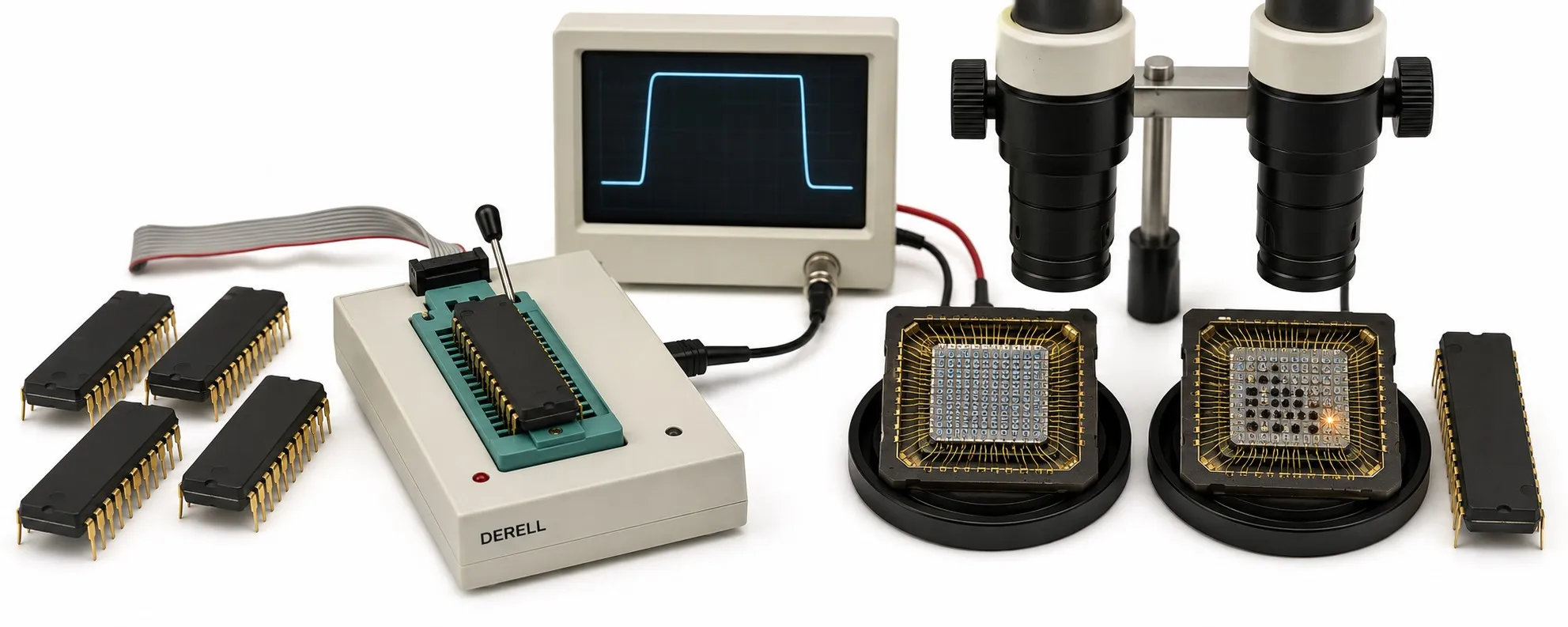
What Is PROM and How Is It Programmed?
PROM stands for Programmable Read-Only Memory. A traditional PROM is supplied unprogrammed and becomes nonvolatile storage whose contents cannot be erased and rewritten by normal methods. It belongs to the ROM family, but differs from Mask ROM, which has its contents defined during manufacture. PROM retains data without power and does not serve as frequently updated working memory like RAM.
How does the data become permanent?
In a classic fusible-link PROM, a programmer permanently changes microscopic links in selected cells using controlled electrical pulses. This explains the expression “burning a PROM.” It does not mean burning the entire chip or applying arbitrary high voltage to the board. OTP memory also describes one-time programmability, but not every OTP product uses fusible-link PROM technology.
The memory stores bit patterns at particular addresses. For example, a 256 × 4-bit organization holds four bits at each of 256 addresses: 1024 bits, equivalent to 128 bytes of capacity. This does not imply that the device has an eight-bit physical data output.
Steps for programming a PROM
1. Identify the device: Read the complete manufacturer and part number. The pinout, memory organization and programming algorithm must match the data sheet. Fitting the same socket does not establish programming compatibility.
2. Prepare the data: Check the file's address range and bit width. When copying an existing board, retain a backup of known-good original contents. A file read from a faulty memory must not automatically be treated as correct.
3. Select a compatible programmer: Confirm that it supports programming the exact device. Read support does not establish write support. Use the specified adapter when required and check for an unprogrammed device using the supported procedure.
4. Run the programming operation: The programmer applies the manufacturer's specified voltage, current, pulse duration and sequence. There is no single programming voltage suitable for every PROM.
5. Read back and verify: Compare the programmed contents with the target file. Successful verification confirms that the stored data matches; it does not establish that every function of the board works correctly.
Can an incorrectly programmed PROM be erased?
A traditional PROM cannot be erased by normal methods. An error requiring reversal, or a change of contents, usually calls for a new unprogrammed device. Some implementations allow previously unchanged cells to be programmed later; this is not unrestricted erasure and rewriting. EPROM can be UV-erased in a suitable windowed package, while EEPROM and Flash provide electrical erasure and rewriting.
Why does PROM matter in older automation boards?
PROM has been used for fixed control data, address-decoding tables and unchanging program contents. During repair, capacity is only one consideration: access time, supply voltage, output type and pin compatibility also matter. A NOR or NAND Flash device should not be assumed to be a direct replacement.
Nonvolatile storage does not guarantee indefinite retention. Temperature, aging and physical damage must be considered. See memory durability and reliability and causes of data loss for related guidance. For changing data, FRAM, MRAM and other NVRAM solutions can be evaluated against the application's requirements.
Technical references: Andromeda Research Labs bipolar PROM programming documentation · Microchip OTP EPROM technology · Microchip memory technologies