
Choosing storage for firmware, settings and changing data
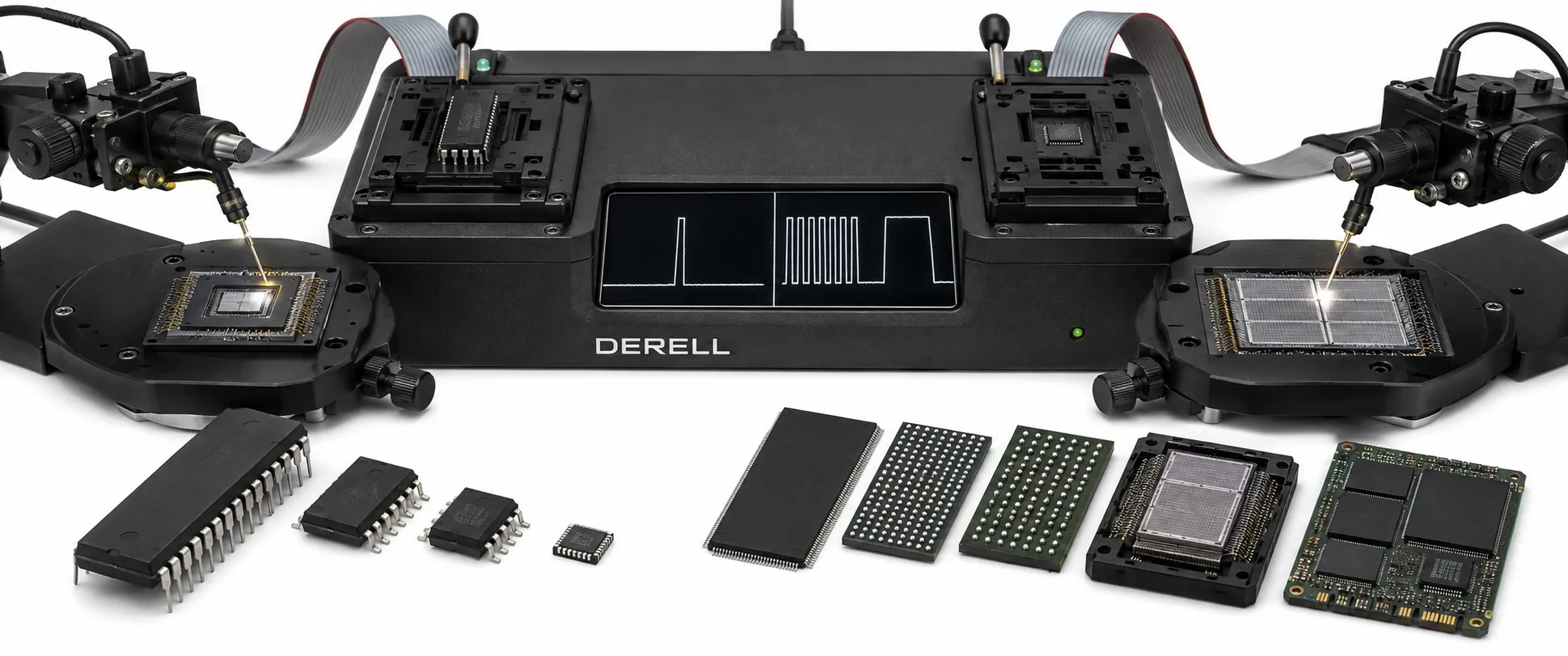
Flash memory is semiconductor storage that retains data without power and can be electrically erased and reprogrammed. Firmware inside a microcontroller, files on a USB drive and data in an SSD are different applications of the technology. Unlike ordinary RAM, Flash primarily provides persistent program and data storage; it belongs to the broader non-volatile memory category.
EEPROM stands for Electrically Erasable Programmable Read-Only Memory. Despite “read-only” in the name, it supports rewriting. The practical difference from Flash is the granularity of an update. Conventional EEPROM makes it straightforward to change small amounts of data, often individual bytes. Flash typically erases a page, sector or block, even when the application only wants to change a small field.
How information survives without a supply
These memories preserve information through electrical charge held within a cell. The stored charge changes the transistor's read behavior. Traditional designs use a floating gate; some Flash technologies use charge-trapping structures. The read circuitry interprets the resulting electrical states as stored bits. No moving mechanism is involved.
Flash and EEPROM use electrical erase operations, unlike conventional windowed EPROM devices erased with ultraviolet light. The wider ROM terminology should not be taken to mean that every device supports the same updating method.
The differences that matter in a design
| Feature | Conventional EEPROM | Flash |
|---|---|---|
| Loss of power | Completed records remain stored. | Completed records remain stored. |
| Small updates | Byte-level rewriting is common. | Existing bit states may require a larger region to be erased. |
| Erase and program | Internal erase/program steps are commonly handled by the write operation. | Erase and program are usually separate operations. |
| Typical role | Calibration, identifiers, settings and small records. | Firmware, larger datasets and file storage. |
| Rewrite endurance | Finite; use the endurance unit specified for the part. | Finite; manage cycling of the erased regions. |
This describes common, conventional devices. High-endurance Flash and specialized Page EEPROM products can change the comparison. Neither “EEPROM always lasts longer” nor “Flash is always faster” is a sound selection rule.
Why a one-byte change can involve an entire sector
In a conventional NOR Flash example, erased bits read as 1. Programming changes bits from 1 to 0; returning a bit from 0 to 1 requires an erase of the relevant region. Programming granularity and erase granularity are different specifications. NAND likewise uses different units for page programming and block erasure.
Where the data goes in a control board
A PLC or embedded controller may keep its firmware in Flash and its calibration values and user settings in EEPROM. SRAM or DRAM handles temporary calculations. This is a common arrangement, but a controller need not contain a separate EEPROM device.
EEPROM emulation uses software to make a region of Flash behave like an EEPROM-style parameter store. Updated records are placed in unused locations, occupied areas are reorganized and erases are managed. Calling an “EEPROM write” function does not establish which physical memory is underneath. Emulation does not remove Flash's erase constraints.
A USB drive or SSD is a complete storage system containing Flash, a controller and management firmware. Deleting a file is not the same operation as erasing a physical Flash block. Comparisons of capacity and speed should distinguish a finished storage device from the behavior of an individual memory chip.
What frequent saving does to endurance
A read is not an erase/write cycle. In conventional EEPROM and Flash, rewriting is the main workload considered in cycling endurance. Some EEPROMs specify endurance for small internal groups of bytes, even though software can update one byte. Assess endurance and reliability using the actual device's cycling unit and temperature conditions.
For a simplified calculation, assume a region rated for 100,000 cycles. If every update consumes one cycle in that region and occurs once per minute, 100,000 / 1,440 ≈ 69.4 days. This illustrates a workload, not a guaranteed failure date. Avoiding unnecessary saves, writing only changed data and using wear leveling to distribute updates across locations can increase the total number of records that can be stored.
For intensive counters and event logs, FRAM or MRAM may also be worth evaluating. Industrial IoT designs additionally need to account for write energy and standby consumption. Data retention and cycling endurance are separate ratings: non-volatile does not mean an unlimited retention guarantee.
Technical references: Microchip — Flash data memory · ST — AN4894 EEPROM emulation · Microchip — Flash design considerations · ST — Page EEPROM