
Yaskawa G7 fault codes
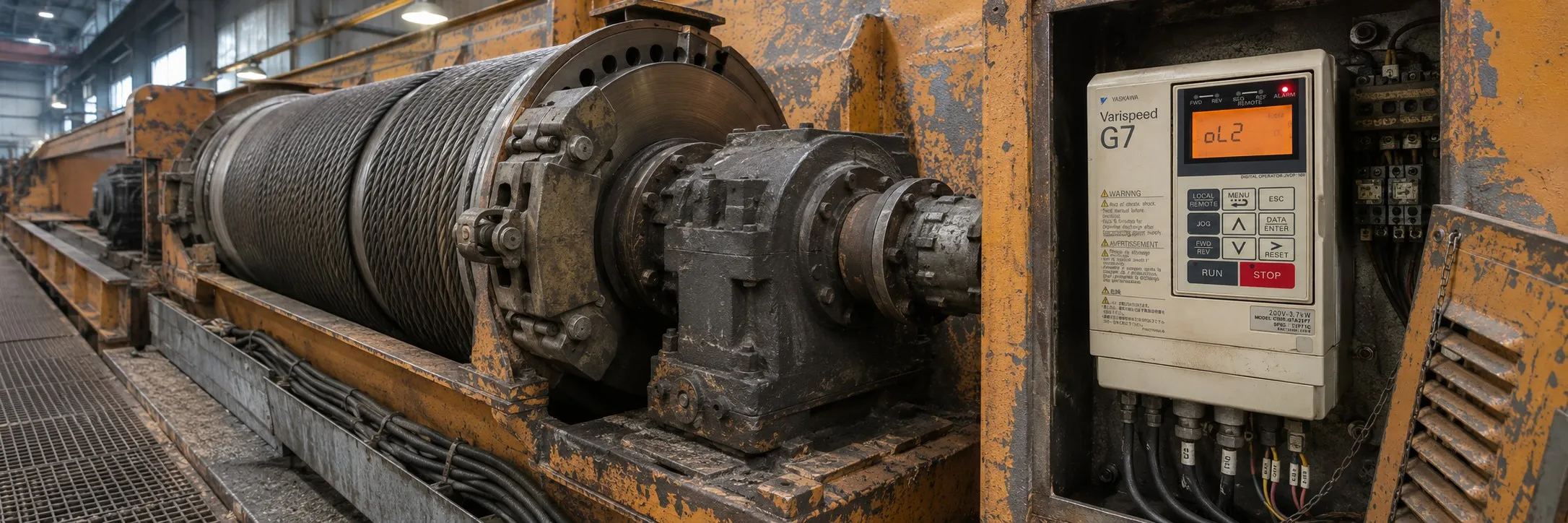
Yaskawa G7 AC drive's protective and diagnostic functions include the drive's alarm functions. Alarm functions cover fault detection, alarm detection, operational error detection, and auto-tuning error detection.
Fault Detection
When the drive detects a fault, the fault contact output operates and the drive output shuts off, causing the motor to coast to a stop. (However, for some faults, the stop method is selectable, and the selected stop method will be used with these faults.) A fault code is displayed on the Digital Operator.
When a fault occurs, refer to the following table to determine the cause and take appropriate action.
To reset the fault after restarting the drive, use one of the following methods:
- Set a multi-function contact input (H1-01 to H1-05) to 14 (Fault Reset) and turn on the fault reset signal.
+ Press the RESET Button on the Digital Operator.
+ Turn OFF and then ON the main circuit power supply.
Note: The Yaskawa G7 AC drive has a specific fault table. When a fault occurs, refer to this table to determine the cause of the fault and implement the appropriate corrective steps.
OC (Over Current): The drive output current exceeded the overcurrent detection level. (200% of the nominal current)
+ A short circuit or grounding fault occurred at the drive output. (A short circuit or grounding fault can occur due to motor burnout, worn insulation, or damaged cable.)
+ The load is too large or the acceleration/deceleration time is too short.
+ A special motor or motor with a capacity too large for the drive is being used.
+ A magnetic contactor at the drive output opened.
+ After correcting the cause of the fault, reset the fault.
GF (Ground Fault): The grounding current at the drive output exceeded approximately 50% of the drive's nominal output current.
+ A grounding fault occurred at the drive output. (A grounding fault can occur due to motor burnout, worn insulation, or damaged cable.)
+ After correcting the cause of the fault, reset the fault.
PUF (Main IGBT Fuse Blown): The fuse in the main circuit blew.
+ The output transistor was damaged due to a short circuit or grounding fault at the drive output.
+ Check for a short circuit between the following terminals. A short circuit will damage the output transistor: B1 (3) ←→ U/T1, V/T2, W/T3
+ After correcting the cause, replace the drive.
OV (DC Bus Over Voltage): The main circuit DC voltage exceeded the overvoltage detection level.
+ For 200-240 V class: Approximately 410 V
+ For 380-480 V class: Approximately 820 V
+ The deceleration time is too short, and the regenerative energy from the motor is too large.
+ Increase the deceleration time or connect a braking resistor (or Brake Resistor Unit).
+ The power supply voltage is too high. Reduce the voltage to within specifications.
UV1 (DC Bus Under Voltage): The main circuit DC voltage is below the Under Voltage Detection Level (L2-05).
+ An open phase occurred in the input power supply.
+ A momentary power loss occurred.
+ The wiring terminals for the input power supply are loose.
+ The voltage fluctuations in the input power supply are too large.
+ After correcting the cause of the fault, reset the fault.
UV2 (CTL PS Under Voltage): The control power supply voltage dropped.
+ Try turning the power supply off and on.
+ If the fault persists, replace the drive.
UV3 (MC Response): A fault occurred in the surge suppression circuit.
+ Try turning the power supply off and on.
+ If the fault persists, replace the drive.
PF (Input Phase Loss): The main circuit DC voltage is abnormally fluctuating (not during regeneration). This fault is detected when L8-05 "Enabled" is set.
+ An open phase occurred in the input power supply.
+ A momentary power loss occurred.
+ The wiring terminals for the input power supply are loose.
+ The voltage fluctuations in the input power supply are too large.
+ The voltage balance between phases is poor.
+ After correcting the cause of the fault, reset the fault.
LF (Output Phase Loss): An open phase occurred at the drive output. This fault is detected when L8-07 "Enabled" is set.
+ There is a broken wire in the output cable.
+ There is a broken wire in the motor winding.
+ The output terminals are loose.
+ After correcting the cause of the fault, reset the fault.
+ The capacity of the motor used is less than 5% of the drive's maximum motor capacity. Check the motor and drive capacity.
OH (OH1) (Heat Sink Overheating): The temperature of the drive's cooling fins exceeded the setting in L8-02 or 105°C.
+ The ambient temperature is too high. Install a cooling unit.
+ There is a heat source nearby. Remove the heat source.
+ The drive's cooling fan stopped. Replace the cooling fan. (Contact your sales representative.)
OH3 (Motor Overheating 1): The drive will stop or continue to operate according to the setting in L1-03.
+ The motor overheated. Check the load size and the length of acceleration, deceleration, and cycle times.
+ Check the V/f characteristics.
+ Check the Motor Nominal Current (E2-01).
OH4 (Motor Overheating 2): The drive will stop according to the setting in L1-04.
+ The motor overheated. Check the load size and the length of acceleration, deceleration, and cycle times.
+ Check the V/f characteristics.
+ Check the Motor Nominal Current (E2-01).
RH (Dynamic Brake Resistor): The brake resistor overheated. The brake resistor protection function set in L8-01 operated.
+ The deceleration time is too short, and the regenerative energy from the motor is too large.
+ Reduce the load, increase the deceleration time, or reduce the motor speed.
+ Switch to a Brake Resistor Unit.
RR (Dynamic Brake Transistor): The brake transistor is not operating properly.
+ Try turning the power supply off and on.
+ If the fault persists, replace the drive.
OL1 (Motor Overloaded): The motor overload protection function operated based on the internal electronic thermal value.
+ The load is too heavy. The acceleration time, deceleration time, and cycle time are too short.
+ Check the load size and the length of acceleration, deceleration, and cycle times.
+ The voltage of the V/f characteristics is too high. Check the V/f characteristics.
+ The Motor Nominal Current (E2-01) is incorrect. Check the Motor Nominal Current (E2-01).
OL2 (Inv Overloaded): The drive overload protection function operated based on the internal electronic thermal value.
+ The load is too heavy. The acceleration time, deceleration time, and cycle time are too short.
+ Check the load size and the length of acceleration, deceleration, and cycle times.
+ The voltage of the V/f characteristics is too high. Check the V/f characteristics.
+ The drive capacity is too low. Replace with a drive of larger capacity.
OL3 (Over Torque Detection 1): A current greater than the settings in L6-02 occurred for a longer time than the settings in L6-03.
+ Verify that the settings in L6-02 and L6-03 are appropriate.
+ Check the mechanical system and correct the cause of the excessive torque.
OL4 (Over Torque Detection 2): A current greater than the settings in L6-05 occurred for a longer time than the settings in L6-06.
+ Verify that the settings in L6-05 and L6-06 are appropriate.
+ Check the mechanical system and correct the cause of the excessive torque.
OL7 (HSB-OL - High Slip Braking Overload): The output frequency did not change for the time set in n3-04.
+ The load's returning inertia is too large. Ensure that the load is an inertia load.
+ Set a system with a 0 V generation time of 120 s or less for deceleration.