
what is D.A.C. (Digital-to-analog converter)?
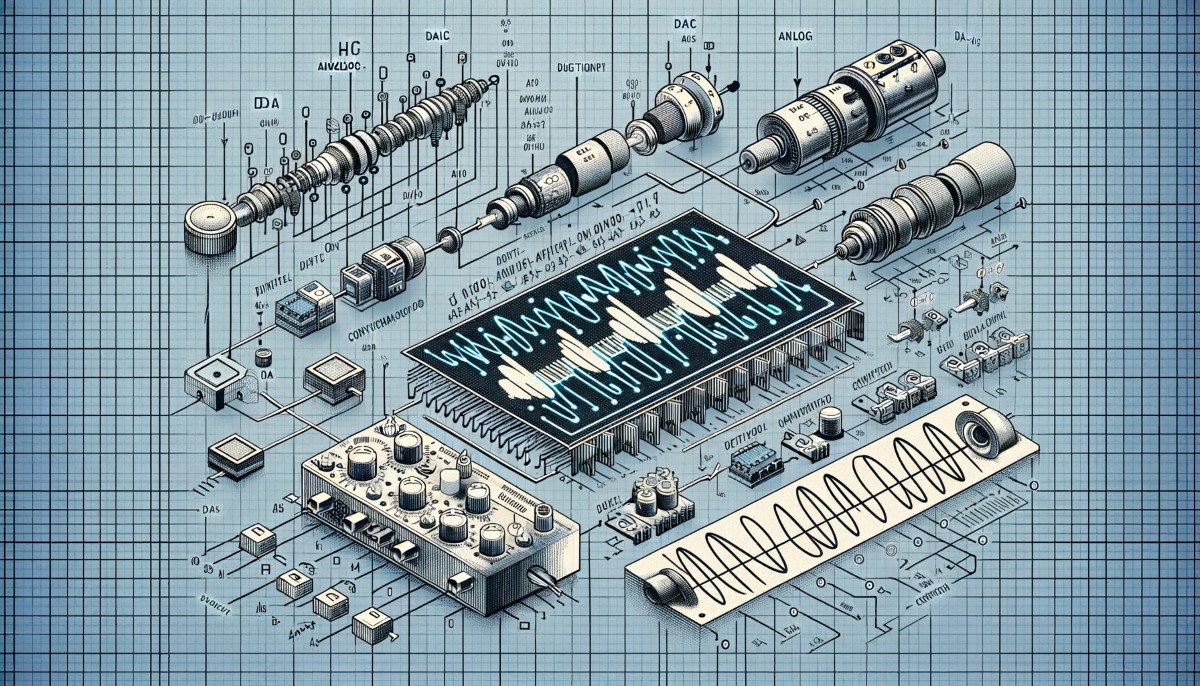
Digital-to-analog conversion
Digital-to-analog conversion (DAC) is the process of converting a digital signal, which is a discrete, quantized signal represented by a series of binary digits (1s and 0s), into an analog signal, which is a continuous signal that can take on any value within a given range.
The process of DAC typically involves using an electronic device, known as a digital-to-analog converter, or DAC, that takes in a digital signal and outputs an analog signal. A DAC converts a digital value into a corresponding analog voltage or current.
There are many different types of DACs, and they can be implemented using different technologies and circuit architectures. However, most DACs use a common basic principle: they generate a reference voltage or current and then use switches, resistors, and other components to vary the voltage or current in proportion to the digital input.
The most common types of DACs are the pulse width modulator (PWM) DAC, the R-2R ladder DAC, and the Sigma-Delta DAC. Each type of DAC has its own set of advantages and disadvantages in terms of accuracy, resolution, and cost.
DAC is used in many applications such as audio systems, video systems, data communications, and other electronic devices where a digital signal needs to be converted to an analog signal. It also has several applications in control systems and industrial measurements and in other areas where digital signals are used to drive an analog system.
It's important to note that the conversion process is not perfect and there will always be some level of quantization error. This error is the difference between the actual analog output and the ideal output that would be obtained if the converter had infinite resolution.
What is D.A.C. (Digital-to-analog converter)?
A digital-to-analog converter (DAC) is an electronic device that converts a digital signal, which is a discrete, quantized signal represented by a series of binary digits (1s and 0s), into an analog signal, which is a continuous signal that can take on any value within a given range.
DACs are used in a wide range of electronic devices and systems, such as audio systems, video systems, data communications, and other electronic devices where a digital signal needs to be converted to an analog signal. This might include a wide range of devices such as televisions, DVD players, and sound systems.
DACs are also used in control systems, industrial measurements, and in other areas where digital signals are used to drive an analog system.
There are many different types of DACs available, and they can be implemented using different technologies and circuit architectures. Some common types of DACs include pulse-width modulator (PWM) DACs, R-2R ladder DACs, and Sigma-Delta DACs. Each type of DAC has its own set of advantages and disadvantages in terms of accuracy, resolution, and cost.
It's important to note that the conversion process is not perfect, and there will always be some level of quantization error. This error is the difference between the actual analog output and the ideal output that would be obtained if the converter had infinite resolution.
How is digital converted to analog?
Digital-to-analog conversion (DAC) typically involves using an electronic device, known as a digital-to-analog converter (DAC), that takes in a digital signal and outputs an analog signal.
The basic principle used by most DACs is to generate a reference voltage or current, and then use switches, resistors, and other components to vary the voltage or current in proportion to the digital input. The most common types of DACs are:
Pulse Width Modulator (PWM) DAC: This type of DAC uses PWM technique to generate an analog output. A PWM signal is a square wave that switches between two levels. The width of the high-level pulses is varied to produce an average output voltage proportional to the digital input.
R-2R Ladder DAC: This type of DAC uses a resistive ladder network to generate an analog output voltage. It uses a series of resistors of two different values, such as R and 2R. Each bit of the digital input code corresponds to a switch that connects one of these resistors to the output.
Sigma-Delta DAC: It is a high-resolution and high-performance type of DAC. It uses a type of modulation called sigma-delta modulation. In this, the input digital value is integrated, and the result is compared with a reference voltage. The error generated is used to modulate a high-frequency signal. Then, a low-pass filter is used to obtain the output analog signal.
All the above-described types of DACs have their own advantages and disadvantages in terms of resolution, accuracy, and cost. The particular type of DAC used will depend on the application and the required resolution.
It's worth noting that the process of digital to analog conversion is not perfect and there will always be some level of quantization error, which is the difference between the actual analog output and the ideal output that would be obtained if the converter had infinite resolution.
Your shopping cart is empty!