
what is zelio smart relay?
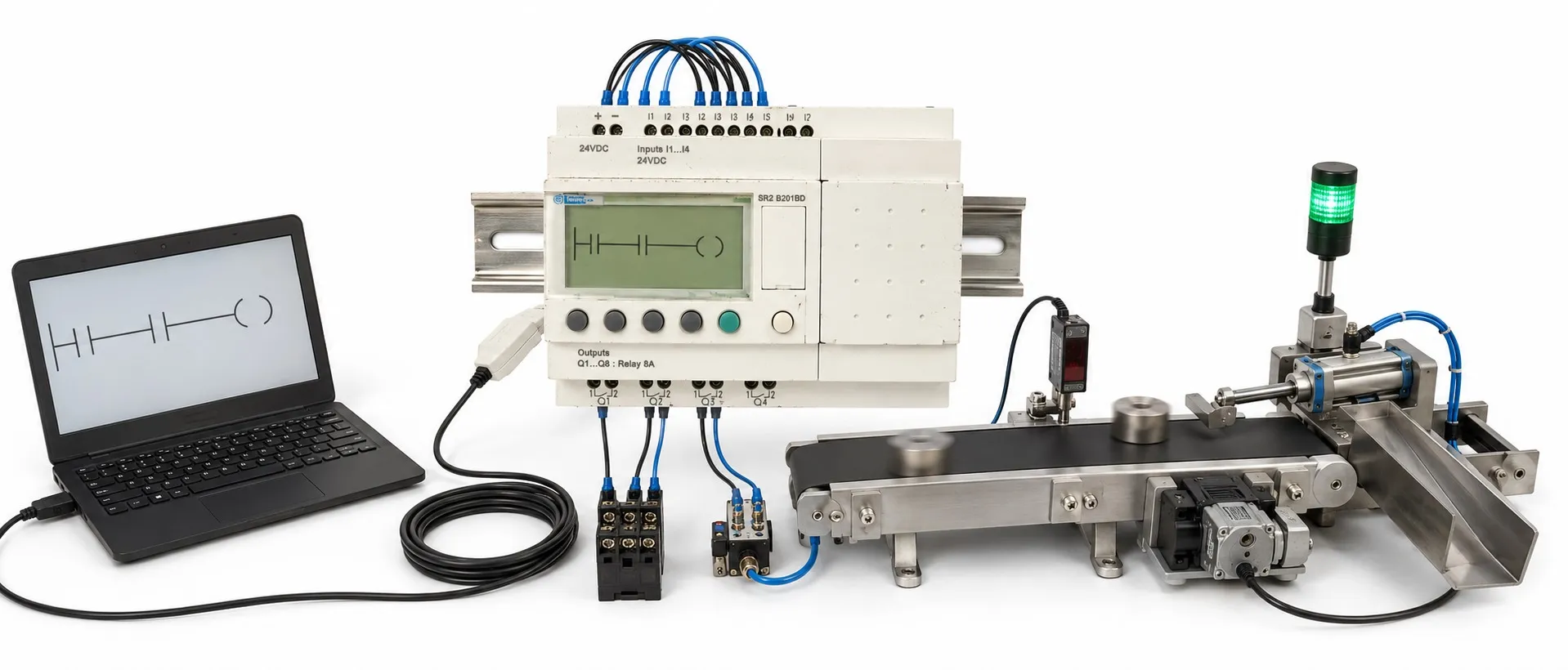
Managing small automation tasks with programmable logic
Zelio Logic is Schneider Electric’s family of programmable smart relays for simple machine and installation control. It evaluates signals from pushbuttons, contacts and compatible sensors, then controls outputs according to the program. In a suitable application, several auxiliary relays, timers and counters can be replaced by one controller. Here, smart relay means a small automation controller rather than an internet-connected household relay.
Lighting schedules, delayed fan operation, tank filling and simple sequences are typical applications. However, choosing between a smart relay and a PLC involves more than counting inputs and outputs. Applications requiring fast data processing, complex communications or advanced motion control should be assessed for a more capable controller.
How do SR2 and SR3 models differ?
SR2 compact models have fixed input/output configurations, while SR3 modular models accept compatible expansion modules. Depending on the configuration, the family serves applications with 10–40 total I/O. This is not the number of inputs alone: 16 inputs and 10 outputs, for example, make 26 I/O. When planning expansion, check both input/output capacity and the permitted module combination.
Model variants differ in supply voltage, display, clock, output technology and programming language support. 24 V DC and 100–240 V AC are not interchangeable supplies for the same unit; check the full product reference. A DIN rail power supply selected for a DC model must also accommodate any field devices powered from that source.
Input signals and output loads require separate checks
A digital input can receive a pushbutton signal or a signal from an inductive sensor with a compatible output. Voltage levels, commons and sensor output arrangements must match. On some DC models, selected inputs also support 0–10 V analogue measurement. This does not apply to every input or every Zelio model. A 4–20 mA signal, temperature probe or other measurement signal may require a suitable input module or signal conditioner.
Relay outputs and transistor outputs have different load requirements. A motor power circuit normally uses a suitable contactor and motor protection, with Zelio providing the control command. An output current rating alone does not establish that any load can be connected directly. Inductive loads require consideration of inrush current, switching frequency and contact life. Coil suppression must suit the AC or DC circuit; devices such as diodes can also increase release time.
LD and FBD programming with Zelio Soft 2
Program development starts in Zelio Soft 2 by selecting the exact device reference and any extensions. Supported models can use LD, or Ladder Diagram, or FBD, or Function Block Diagram. Some compact models support LD only. On units with a display and a suitable configuration, front-panel program editing is for LD; FBD programs are created on a computer.
Contacts, internal relays, comparisons, counters and timing functions are combined using the blocks available for the application. A weekly operating schedule and a delay of a few seconds serve different purposes. Software simulation helps check the logic, but it does not verify field wiring, output loads or safe behaviour on the actual installation. Program transfer also requires a compatible connection and suitable software and device versions.
Editor's note: For models with a clock, the quoted 10 years is the manufacturer’s estimated clock/date battery backup life at 25 °C. It does not mean that the controller and its loads operate on a battery for ten years. Retaining the program in non-volatile memory and retaining a counter or timer value are also separate matters; retaining current values depends on the relevant setting in a supported function block.
Thinking through a practical application
In a tank-filling application, a low-level signal can start filling and a high-level signal can stop it. Lack of water in the source tank can inhibit operation, while failure to fill within the expected time can trigger an alarm. This illustrates why smart relay applications need stop conditions, permissives and fault responses alongside the run command. Process logic does not replace separate motor protection or any required safety functions.
Another example is lighting controlled by a weekly schedule, with a timed manual override for cleaning staff. The conditions for restarting after a power failure should be defined explicitly. This makes the program account for interruptions and recovery as well as normal operation.
Expansion, communications and program backup
Communication with other control systems is not built into every Zelio. Compatible SR3 models can use an SR3MBU01BD serial Modbus module or an SR3NET01BD Ethernet Modbus/TCP module. The serial module operates as a Modbus slave and the Ethernet module as a server; they should not be treated as general-purpose communications masters issuing commands to other devices. Check the module documentation for supported base units, programming languages and accessible data areas.
A compatible memory cartridge can simplify program transfer or backup. Keep an annotated project file on a computer as well, together with the device reference and version information. Hardware compatibility must be reassessed before transferring an application to a different model.
Commissioning and the boundary of safety control
During fault finding, first check the supply, RUN/STOP state, input indicators and program conditions. An active output indication does not by itself prove that the load circuit has the correct voltage or wiring. Also check fuse protection suitable for the wiring and loads, the output circuit and restart behaviour.
Zelio Logic is not a safety relay. Emergency stopping, guard monitoring and safe stopping of hazardous motion require a suitable safety relay or safety control system designed according to the risk assessment. Adding a stop contact to an ordinary automation program does not, by itself, create a safety function.
Related topics and main links
For further selection guidance, explore the advantages and limitations of smart relays and frequently asked questions about smart relays. A suitable choice depends on assessing the complete product reference, field signals, output loads and future expansion needs together.
Smart Relays, PLC and HMI Main Page
References
Schneider Electric: Zelio Logic catalogue and model selection (2018)
Schneider Electric: LD/FBD, expansion and communications programming guide (2017)
Schneider Electric: Memory retention and clock battery operation during power loss
OMRON: Contact protection and suppression for inductive loads
Pilz: Safety relay functions and safety circuit principles