
What is the importance of voltage in electrical devices?
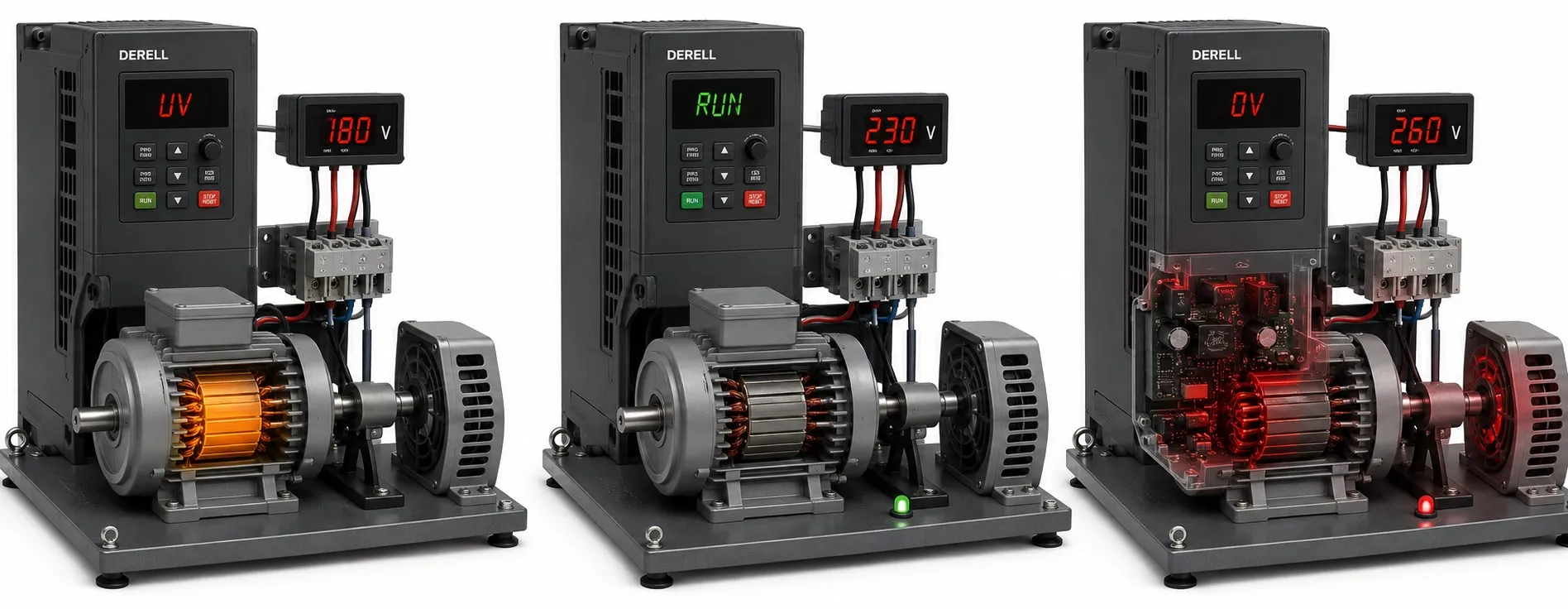
Why does voltage matter in electrical equipment?
Equipment needs the right voltage to operate as designed. Too much can overstress insulation and electronic components; too little may stop a device from starting, make it reset or leave it unable to drive its load. The result depends on the equipment. A heater, a motor, a PLC and a regulated power supply do not respond to a voltage change in the same way.
On this page: Reading the rating label · Different types of load · Choosing an adapter · Voltage drop and measurement · Related guides
Voltage is not the same as energy or power
Voltage is the electric potential difference between two points: an energy difference per unit of charge. Power also depends on current. For a steady DC circuit, P = V × I; a load drawing 2 A at 12 V receives 24 W of electrical power. Energy consumption depends on how long it operates as well. Understanding the difference between voltage and current helps make sense of the calculation.
Read the input and output ratings separately
Consider an adapter marked INPUT: 100–240 V AC, 50/60 Hz and OUTPUT: 12 V DC, 2 A. The first line describes the mains connection. The second describes the supply delivered to the device. A wide input range does not mean the output varies from 100 to 240 V; the adapter regulates it to approximately 12 V under its specified operating conditions.
The 2 A rating is capacity, not continuous consumption. Actual load current depends on what the connected equipment is doing. Check any manufacturer limits for temperature, input voltage and output derating. If a label gives only a nominal voltage, obtain the permitted operating range from the documentation. A blanket “±10% is acceptable” rule does not apply to every device.
Matching the voltage number is only part of the job. AC-output and DC-output adapters are different. A DC device also needs the correct connector polarity, while AC equipment may have specific 50 Hz or 60 Hz requirements. A plug that fits can still deliver the wrong supply.
How different loads respond to a voltage change
Resistive loads: With approximately constant resistance, a heater draws less current and produces less heat when voltage falls. Power rises more rapidly than voltage because P = V² / R. A real heating element may change resistance as it warms, and a thermostat may cycle it on and off. The example below deliberately uses a fixed resistance to show the underlying Ohm’s law calculation.
Open the example: does power rise at the same rate as voltage?
Consider a DC load with a fixed resistance of 10 Ω. This is a calculation model, not a suggestion to test equipment outside its rated voltage.
10 V
I = 1 A
P = 10 W
12 V
I = 1.2 A
P = 14.4 W
14 V
I = 1.4 A
P = 19.6 W
I = V / R · P = V² / R
Raising the voltage from 12 V to 14 V is an increase of about 16.7%, but power rises by about 36.1%. The bars compare power; they do not predict temperature or service life.
Induction motors: Insufficient voltage can reduce the torque available to accelerate the load. Failure to start or operation at excessive slip can cause overheating. Excessive voltage can also stress the magnetic circuit, particularly if the voltage-to-frequency relationship is wrong. Rated voltage does not guarantee maximum torque or peak efficiency at every load. Load, frequency, cooling and rated motor current all matter.
Regulated power supplies: Some supplies maintain their output as input voltage changes. At approximately constant output power, lower input voltage can mean higher input current, but only within the specified operating range. Below that range, a supply may shut down, repeatedly attempt to restart or allow its output to fall. Protection behaviour depends on the design.
PLCs, sensors and relays: A brief supply dip may reboot a controller, disturb a sensor output or release a relay. An intermittent control problem is therefore not necessarily a software problem. Check for undervoltage when loads switch on and for repeated voltage fluctuations affecting the supply.
What does 230/400 V on a motor nameplate mean?
On a suitable three-phase motor marked 230/400 V Δ/Y, the ratings indicate delta connection for a 230 V line-to-line supply and star connection for a 400 V line-to-line supply. In star, winding voltage is approximately the line voltage divided by √3. Read the voltage values and the Δ/Y symbols together; do not choose a connection merely because “400 V” appears on the plate. Confirm the actual arrangement against the manufacturer’s terminal diagram and supply conditions.
One normal-looking line-to-line reading does not establish that a three-phase supply is healthy. Voltage unbalance can produce unbalanced currents and additional motor heating. With a variable-frequency drive, the output voltage/frequency relationship and motor setup also need to be correct.
Can a 12 V device use a different adapter?
Start with the required voltage. A device requiring 12 V should not be connected to a 19 V adapter unless its manufacturer explicitly permits that input. A lower voltage is not automatically an acceptable substitute either: the equipment may refuse to start or behave unpredictably. When considering an adapter with a different output voltage, use the device’s documented input range.
A suitable regulated 12 V / 5 A adapter can, however, replace a 12 V / 2 A adapter when all the other requirements match. It does not force a normally operating load to draw 5 A. A higher current rating and a higher voltage are different changes. When choosing an adapter, also check polarity, connector dimensions, load requirements and any required communication or charging protocol.
Battery charging is a separate application. An apparently suitable voltage does not prove that a supply has the right charging method for the battery chemistry or cell count. Understand the difference between a power adapter and a battery charger before connecting a supply to a battery.
Why does a device see less than the supply’s rated voltage?
The voltage at the load can differ from the voltage at the source. Current flowing through wiring and connections produces a drop. For example, a 0.5 Ω total outgoing-and-return resistance carrying 2 A gives ΔV = I × R = 1 V. If the source terminals remain at 24 V under that load, the device receives about 23 V. This calculation includes wiring loss only; a faulty or overloaded source may also sag. See voltage-drop calculations for the distinction.
A correct reading with no load does not prove that the supply remains healthy during operation. Assessment should include the voltage at the device’s input while it runs, under appropriate test conditions. A DC voltage measurement with a multimeter can show the basic level, but a brief transient or interruption may escape the display. True RMS and CAT ratings describe different properties: measurement method and measurement-category safety. Mains and panel testing require a competent person and appropriately rated instruments and probes.
Does reducing voltage save electricity?
Not automatically. Reducing a heater’s power may simply make it take longer to heat the same water to the same temperature. Instantaneous watts alone do not establish total energy use. A regulated supply may increase input current to maintain the load’s power, while an arbitrary voltage reduction at a motor may create torque and heating problems.
A voltage regulator is intended to manage specified supply variations; it is not a universal repair or energy-saving device. Assess savings by measuring the energy needed to deliver the required work and performance. LED lighting should likewise be dimmed using a method supported by its driver.
A reliable match needs more than the right plug. Check the permitted input range, AC or DC type, frequency, polarity, current capacity and connection requirements together. A device switching on is not proof of a suitable supply. Our low-voltage safety guide also explains why short-circuit and heating risks still matter at small voltages.
Concepts and calculations: What is voltage? · Voltage and current · Ohm’s law · Voltage drop
Adapters and power supplies: Adapter selection · Different output voltages · Higher-current adapters · Voltage regulators
Motors, measurement and faults: Rated motor current · 50 Hz and 60 Hz · Voltage fluctuations · Measuring DC voltage
Manufacturer references
MEAN WELL technical FAQ: power-supply operating ranges, output capacity and protection behaviour. Fluke voltage-unbalance guide: effects of an unbalanced supply on three-phase motors.
For a particular device, use its manufacturer’s rating label, instructions and connection diagram. You may share this article with attribution to OtomasyonAVM.