
What causes voltage fluctuations and how can they be prevented?
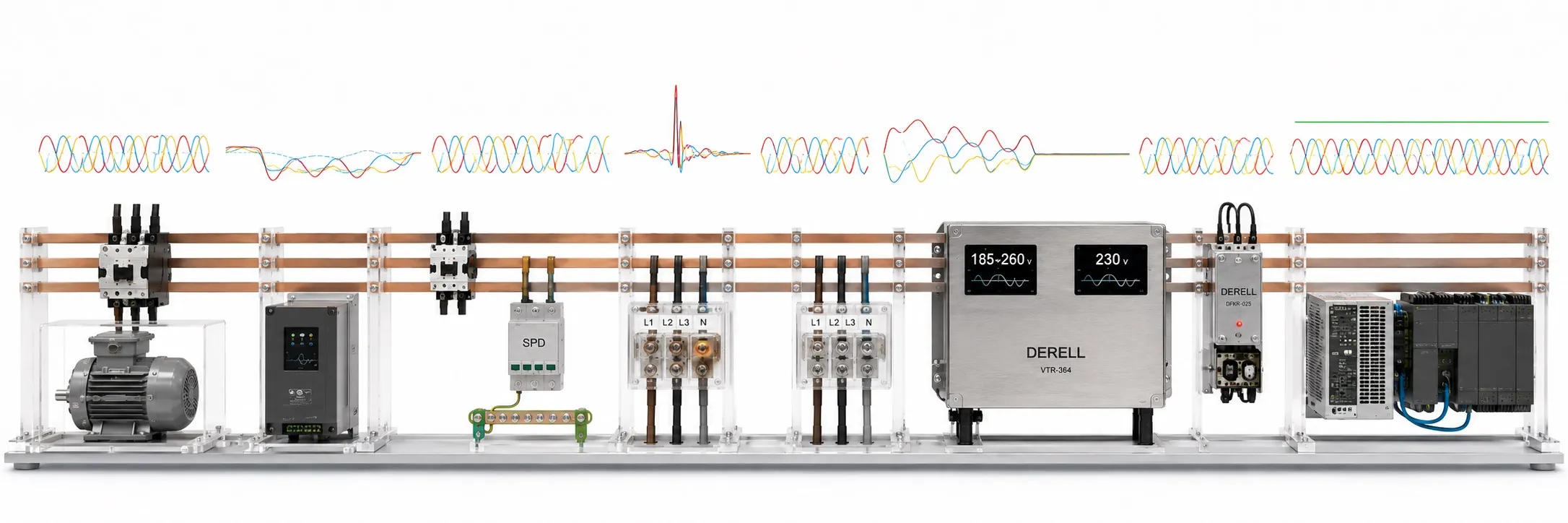
Voltage fluctuations: causes and practical remedies
Voltage fluctuations are changes in supply voltage over time. The right remedy depends on their size, duration and origin. A light dimming during a motor start, a computer reboot and a lightning-related transient are different events. Identify the disturbance before deciding how to protect the load.
Normal AC operation or a supply disturbance?
Voltage is an electrical potential difference. The instantaneous voltage of an AC supply changes periodically by design. In power-quality discussions, fluctuation generally concerns changes in the RMS voltage level or voltage envelope, rather than the normal alternating waveform.
A nominal rating is not an acceptance band. Assess a nominal 230 V supply against the relevant voltage standards, event duration and equipment input limits. Small variations are not automatically dangerous, and a brief event may disappear before an ordinary meter display can show it.
Distinguish the events
A voltage sag is a short reduction in voltage, potentially associated with a motor start or an upstream fault. Sustained undervoltage needs a separate assessment. Feeder voltage drop is the source-to-load difference caused by current flowing through circuit impedance; that difference can vary as the load changes.
A voltage swell is a rise in the supply level, sometimes following the disconnection of a large load. A transient is a very brief disturbance associated with events such as lightning or switching. It calls for a different protection approach from a slowly rising RMS voltage.
Repeated changes and flicker can occur with fluctuating loads such as welding equipment. One flickering LED, however, does not establish a building-wide supply problem: its driver or connection may be faulty. An interruption is loss of supply. Adjusting voltage and maintaining energy delivery are separate tasks.
Look on both sides of the supply point
Local load changes: A large motor or compressor can draw substantial current when starting. The distinction between voltage and current matters because changing current creates changing voltage drop across source and feeder impedance. Cable resistance, length, size and connections influence the result.
Connection and neutral faults: Loose or corroded contacts can produce variable drop and local heating. In a three-phase system supplying line-to-neutral loads, a broken neutral can expose different loads to low or excessive voltage. Unusually bright lights in one area, dim lights elsewhere or burning smells require urgent fault investigation and should not be ignored while equipment remains in use.
Upstream conditions: Transformer loading, network faults and switching can affect several circuits. Solar generation and battery storage can also influence local voltage, depending on the feeder and control settings. Adding renewable generation does not automatically improve voltage stability.
Symptoms depend on the equipment
Contactors may drop out, motors may struggle to start, power supplies may restart and lighting may change. The outcome depends on the equipment’s supply requirements and disturbance tolerance. Because the voltage-to-power relationship depends on load type, fluctuations do not affect every device in the same way.
Capture timing as well as voltage
A qualified electrician takes voltage measurements with a suitable multimeter, comparing incoming and load-side readings against load state and event timing. An appropriate ammeter or clamp instrument adds current information. Simultaneous observations help investigate whether a disturbance follows a local load or originates upstream.
Intermittent faults need a record. Min/max functions can reveal some variations, but should not be assumed to capture every fast event. A recording power-quality analyser can provide timestamps and waveform information. Oscilloscope investigation requires suitable mains-rated probes and a safe measurement arrangement; a standard grounded bench-scope probe must not be connected indiscriminately.
Choose protection by function
A voltage regulator corrects input variations within its specified operating range. Response time and load capacity matter. Without stored energy it cannot maintain supply through an outage, and it does not repair faulty connections.
A UPS can provide temporary backup power, while its voltage-conditioning behaviour depends on topology. Standby, line-interactive and online double-conversion designs behave differently. An online UPS also behaves differently in normal double-conversion operation and bypass. Check capacity, transfer behaviour, output waveform and operating mode.
A surge protective device (SPD), properly selected and installed, limits transient overvoltages. It does not correct sustained undervoltage or supply backup energy. A regulator, UPS and SPD are not interchangeable solutions to every power-quality problem.
Fix the cause before adding equipment
Repair defective connections and neutral faults first. Assess conductor size, circuit layout and voltage distribution. Large-load starting demand may need attention, or the supply may need reinforcement. Document upstream disturbances for the distribution operator. A generator’s voltage and frequency response must also be assessed under load; installing one does not guarantee a perfectly stable supply.
Protection equipment cannot substitute for sound wiring. A practical sequence is to repair the fault, establish suitable supply conditions and select protection for the remaining disturbance. No single product can guarantee the elimination of every voltage fluctuation.