
What does an uninterruptible power supply do?
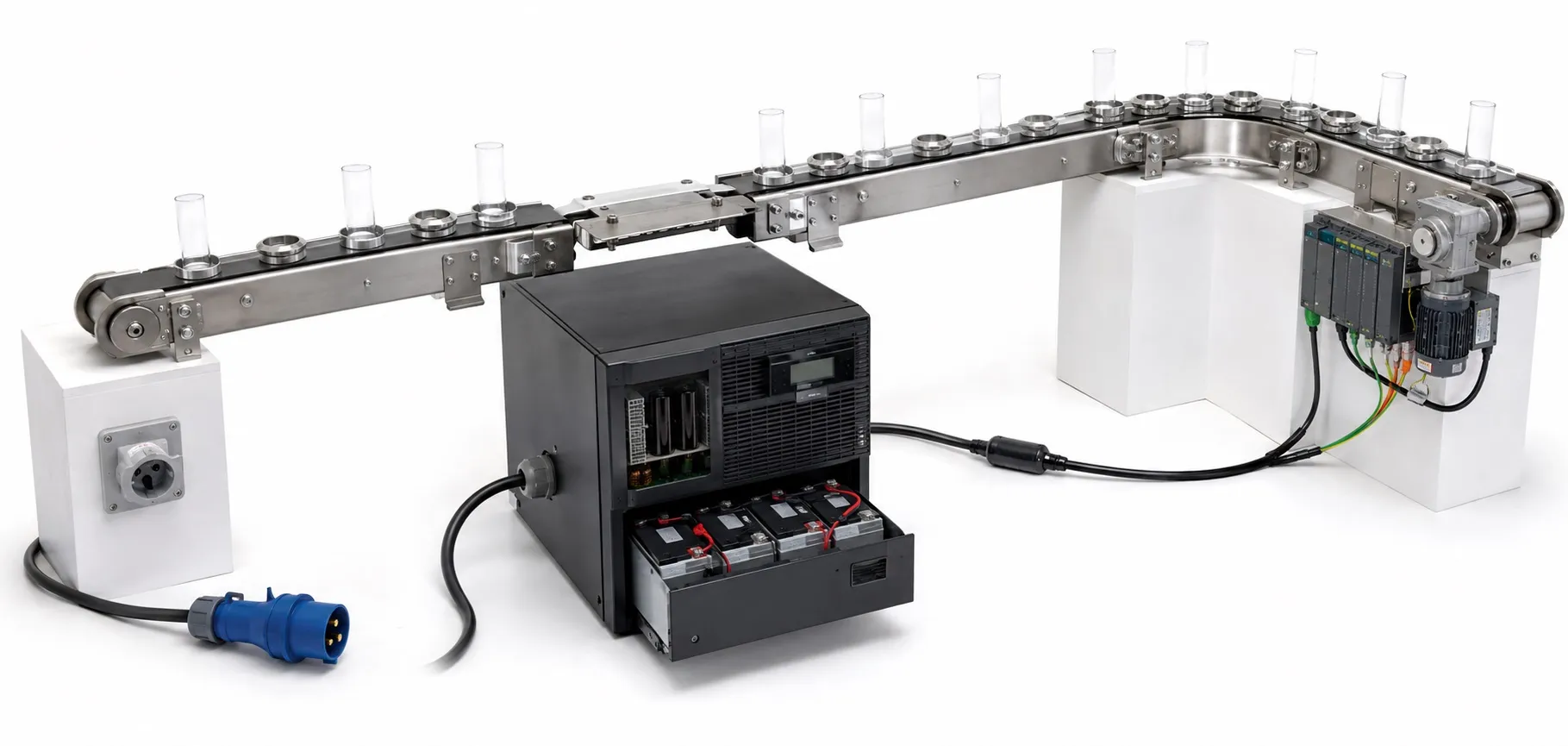
An uninterruptible power supply (UPS) keeps connected equipment powered for a limited time using stored energy when the utility supply fails. A UPS system can help equipment ride through brief outages, save data, shut down cleanly or remain operational until a generator starts. Backup duration and power protection depend on the model and the application.
How does a UPS work?
A battery-based UPS combines energy storage, a charging circuit, an inverter and control electronics. The battery pack stores energy, while the battery charging system replenishes it and maintains the battery under suitable charging conditions. In an AC-output UPS, the inverter converts battery direct current (DC) into the alternating current (AC) required by the load. The normal power path between the utility supply and the equipment depends on the UPS topology.
Many models use lead-acid batteries; lithium-ion batteries are another option. Battery chemistry, charging controls and replacement requirements must be considered together. Matching the voltage alone does not make a different battery chemistry suitable for an existing UPS.
Do all UPS systems provide the same protection?
No. The three main UPS types differ in their voltage regulation, power path and transfer time to battery operation.
Standby / offline UPS: Under normal conditions, the utility supply powers the equipment. The UPS switches to battery power during an outage or when the input voltage moves outside its accepted limits. There is a brief transfer interval, which the connected equipment must be able to tolerate.
Line-interactive UPS: Automatic voltage regulation, usually called AVR, corrects certain low- and high-voltage conditions without using battery energy. The UPS switches to battery operation during an outage. Transfer time is not zero and should be checked in the specifications.
Online / double-conversion UPS: In normal double-conversion mode, incoming AC is converted to DC and then back to AC through the inverter. Because the inverter already supplies the load, utility-to-battery operation involves no transfer interruption. However, eco mode, bypass operation and fault conditions require separate consideration; the online designation does not describe every operating mode.
What do the VA and watt ratings mean?
VA measures apparent power, while watts measure active power. Understanding the difference between VA and watts is essential when sizing a UPS. A unit rated 1000 VA / 600 W has a 600 W active-power limit, not a 1000 W limit. The connected load must remain within both ratings. Larger systems use the same distinction between kW and kVA.
Worked example: A computer drawing 240 W, a monitor drawing 35 W and network equipment drawing 25 W produce a combined load of 300 W. Assuming an overall load power factor of 0.90, apparent power is approximately 333 VA. Both values are within the continuous output limits of the 1000 VA / 600 W example. Load peaks, capacity headroom and required runtime still need checking. A computer's 750 W power-supply rating does not mean that the computer continuously consumes 750 W.
How long will a UPS run during an outage?
Power capacity and backup runtime are different specifications. Two UPS units with the same VA rating can have different battery arrangements and very different runtimes. Duration depends on load in watts, usable battery energy, battery age, temperature and conversion losses. An ampere-hour rating alone is insufficient; battery-bank voltage and discharge conditions also matter.
Use the manufacturer's runtime curve for your actual load. For the example above, check the runtime at 300 W. Halving the load does not always double the runtime exactly. External batteries can extend operation only where the UPS supports the specified battery modules and connection arrangement.
Computer backup and industrial control backup
For a computer, the main objective is often to save work and shut down the operating system properly. An industrial installation needs a backup plan covering its PLC, HMI panels, industrial computer and SCADA workstation as required. If devices communicate over Ethernet, the relevant network switches also need power; keeping the controller running alone may not preserve communication.
A powered control system does not necessarily mean that the machine can keep producing. Motors, drives or other field equipment may have lost their supply. Select the backed-up loads according to the required response to an outage: preserving records, transmitting an alarm or completing a designed stopping sequence. Motor loads also require careful checks of starting current and UPS load compatibility.
What else matters when choosing a UPS?
Check the output waveform, transfer time, input voltage range, overload capability and battery maintenance requirements. For sensitive equipment or active-PFC power supplies, pay particular attention to pure sine-wave output and the equipment manufacturer's compatibility guidance. Some models include outlets that provide surge protection only; not every outlet necessarily receives battery backup.
USB communication, shutdown software and network management cards are useful UPS accessories for automating action when remaining runtime becomes low. Loads such as laser printers, heaters and motors can draw high power or create sharp load peaks; do not assume a small desktop UPS can support them.
How is a UPS different from a regulator or an inverter?
A voltage regulator adjusts voltage within its operating limits. Without energy storage, it cannot power the load during an outage. This backup-energy function is central to the difference between a voltage regulator and a UPS. An inverter converts power; it should not automatically be assumed to include a battery, charger or automatic transfer system. These functions matter when comparing a UPS with an inverter.
Protection limits and maintenance
A UPS does not eliminate every electrical hazard. Correct earthing and grounding, suitable circuit protection and, where required, coordinated surge protective devices remain part of the installation. Depending on the design, bypass operation can expose the load more directly to utility supply conditions.
Monitor battery health using the manufacturer's testing and maintenance procedure. A UPS that works normally on utility power may still have inadequate battery runtime. Fan noise, heat, conversion losses and battery replacement costs are also relevant limitations of UPS operation. Disconnecting the input plug does not necessarily remove voltage from the output or internal circuits because the battery remains an energy source.