
What is the relationship between voltage and wattage?
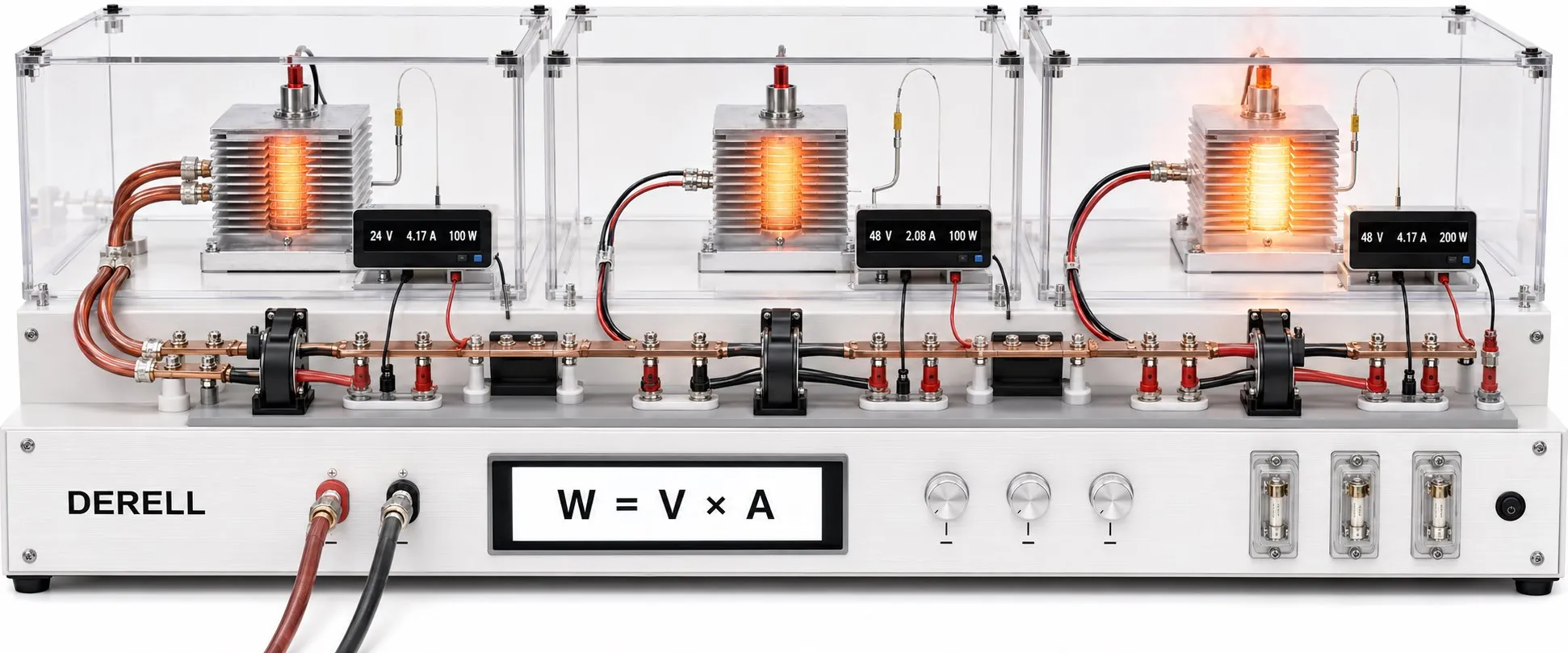
How voltage relates to watts
Voltage describes electrical potential difference; watts describe the rate of energy transfer. A voltage rating alone cannot tell you the power a device uses. You also need current and the appropriate model for the circuit. Steady DC, single-phase AC and three-phase AC require different assumptions.
Three quantities with different jobs
Volts measure potential difference. Amperes measure the rate of net charge flow through a cross-section. Keeping voltage and current distinct makes the power relationship easier to understand. A watt is one joule per second: it measures how quickly energy is transferred.
Sharing the same supply voltage does not mean sharing the same power demand. Under steady DC conditions, a load drawing 0.5 A at 12 V takes 6 W, while another drawing 2 A at 12 V takes 24 W.
Start with steady DC power
For steady DC, electrical input power is P = V × I. Thus 12 V × 2 A = 24 W. If power and voltage are known, I = P / V gives current. Converting watts to amperes requires these operating conditions to be clear.
Two systems designed for their respective voltages could each take 24 W: one at 12 V and 2 A, the other at 24 V and 1 A. This does not mean a 12 V device can be connected to 24 V. Respect the equipment’s permitted supply voltage.
A fixed resistor behaves differently
For an ohmic resistor at constant temperature, V = I × R. Combining this with the power equation gives P = V² / R and P = I² × R. An ideal 6 Ω resistive load draws 2 A and dissipates 24 W at 12 V. At 24 V, that same resistance draws 4 A and dissipates 96 W.
Doubling voltage across a fixed resistance quadruples power. The calculation assumes resistance does not change with temperature; actual component power and thermal ratings must also be respected. Motors and regulated power supplies cannot always be treated as fixed resistors.
Single-phase AC: distinguish watts from VA
Multiplying RMS voltage by RMS current gives apparent power: S = Vrms × Irms, measured in volt-amperes (VA). Active power is P = Vrms × Irms × PF, where PF is the true power factor. The difference between VA and watts matters when sizing UPS systems and power supplies.
At 230 V, 2 A and PF = 0.80, apparent power is 460 VA and active power is 368 W. For sinusoidal voltage and current, PF equals cos φ. With nonlinear loads and harmonics, phase angle alone may not capture the relationship. True power factor and fundamental displacement power factor are not automatically the same.
Balanced three-phase power
For a balanced, sinusoidal three-phase system, total active power is P = √3 × Vline × Iline × PF. Use RMS line-to-line voltage and line current. With 400 V, 10 A and PF = 0.80, the result is approximately 5.54 kW.
For unbalanced or substantially distorted systems, one line-current reading is not sufficient for this shortcut; appropriate multiphase power measurement is needed. When assessing voltage levels and circuit voltage distribution, distinguish line-to-line readings from line-to-neutral readings.
Read the rating before using the number
A motor’s power rating generally refers to rated shaft output. Electrical input is higher because of losses: Pout = η × Pin, with η representing efficiency. A motor delivering 1.5 kW at 90% efficiency takes about 1.67 kW of active electrical power. Efficiency and power factor are separate concepts.
A 12 V, 5 A power supply has capacity for 60 W of output at those ratings; it does not continuously consume 60 W. Actual input depends on the load and conversion losses. Undervoltage and supply fluctuations can change operating behaviour and current demand.
Power is not energy consumption
Watts measure power; kilowatt-hours measure energy. For constant or average power, the energy calculation is E = P × t. A device averaging 100 W over five hours uses 0.1 kW × 5 h = 0.5 kWh. If demand varies, use a suitable average or an energy record instead of extending one instantaneous reading across the whole period.
Check power at the correct measurement point
Voltage measurement uses a suitable multimeter; current measurement uses an appropriate ammeter or clamp instrument. In AC circuits, multiplying those readings does not by itself establish active power. Use a wattmeter or power analyser. An oscilloscope helps examine waveforms. In general, p(t) = v(t) × i(t) is instantaneous power; active power is its time average.
Voltage drop in conductors means source-terminal power and the power reaching the load may differ. A meaningful power figure includes the measurement location and the operating conditions.