
What is the disadvantage of UPS?
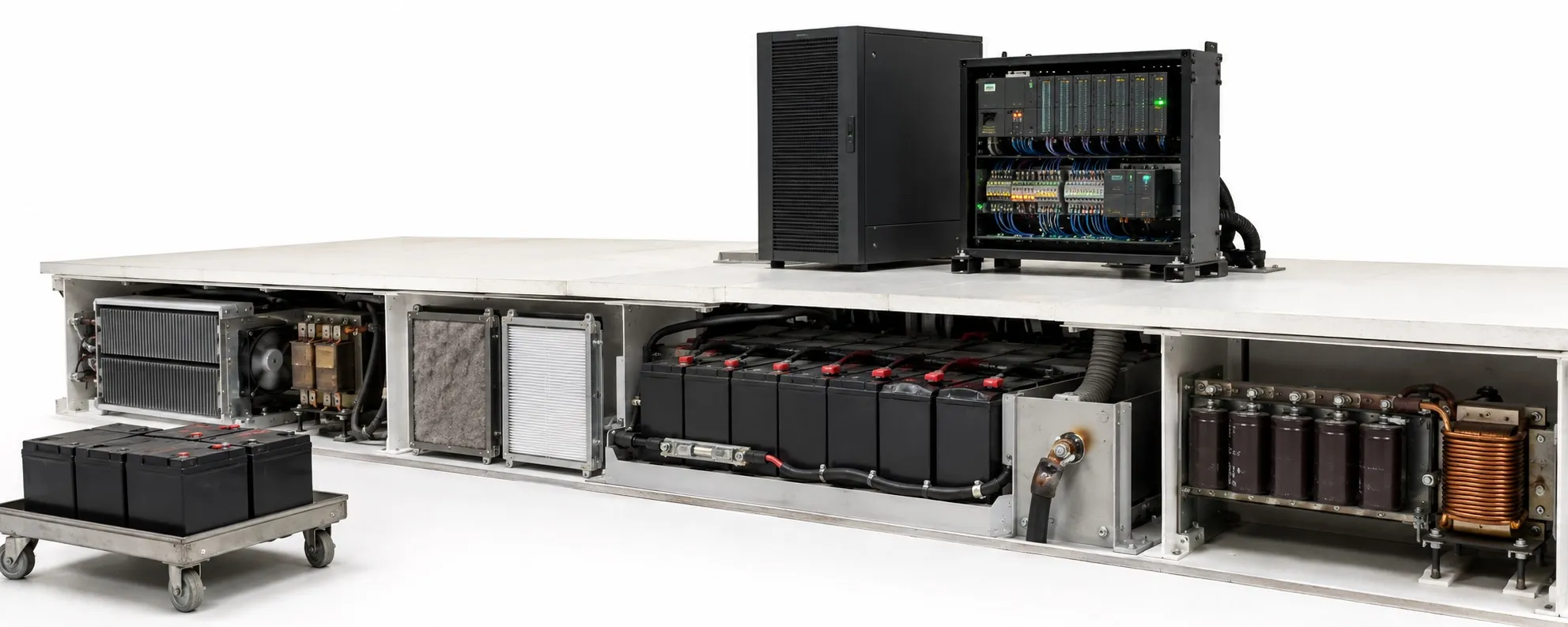
A correctly selected and operated uninterruptible power supply (UPS) reduces the impact of power outages. Its drawbacks fall into two categories: operating disadvantages and risks caused by unsuitable equipment or incorrect use. Battery replacement costs, energy losses and fan noise belong to the first category. Overloading, an incompatible output waveform and neglected maintenance can affect the connected system's operation. Having a UPS does not guarantee adequate protection under every condition.
Runtime is limited, and the power rating does not tell you how long it will last
Backup duration depends on load in watts, usable battery energy, temperature and battery condition. Different battery packs and supported external modules can provide minutes or hours of operation; there is no single runtime range that applies to every UPS. Two units with the same VA rating can have different runtimes. Check the manufacturer's runtime curve at your actual load.
Incorrect sizing can cause an overload
Overlooking the difference between VA and watts can lead to an overloaded UPS. For example, connecting a 700 W load to a unit rated 1000 VA / 600 W exceeds its active-power limit. Larger systems require the same distinction between kW and kVA. Depending on its design and operating conditions, an overloaded UPS may raise an alarm, transfer to bypass or shut down its output.
Motors, compressors and laser printers also require checks of short-duration power demand. Starting conditions can exceed the UPS limits even when normal running consumption is modest. Do not assume that these loads are suitable for a small desktop UPS.
Output waveform and transfer time can affect compatibility
Some UPS units produce a stepped approximation to a sine wave during battery operation rather than a pure sine wave. Incompatible equipment may malfunction, make unwanted noise or run hotter. For sensitive equipment and active-PFC power supplies, check the equipment manufacturer's waveform compatibility guidance; different devices do not necessarily respond in the same way.
Transfer behaviour also differs between UPS types. Standby and line-interactive units have a brief transfer interval to battery power. An online UPS has no utility-to-battery interruption in normal double-conversion mode, but eco and bypass modes need separate assessment. Match the UPS specifications to the load's sensitivity.
A UPS consumes electricity and produces heat
Power conversion and auxiliary circuits create energy losses. Battery charging also draws energy from the supply. Most losses become heat, making ventilation and installation conditions important. When comparing UPS models, look beyond the highest advertised efficiency figure and check efficiency at the load level you will actually use.
Simple calculation: If a UPS supplies 300 W at 90% efficiency, its input power at that operating point is approximately 300 / 0.90 = 333 W. The difference, roughly 33 W, is lost. If those conditions remain constant throughout the year, the loss amounts to approximately 292 kWh per year. This hypothetical example excludes battery recharge energy and room cooling.
Does choosing a larger UPS always waste energy?
No; the VA rating alone cannot establish that. Some substantially oversized models operate less efficiently at a low percentage of rated load. The result depends on the design, fixed losses, operating mode and efficiency curve. Allowing headroom for load peaks and planned expansion is appropriate. The aim is to calculate the real requirement and suitable headroom, then select a model that performs well at that operating point.
Batteries age and create replacement costs
Lead-acid batteries and lithium-ion batteries have different characteristics and maintenance requirements. Both can lose usable energy as they age. High temperatures, discharge frequency, discharge depth and unsuitable charging conditions affect service life. The battery charging system must be compatible with the battery.
A 100% charge indication does not mean that an ageing battery stores as much energy as a new one. Assess battery alarms, declining runtime and maintenance records together. Use the manufacturer's specified compatible replacement battery or battery module.
A battery self-test is different from a deep discharge
A self-test is a check defined by the manufacturer. A runtime calibration may substantially discharge the battery to update the estimated backup duration. Frequent deep discharges can accelerate battery wear and temporarily reduce the available backup after testing. Follow a model-specific testing and maintenance plan rather than repeatedly running the UPS until its battery is exhausted.
Noise, weight and maintenance access matter
Fan noise, audible alarms and other operating sounds can be disruptive in quiet offices. Fan operation varies between models and may change with load and temperature. Large battery arrangements also increase weight and space requirements. Install the equipment with unobstructed airflow and adequate maintenance access.
Total ownership cost includes the purchase price, battery replacement, energy losses, servicing and any necessary cooling. Supported UPS accessories, network cards and shutdown software may also form part of that budget.
An incomplete backup plan can disrupt industrial control
Powering only the PLC does not ensure that the HMI panel, SCADA system or essential field devices remain operational. If a switch in the Ethernet network loses power, communication may fail while the controller stays on. Assess backed-up equipment as part of the same outage scenario.
Keeping control electronics powered and maintaining machine production are different objectives. The application's control and safety design must define which functions remain available during an outage and how the system behaves when power returns.
A UPS does not replace other electrical protection
Correct earthing and grounding, suitable circuit protection and, where required, coordinated surge protective devices remain necessary. A UPS can retain voltage at its output or inside its enclosure after the input plug is disconnected. Internal maintenance and repairs require competent personnel following the equipment's safe working procedure.
Also establish whether backup energy is actually required. A voltage regulator adjusts voltage, but a regulator without stored energy cannot supply a load during an outage. Understanding voltage regulators versus UPS systems and UPS systems versus inverters helps avoid expecting functions that the selected device does not provide.