
What is an integrated circuit?
Hello dear friends,
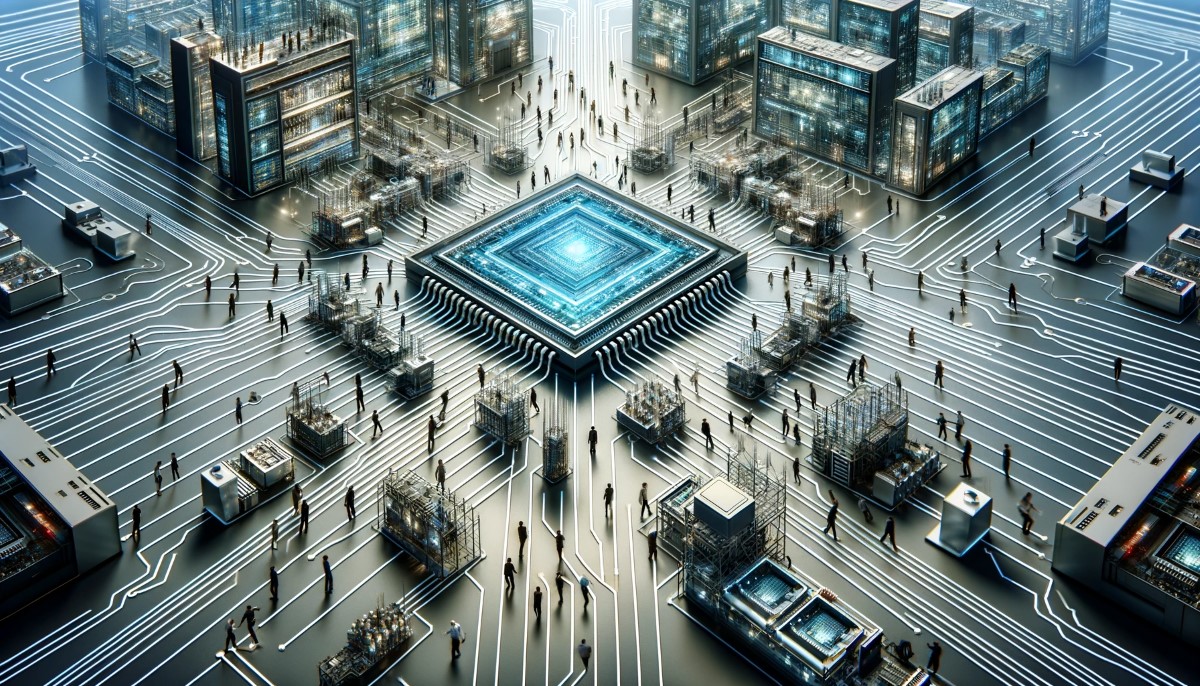
An integrated circuit (IC), often referred to as a chip or microchip, is a compact assembly of interconnected electronic components embedded on a small semiconductor material, usually silicon. These electronic components can include transistors, diodes, resistors, and capacitors. The development of ICs marked a major milestone in the miniaturization of electronic devices, allowing for powerful yet tiny computing devices.
Here are some key points about integrated circuits:
Miniaturization: ICs greatly reduced the size and weight of electronic devices. What once took up entire rooms (like early computers) can now fit in the palm of your hand or even smaller.
Types of ICs: There are several types of integrated circuits, including digital ICs (like microcontrollers and memory devices), analog ICs (like operational amplifiers), and mixed-signal ICs (which have both analog and digital components).
Fabrication: ICs are made through a process known as photolithography, where layers of different materials are laid down and patterned on a silicon wafer.
Packaging: After fabrication, ICs are often encased in a plastic or ceramic package with metal pins sticking out. This makes it easier to mount them on circuit boards.
Applications: ICs are used in virtually all electronic devices today, from smartphones and computers to cars and household appliances.
Development: The idea of an integrated circuit was proposed independently by Jack Kilby at Texas Instruments and Robert Noyce at Fairchild Semiconductor in the late 1950s. Kilby is often credited with building the first working integrated circuit in 1958.
Complexity: Over the years, with advancements in technology, the number of transistors and components on an IC has exponentially increased, leading to more powerful and efficient chips. This trend was famously observed by Gordon Moore, co-founder of Intel, and became known as Moore's Law.
System on a Chip (SoC): Advances in IC technology have led to SoCs, where almost all components of a computer or other system are integrated onto a single chip.
In essence, integrated circuits revolutionized the field of electronics, making possible the vast array of electronic devices and systems that we have today.
"The topic of electronic components is broad in scope, encompassing a diverse range of products. Here are the answers to the most common questions posed by our valued visitors."
- What is an integrated circuit?
- What is a crystal oscillator?
- What is an LED (Light Emitting Diode)?
- What is a radio frequency (RF) module?
- What is a ceramic resonator?
+ Back to Main page
"These
questions often include those that many people might have about the
component parts of electronic devices. Each user or student will have
their own specific questions depending on a particular situation or
application. The answers provided are not binding and do not express
absolute certainty. You are free to share the article above, citing it as a source. 04/2020."
Your shopping cart is empty!