
What is SVC?
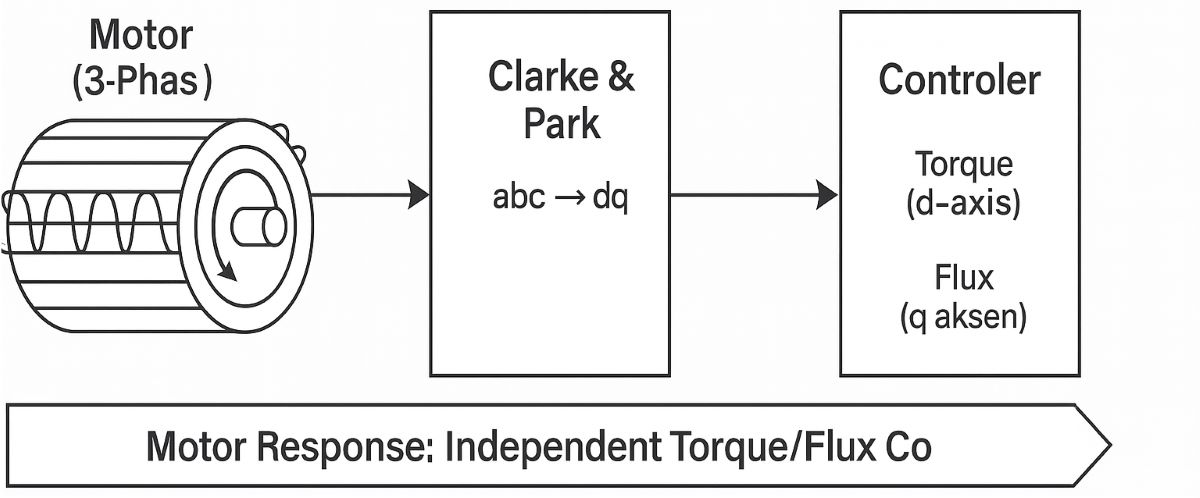
Sensorless Vector Control (SVC) is a motor control method used for induction motors and permanent magnet synchronous motors (PMSM) that does not require sensors to provide feedback on the rotor position. Instead, the rotor position is estimated based on the motor’s electrical characteristics and behavior. SVC is also known as Field-Oriented Control (FOC) or simply Vector Control.
The main goal of SVC is to optimize motor performance by controlling torque and magnetic flux independently. This is achieved by transforming the motor’s three-phase AC voltage and current into a two-axis coordinate system using the Clarke and Park transformations. This transformation allows the controller to manipulate torque and flux as if they were separate, scalar quantities.
Key advantages of sensorless vector control:
Lower system cost and complexity: No need for encoders or resolvers reduces cost and design complexity.
Higher reliability: Removing sensors eliminates possible failure points, improving system durability.
Improved performance: Compared to V/f control, SVC provides faster dynamic response, higher efficiency, and more precise speed/torque regulation.
There are, however, some challenges with SVC. The method requires higher computational power, and estimating rotor position can be difficult at very low speeds or during startup conditions. Even so, its strong performance and reliability make it highly preferred in electric vehicles, industrial automation, and robotics.
From a practical perspective, the biggest benefit of SVC is achieving better motor control with fewer hardware components. In many industries, reducing dependency on additional sensors directly translates to lower maintenance costs and higher uptime.
Another significant point is how SVC handles dynamic load changes. In applications such as winding, lifting, or conveyor systems, the independent torque and flux control allow the motor to respond smoothly and efficiently to sudden variations in demand.
In sensor-based systems, encoder failures are one of the most common causes of downtime. By eliminating these devices, SVC creates a simpler yet more robust control structure. This makes it especially appealing in harsh industrial environments where dust, vibration, and temperature variations are present.
Although low-speed estimation remains a challenge, modern drives with advanced algorithms and faster processors are increasingly overcoming this limitation. As a result, the disadvantages of SVC are shrinking year by year.
Ultimately, sensorless vector control is not just an alternative—it is the standard approach for modern motor drives. Its blend of efficiency, reliability, and cost-effectiveness explains why it is spreading so rapidly across today’s automation and motion control systems.
Your shopping cart is empty!