
what is skip frequency in vfd?
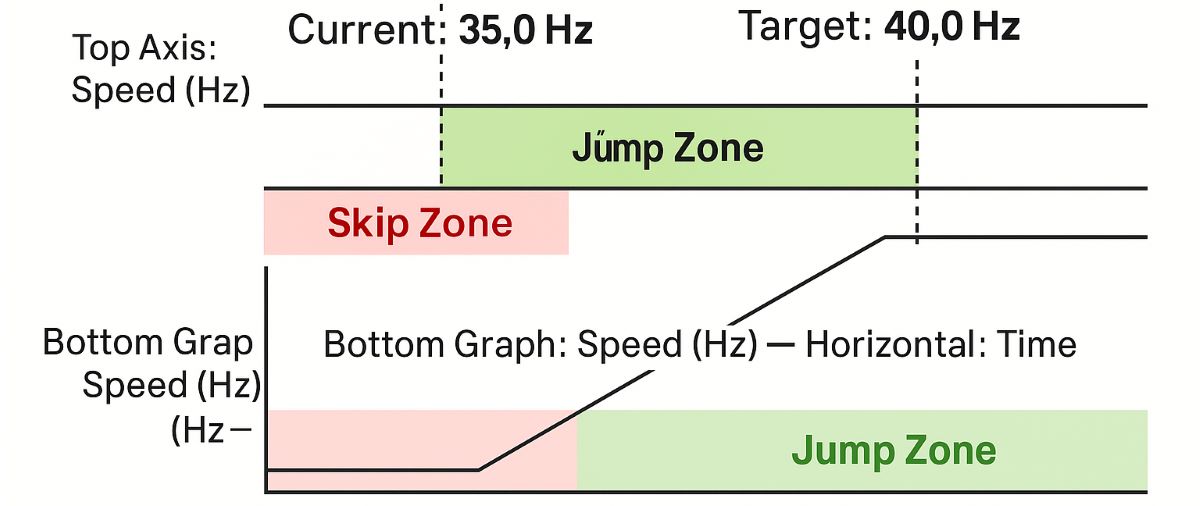
Skip frequency is a feature that can be found in many variable frequency drives (VFDs). It allows the VFD to momentarily freeze the output frequency at a specific point, avoiding resonance conditions when the input command changes. This helps reduce mechanical wear, minimizes vibration, and decreases system noise. The skip frequency is generally configured in Hertz (Hz) and represents only a small portion of the VFD’s total operating frequency range.
What is the purpose of the jump frequency range and skip frequency range on a VFD?
The skip frequency range is specifically designed to bypass frequencies that could cause harmful vibration or resonance in the motor or connected mechanical system. By preventing operation within these critical bands, the drive ensures longer equipment life and quieter operation. Skip frequency is particularly important in systems where mechanical resonance can cause excessive stress or noise.
The jump frequency range, in contrast, allows the VFD to quickly traverse through a set frequency window without lingering. This ensures that the motor accelerates or decelerates rapidly through problematic or unnecessary speed zones. It is especially useful in applications where sudden load changes occur and the system needs to adapt quickly.
From a practical standpoint, skip frequency acts as a protective measure, shielding the motor and mechanical components from excessive vibration. Without it, the system might repeatedly pass through a resonance point, leading to fatigue and premature failure of couplings, bearings, or frames.
Jump frequency, on the other hand, can be considered a performance booster. It reduces transition time when shifting between speeds and ensures that the motor reaches the desired operating point faster, which can directly improve production efficiency in industrial environments.
Incorrect adjustment of these parameters may cause the opposite effect. If skip frequency is misconfigured, the system might still operate in resonance zones. If jump frequency is set too aggressively, the motor could experience unnecessary stress due to rapid accelerations.
Technicians usually determine the correct settings through testing and observation. Each mechanical system has unique resonance characteristics, so fine-tuning is essential for maximizing reliability. Factory defaults may work in general cases, but field adjustments bring the best results.
In summary, skip frequency enhances reliability by avoiding destructive resonance, while jump frequency increases responsiveness by shortening transition times. Used together and properly adjusted, they provide both protection and agility to VFD-controlled systems.
Your shopping cart is empty!