
what is pressure sensor?
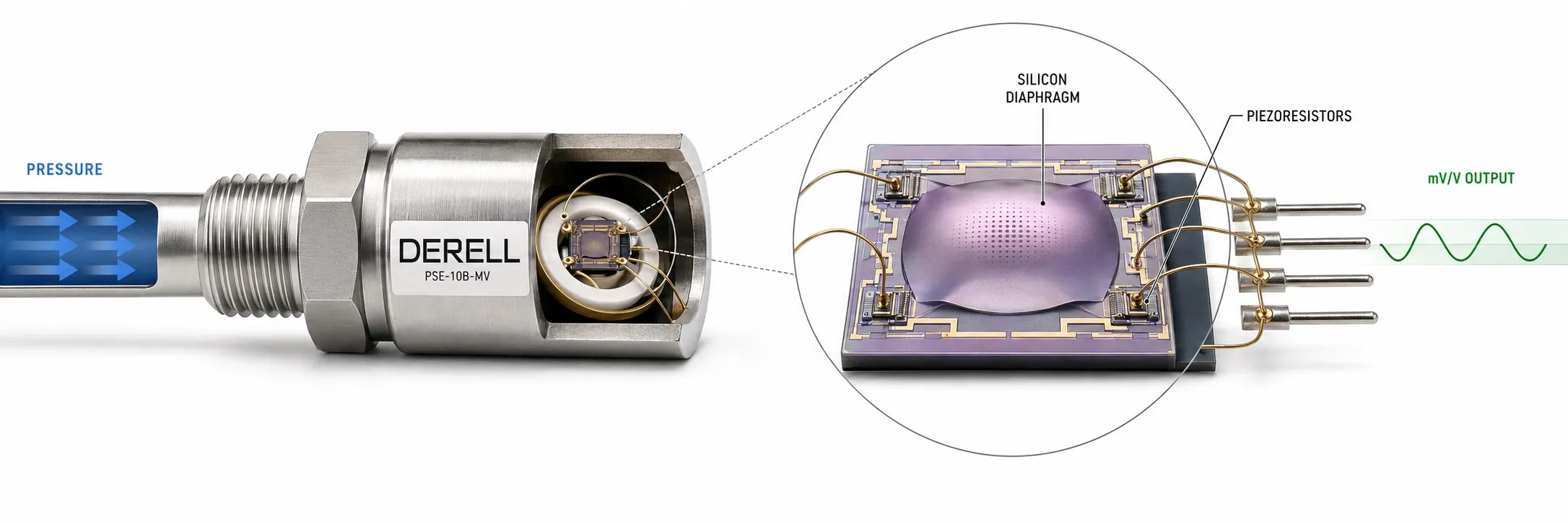
How a pressure change becomes a measurement
A pressure sensor responds to gas or liquid pressure and turns that response into an electrically measurable change. Depending on its construction, it may provide a raw sensing signal or a conditioned output. Industrial pressure sensors are used in compressed-air systems, hydraulic machinery, pumps and process installations.
Pressure describes force acting over an area. It is distinct from force itself, and a pressure reading does not directly establish fluid flow or tank volume. Those quantities require additional information and an appropriate measurement arrangement.
The diaphragm and the sensing element have different jobs
In many designs, pressure causes a small, controlled deformation of a diaphragm. The diaphragm provides the mechanical response; another structure detects that response electrically. A diaphragm is not, by itself, a separate electronic sensing principle. The measurement method depends on how the instrument converts deformation into a usable signal.
Wetted materials are part of the measurement design too. Stainless steel, ceramic and seal materials have different compatibility limits. Fluid chemistry, temperature and cleaning requirements all matter. Protection against water entering the outer enclosure does not establish compatibility with the process fluid inside.
Common sensing principles
Piezoresistive: Mechanical stress changes electrical resistance, often in a silicon sensing structure. Strain gauge and film-based: Strain-sensitive resistors respond to stretching and compression; thin-film and thick-film designs differ in how those structures are made. These labels can overlap rather than forming completely separate categories.
Capacitive: Diaphragm movement changes electrode geometry and capacitance. This approach can be used for low-pressure and differential pressure measurements. Piezoelectric: Mechanical loading generates electrical charge in the sensing material. It is especially useful for rapid pressure changes and pulses, rather than as a general solution for indefinitely measuring a steady pressure.
Optical: Pressure-induced movement changes an optical property that the measurement system reads. Fibre optic designs can serve specialised applications where electromagnetic interference is a concern. Choosing a sensing technology still requires checking the particular instrument's specifications; the principle alone does not establish suitability.
Measuring a steady value is different from catching a pulse
Monitoring an air line operating near 6 bar is different from capturing the short pressure event produced by a closing valve. The latter depends on sensor dynamics, acquisition rate and filtering. A slowly refreshed display may never show the peak. When reviewing a pressure graph, consider how the record was acquired as well as the number shown.
Sensor, transmitter or pressure switch?
A bare sensing element may need additional signal conditioning. A pressure transmitter delivers a standardised measurement output, such as 4–20 mA or 0–10 V. A pressure switch usually changes its output state at a configured threshold. Some instruments combine measurement and switching functions.
The output must suit the receiving PLC or pressure indicator. Having an electrical signal does not mean that a sensor can connect directly to any analog input. Establish output type, supply requirements and scaling from the instrument's documentation.
Choose the correct pressure reference
Gauge pressure, on an atmosphere-referenced sensor, is measured relative to local atmospheric pressure. Absolute pressure is referenced to absolute vacuum. Differential pressure is the difference between two pressure points. A “0–10 bar” specification is incomplete without the reference. The engineering unit and reference must also agree with the display configuration.
Mechanical instruments still have a role
A mechanical pressure gauge can indicate pressure without providing an electronic output. In a Bourdon-tube gauge, deformation of a curved tube moves a pointer. Bellows and diaphragm mechanisms are also used; a U-tube manometer uses the difference in liquid levels. A local gauge can help compare readings, provided both instruments represent the same pressure reference and operating conditions.
Select around the measurement task
Define normal pressure, possible peaks, fluid and temperature first. Then consider accuracy, response time, wetted materials, process connection, output and power requirements. Rated measuring range and overpressure tolerance are different specifications. Compare sensor prices against these requirements rather than the pressure range alone.