
What is PLC Instruction List (IL)?
PLC Instruction List (IL) is a language used in a PLC (Programmable Logic Controller) program. These instructions define the actions that a PLC will perform and are loaded into the memory unit of the PLC. PLC programs typically consist of a series of instructions and conditions that are loaded into the memory unit of a PLC.
What is PLC Instruction List (IL)?
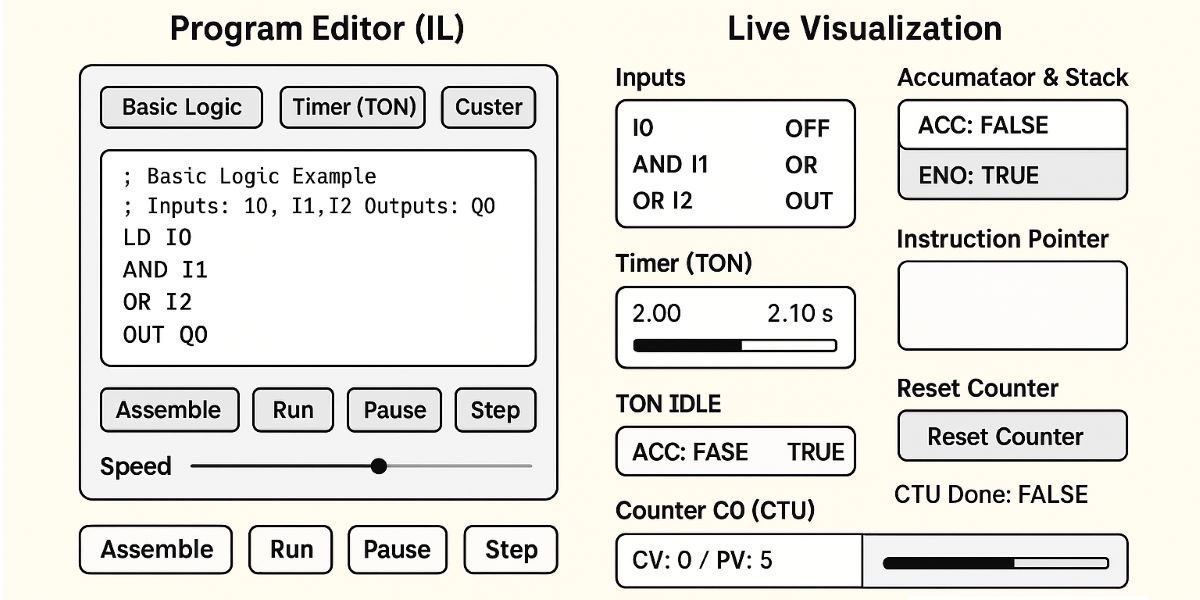
Instruction List (IL) is a text-based, low-level PLC language defined by IEC 61131-3. Instructions execute sequentially using an accumulator (ACC) and an optional stack. In this simulation you can edit, assemble, and run/step IL code while observing inputs/outputs, ACC, a TON timer, and a CTU counter.
Program Editor (IL)
Presets:
Live Visualization
Inputs
Outputs
Timer (TON)
TON: IDLE
Accumulator & Stack
Instruction Pointer
Counter C0 (CTU)
CTU Done: FALSE
How to use: Edit the IL, press Assemble, then use Run or Step. Toggle inputs to see how ACC evolves and how outputs change. In the Timer (TON) preset, the bar fills until the preset time and then turns the output ON. In the Counter (CTU) preset, use I0 as the pulse input, I1 to reset, adjust PV with the slider, and observe when CV ≥ PV the Done flag becomes TRUE and Q1 turns ON.
PLC Instruction List (IL) instructions are typically written using a programming language specific to the PLC. For example, languages used for Siemens PLCs include LAD (Ladder Diagram) for S7-300 and S7-1200 PLCs, and STL (Statement List) for S7-1500 PLCs.
Some examples of PLC Instruction List (IL) instructions include:
ADD: performs the addition of two numbers
AND: performs the AND operation on two numbers
CMP: compares two numbers
JMP: jumps to the labeled location
LD: loads the value at the specified address
MOV: copies a value to another value
OR: performs the OR operation on two numbers
OUT: loads the value at the specified address to the output
ST: stores the specified value to the specified address
These are just a few examples, and the full list of PLC Instruction List (IL) instructions may vary depending on the PLC model and programming language being used.
Your shopping cart is empty!