
what is High Speed Output ?
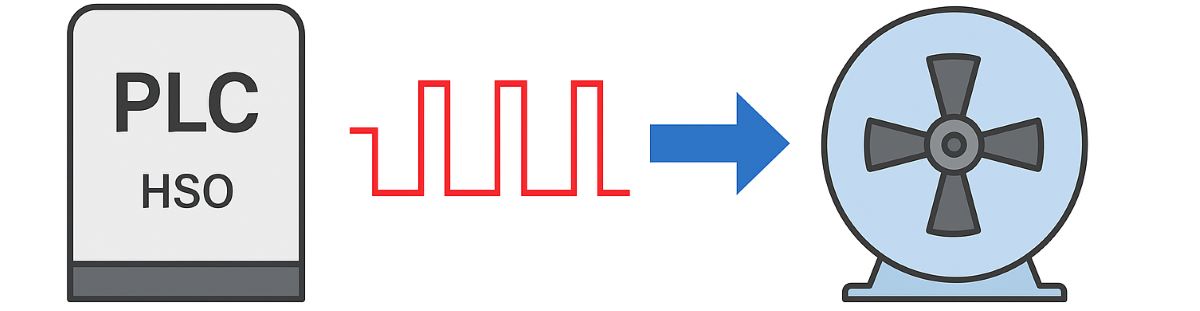
High Speed Output (HSO) is a feature of programmable logic controllers (PLCs) that allows for the generation of high-speed pulse trains or digital signals with precise timing and duration. HSOs are commonly used in motion control applications, such as controlling the position and speed of a motor, as well as in other applications that require fast and accurate digital output signals.
PLCs typically have a set of digital output channels that can be used for general-purpose control, but these channels may not be fast or accurate enough for certain applications. HSOs are designed to provide faster and more accurate digital output signals with pulse widths as short as a few microseconds, and can generate pulse trains with frequencies up to several kilohertz.
HSOs can be used in a variety of applications, such as controlling the position and speed of a servo motor, controlling the frequency of a pulse-width modulation (PWM) signal, generating precise timing signals for sensors and actuators, and synchronizing multiple devices in a system. HSOs are often implemented using special hardware modules or dedicated output channels on the PLC, and may require additional programming and configuration to set up and use effectively.
In real-world applications, the biggest benefit of HSOs is their ability to work with field devices without delay. This ensures accurate synchronization across the system, which is critical in high-speed production lines where even a small error can cause significant losses.
Another advantage is the precision level of HSOs. In servo or stepper motor positioning, even micron-level errors can reduce product quality. By using high-speed outputs, these errors are minimized, resulting in a more stable and reliable process.
Industries such as packaging and printing rely heavily on HSOs. Here, every pulse must be on time to ensure that hundreds of operations per minute run flawlessly. HSOs guarantee that all devices remain synchronized and the process continues smoothly.
When setting up HSOs, it is vital to check the PLC’s processing capacity and supported frequency range. Using incorrect parameters may cause synchronization problems, shorten device lifespan, or lead to production downtime.
For best practice, I strongly recommend field testing after installation. Theoretical calculations do not always match real conditions. Post-installation testing ensures system safety and allows potential issues to be detected before they affect production.
Your shopping cart is empty!