
What is Lithium Battery?
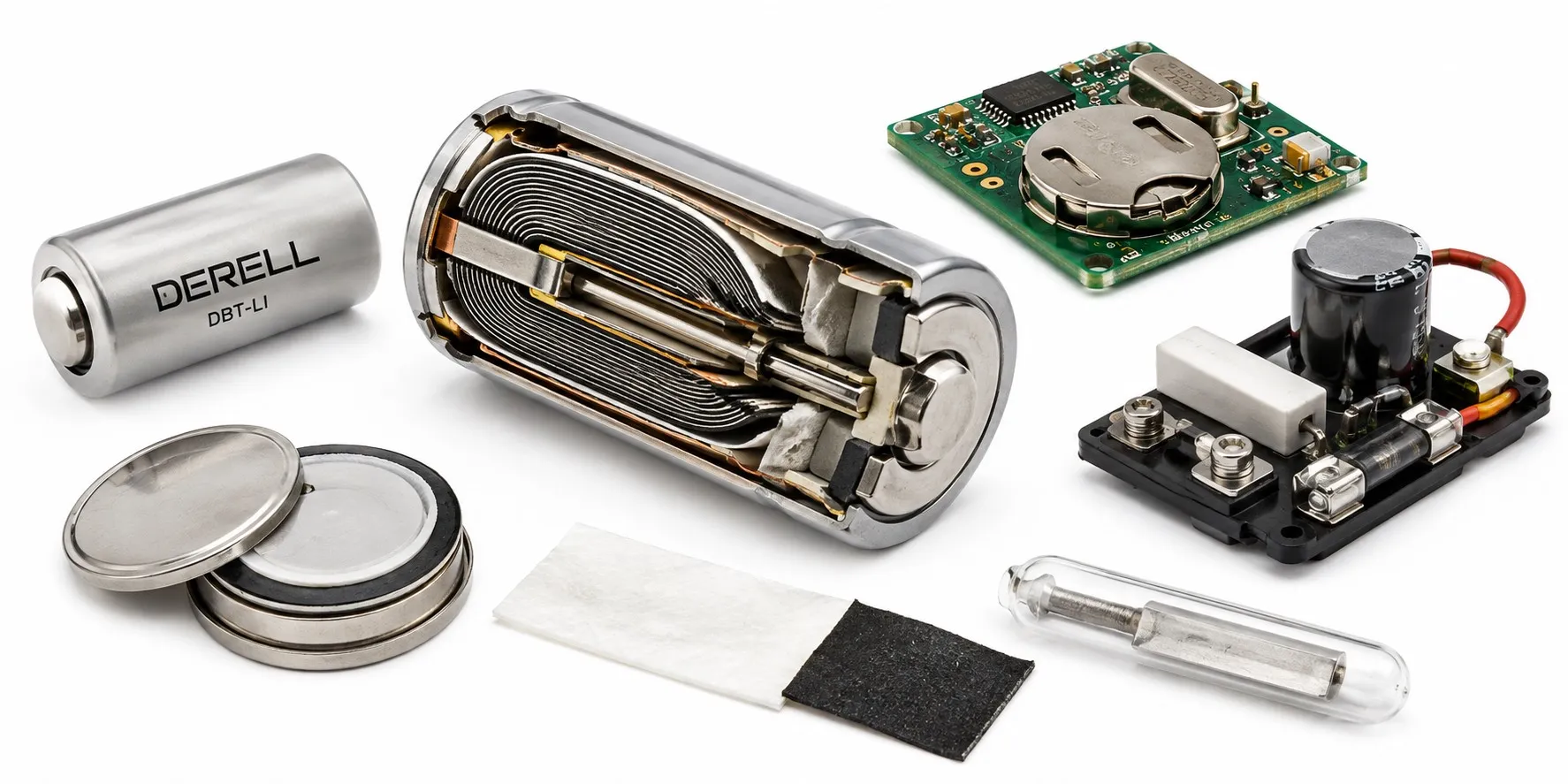
Why rechargeability, cell chemistry and voltage must be considered together
Lithium battery is an umbrella term for different battery technologies in which lithium participates in electrochemical reactions. The family includes non-rechargeable lithium metal cells and rechargeable lithium-ion cells. A memory backup cell, a wireless sensor supply and an electric vehicle battery have different requirements. Selection depends on chemistry, voltage, current demand and operating environment, rather than capacity alone.
Editor's note: The statement “a lithium battery has a lithium metal anode” does not describe the entire family. Common lithium-ion batteries generally use a graphite-based negative electrode; normal operation involves lithium ions moving between electrodes. Also, the word lithium does not mean the cell is rechargeable.
Primary lithium cells: long service without recharging
Primary cells must not be recharged. Common examples include approximately 3 V Li-MnO₂, 3.6 V Li-SOCl₂ and 1.5 V Li-FeS₂ cells. Lithium coin cells such as CR2032, industrial meter cells and AA lithium iron disulfide cells do not all operate at the same voltage. Low self-discharge and long service life are advantages of some chemistries, but not every cell is designed to deliver high pulse currents.
How lithium-ion, LiPo and LiFePO₄ relate
The rechargeable lithium-ion family includes electrode chemistries such as LCO, LMO, NMC, NCA and LFP. These offer different design choices in energy density, power, thermal behaviour and life. LiFePO₄, or LFP, is itself a lithium-ion chemistry. A comparison labelled “lithium-ion versus LiFePO₄” usually means LFP compared with other common lithium-ion chemistries.
Lithium polymer, or LiPo, generally describes rechargeable lithium-ion cells associated with a polymer or gel electrolyte structure; pouch packaging is common. The name alone does not specify cathode chemistry, capacity or safe charging voltage. Packaging format and electrochemical construction are separate characteristics.
Matching dimensions do not mean matching voltage or current
Common lithium-ion cells have a nominal voltage of 3.6–3.7 V, while LFP cells commonly have a nominal voltage around 3.2 V. These are examples, not charging limits. For example, Murata's US18650VTC5 datasheet specifies a nominal voltage of 3.6 V and a charging voltage of 4.2 V. 4.2 V is not suitable for every lithium cell.
18650 identifies a size and format; it does not establish chemistry, capacity, protection circuitry or allowable current. Similarly, installing a physically compatible 3.6 V cell in equipment intended for 1.2 V or 1.5 V cells can damage the equipment. Check the nominal voltage, polarity, terminal arrangement and exact part number together.
Distinguish mAh, Wh and current capability
mAh or Ah describes electrical charge capacity, while Wh describes energy. An approximate calculation is Wh = nominal V × Ah. A cell labelled 3.7 V and 2 Ah therefore corresponds to approximately 7.4 Wh. Usable energy depends on load, temperature and cutoff voltage. Two cells with the same mAh rating may have different continuous and short-duration pulse current limits.
The charger and BMS perform different jobs
The charger must provide the current and voltage profile required by the chemistry and cell count. The constant-current/constant-voltage method used by a suitable Li-ion charging circuit does not mean that an arbitrary power supply can be connected directly to a battery. Permitted charging and discharging temperature ranges may also differ; the manufacturer's cell or pack specification takes precedence.
A BMS monitors cell voltages, current and temperature and provides protection and balancing functions according to its design. A BMS does not replace the correct charger. A small single-cell product may use a simpler protection circuit, while a multi-cell pack has different monitoring and protection requirements. Applying the blanket statement “every lithium battery requires a BMS” equally to a primary coin cell and a rechargeable power pack is incorrect.
Compatibility matters when assembling or replacing packs
Series and parallel connections affect fault current and protection requirements as well as voltage and capacity. Do not arbitrarily combine cells with different chemistries, capacities, ages or states of charge. In complete battery packs, connections, protection, temperature sensing and mechanical construction are designed together. Another pack with the same connector is not automatically a compatible replacement.
Selecting PLC backup cells and wireless sensor batteries
When replacing a backup battery in a PLC, encoder or real-time clock, retain the manufacturer's specified part number, chemistry, connector and polarity. Make the necessary programme and parameter backups before replacement, and consult the service instructions to determine whether the equipment must be powered or isolated during the procedure. A normal open-circuit voltage on a multimeter does not establish remaining capacity under load.
In Li-SOCl₂ cells in particular, passivation forms a surface layer associated with low self-discharge and long life; under some conditions, it can produce a temporary voltage drop during the initial load pulse. A wireless sensor may have low average consumption but still draw a significant transmission pulse. The solution is to select an appropriate cell and manufacturer-approved design, rather than short-circuiting the cell to “revive” it.
Safety, ageing and storage
Short circuits, mechanical damage, incorrect charging and excessive heat can cause dangerous heating, venting or fire. The more stable thermal behaviour of LFP compared with some other lithium-ion chemistries does not make it risk-free. Do not use or charge swollen, leaking, impact-damaged or abnormally hot cells. Never puncture or crush a cell, or bypass its protection circuitry.
Besides cycle ageing, batteries experience calendar ageing even while unused. Temperature, state of charge during storage and operating profile affect life. Follow the manufacturer's storage temperature, charge level and inspection interval recommendations rather than applying one percentage or temperature limit to every chemistry. During selection, review battery standards, the technical datasheet and relevant safety and transport documentation together.
Separate collection at the end of service life
Do not place lithium batteries in household waste or mixed packaging recycling. Insulating accessible terminals on intact used cells reduces short-circuit risks during collection; for damaged batteries, follow the manufacturer and authorised collection provider's instructions. Recoverable materials depend on the chemistry: not every lithium battery contains nickel or cobalt. Separate collection supports both safe processing and material recovery.
Related battery types and accessories
Alkaline batteries, NiMH batteries, NiCd batteries, lead-acid batteries and battery accessories help compare different supply requirements. Physical similarity does not establish that these products are interchangeable.
Related protection and power system topics
DC fuses, uninterruptible power supplies, multimeter measurements, battery management systems and battery chargers provide further context for designing a safe, compatible system around the cell.
Return to battery types. Explore batteries and charging equipment. Visit the power supplies main category.
Sources
US Department of Energy: graphite-anode lithium-ion and lithium metal cells.
Panasonic Energy: lithium coin cell technology; Energizer: L91 lithium iron disulfide cell datasheet.
Tadiran Batteries: passivation in Li-SOCl₂ cells.
Murata: laminated lithium-ion cells and safety measures; US18650VTC5 technical datasheet.
Texas Instruments: LiFePO₄ design considerations; charging, gauging and protection in a single-cell system.