
What is IEC 60751?
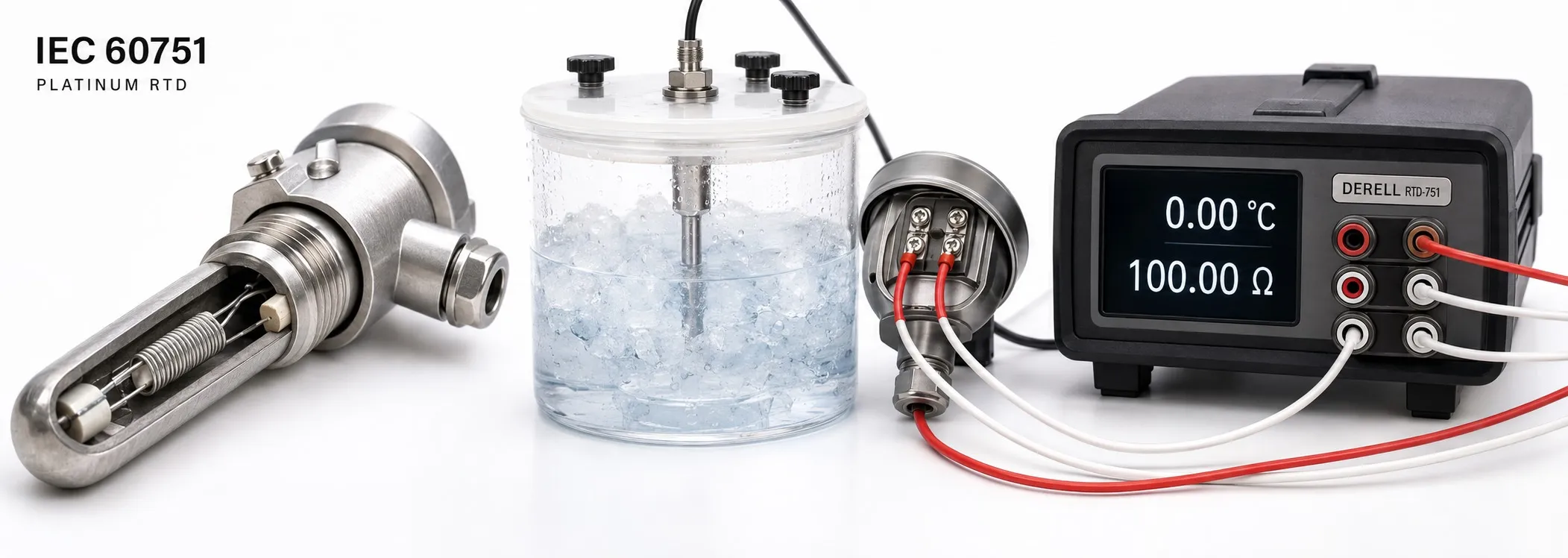
From resistance to temperature: a shared basis for accurate measurement
IEC 60751 is the international standard that defines the resistance–temperature relationship, tolerances and associated tests for industrial platinum resistance thermometers and platinum temperature sensing elements. Its scope extends beyond Pt100 to other nominal resistances, including suitable Pt1000 sensors. Within the wider family of IEC standards, it provides a common reference so that the sensor and measuring instrument interpret resistance using the same temperature characteristic.
What do Pt100 and Pt1000 mean?
A Pt100 sensor has a nominal resistance of 100 Ω at 0 °C; a Pt1000 has a nominal resistance of 1000 Ω at that temperature. With the common IEC 60751 platinum characteristic, their nominal resistances at 100 °C are approximately 138.51 Ω and 1385.1 Ω. The number 100 or 1000 does not specify the accuracy class, maximum operating temperature or number of connecting wires.
The commonly used coefficient α = 0.00385 °C⁻¹ describes the average relative resistance change between 0 and 100 °C. A single linear factor is insufficient across a wide temperature range; the instrument must use the appropriate standard curve. The higher resistance of a Pt1000 can reduce certain lead resistance effects, but it does not automatically provide a better accuracy class.
How should tolerance classes be interpreted?
Completed resistance thermometers use classes AA, A, B and C. Bare sensing elements have designations beginning with W for wire-wound construction or F for thin-film construction, such as W0.1 or F0.15. The element class and the completed probe class should be distinguished: the housing, assembly and manufacturing process affect the performance of the finished thermometer.
Class AA: The permissible temperature deviation is ±(0.10 + 0.0017 × |t|) °C.
Class A: The permissible temperature deviation is ±(0.15 + 0.002 × |t|) °C.
Class B: The permissible temperature deviation is ±(0.30 + 0.005 × |t|) °C.
Class C: The permissible temperature deviation is ±(0.60 + 0.010 × |t|) °C.
Here, t is the temperature in °C and |t| is its absolute value. At 100 °C, the limits are therefore ±0.27 °C for AA, ±0.35 °C for A, ±0.80 °C for B and ±1.60 °C for C. These expressions apply only within the valid temperature range of the specified class. Wire-wound and thin-film constructions can have different ranges; check the class together with the operating range on the probe’s data sheet.
How IEC 60751 relates to DIN EN IEC 60751
IEC 60751 is the international publication; the EN and DIN prefixes identify its European and German adoption. For example, DIN EN IEC 60751:2023-06 is the German publication of EN IEC 60751:2022, based on IEC 60751:2022. It supersedes DIN EN 60751:2009-05. Compare the publication year, edition and adopted text when checking equivalence. When referring to EN standards, state the full standard designation and edition in the specification.
Why do two-, three- and four-wire connections matter?
In a two-wire connection, the resistance of both leads adds to the measured sensor resistance. Near 0 °C, a total lead resistance of 1 Ω can produce an apparent positive temperature error of approximately 2.6 °C with a Pt100, compared with approximately 0.26 °C with a Pt1000. These approximate figures exclude other error sources and the change in curve slope with temperature.
A three-wire connection largely compensates for lead resistance when used with a suitable input circuit and closely matched lead resistances. A four-wire connection separates the current and voltage sensing paths to reduce lead resistance effects. To benefit from either arrangement, verify instrument compatibility with the sensor and wiring configuration. For a temperature controller, an “RTD input” description alone does not establish all the necessary details.
Measuring current, installation and response time
The current used to measure an RTD also heats it slightly. The electrical cause of self-heating follows P = I²R; the resulting temperature rise depends on the sensor construction, surrounding medium, flow rate and heat transfer. At the same measuring current, a Pt1000 can dissipate more power in its resistance than a Pt100. Select the current using the manufacturer’s data and check the input specifications of any temperature sensor converters.
Insufficient immersion, poor surface contact or heat conduction along the probe can introduce errors greater than the class tolerance. The cable outlet and connection head need an appropriate IP rating under IEC 60529 for their environment; an IP rating does not define temperature accuracy. Evaluate the probe position together with the controller installation and electrical connections.
The sensor’s thermal response time and the controller’s response time are different characteristics. A probe that responds quickly in a liquid bath may behave more slowly in still air. In PID temperature control, sensor lag, instrument sampling time and the thermal behaviour of the process all matter. A rapidly refreshed display alone does not establish fast process measurement.
Calibration, tolerance and system accuracy
A tolerance class specifies a permissible deviation limit. Calibration establishes deviation from a reference and measurement uncertainty under stated conditions; it does not automatically include adjustment. A Class A limit of ±0.35 °C at 100 °C does not establish an accuracy of ±0.35 °C for the complete combination of sensor, leads, converter and display.
A display resolution of 0.1 °C does not guarantee accuracy of the same magnitude either. When investigating faults and error codes, check for an incorrect sensor curve, wiring errors, open circuits and short circuits. Precision applications require an assessment of uncertainty across the complete measurement chain and calibration results at the relevant operating temperatures.
What does ASTM E1137 cover?
ASTM E1137/E1137M is a specification for industrial platinum resistance thermometers. It addresses the characteristics and associated tests of metal-sheathed platinum resistance thermometers for direct immersion applications. It is not a thermocouple calibration standard; describing it as a calibration method for platinum-ruthenium or nickel-molybdenum thermocouples is incorrect.
Although IEC 60751 and ASTM E1137 concern a similar product group, compliance with one does not automatically establish compliance with the other. A purchasing specification should identify the required standard and edition, temperature range and performance requirements explicitly.
Making a practical selection
Start with the process temperature range and the acceptable total measurement error. Then choose the probe class, valid range, mechanical construction and wiring arrangement. When selecting a temperature controller, check Pt100/Pt1000 support, two-, three- or four-wire input capability, input accuracy and output behaviour following a sensor fault. Ask the supplier for measurable, documented specifications rather than relying on a general claim of precision.
An RTD senses temperature; it does not form a complete heater switching system on its own. Understanding the difference between a temperature sensor and a thermostat helps distinguish the sensing element from the control and power stages.
Related sensor topics and control components
To compare sensing options, explore Pt100 versus thermocouples, how thermocouples work, thermocouple standards, NTC sensors and PTC sensors. These technologies have different characteristics and should not all be treated as platinum RTDs covered by IEC 60751.
Analog inputs and PID control help connect temperature measurement to the control system. Depending on the application, SSR relays or contactors switch heater power, while suitable power supplies provide power for the electronic circuits. These components perform separate tasks in the control chain; they do not change the sensor’s tolerance class.
Related category: Temperature controllers
Sources
IEC: IEC 60751:2022 — scope and publication details
DIN Media: DIN EN IEC 60751:2023-06 — adoption and superseded edition
ASTM: E1137/E1137M-08(2020) — industrial platinum resistance thermometers
WIKA: technical FAQs — tolerance classes and 1/3 DIN descriptions
WIKA: classifying sensing elements and completed thermometers
OMEGA: platinum RTD fundamentals — wiring and self-heating (PDF)