
What is Humidity sensors?
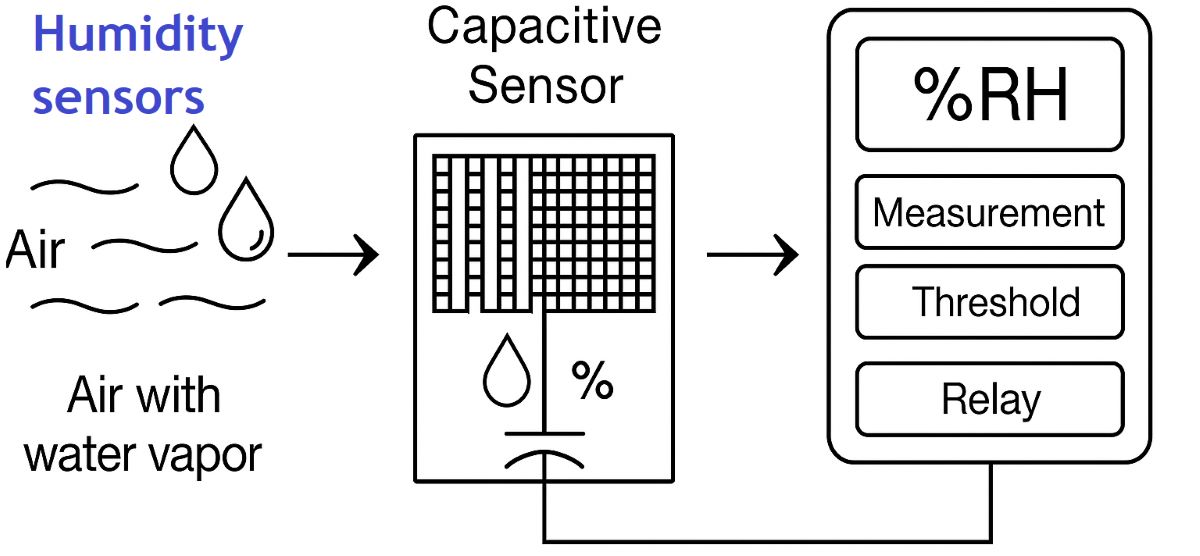
Humidity sensors are devices that measure the amount of moisture or water vapor in the air. Humidity is an important factor in many applications, including weather forecasting, industrial process control, and indoor air quality monitoring. Humidity sensors can be used to measure relative humidity, which is the amount of moisture in the air relative to the maximum amount that the air could hold at a particular temperature, or absolute humidity, which is the mass of water vapor in a particular volume of air.
There are several types of humidity sensors, including capacitive humidity sensors, resistive humidity sensors, and infrared humidity sensors. Capacitive humidity sensors measure humidity by detecting changes in the capacitance of a capacitor that is coated with a humidity-sensitive material. Resistive humidity sensors measure humidity by detecting changes in the resistance of a humidity-sensitive resistor. Infrared humidity sensors measure humidity by detecting changes in the absorption of infrared radiation by water vapor.
Humidity sensors are commonly used in a wide range of applications, including weather stations, greenhouses, HVAC systems, and automotive systems. They are often used in combination with other sensors, such as temperature sensors and pressure sensors, to create more complex systems.
Accuracy: The accuracy of humidity sensors can vary depending on the type of sensor, the range of measurement, and the specific application. Some humidity sensors are more accurate than others, and it is important to select a sensor that is appropriate for the required level of accuracy.
Range of measurement: Humidity sensors can measure humidity over a wide range of values, from very low humidity to very high humidity. The range of measurement depends on the type of sensor and the specific application.
Response time: The response time of a humidity sensor refers to the amount of time it takes for the sensor to reach a stable reading after a change in humidity. Some humidity sensors have faster response times than others, which can be important in certain applications.
Calibration: Humidity sensors may need to be calibrated periodically to ensure accurate readings. Calibration can be done using specialized equipment or by comparing the sensor's readings to those of a reference humidity sensor.
Environmental factors: Humidity sensors can be affected by various environmental factors, including temperature, pressure, and the presence of other gases. It is important to consider these factors when selecting and using a humidity sensor to ensure accurate readings.
Your shopping cart is empty!