
What is Home return for servo?
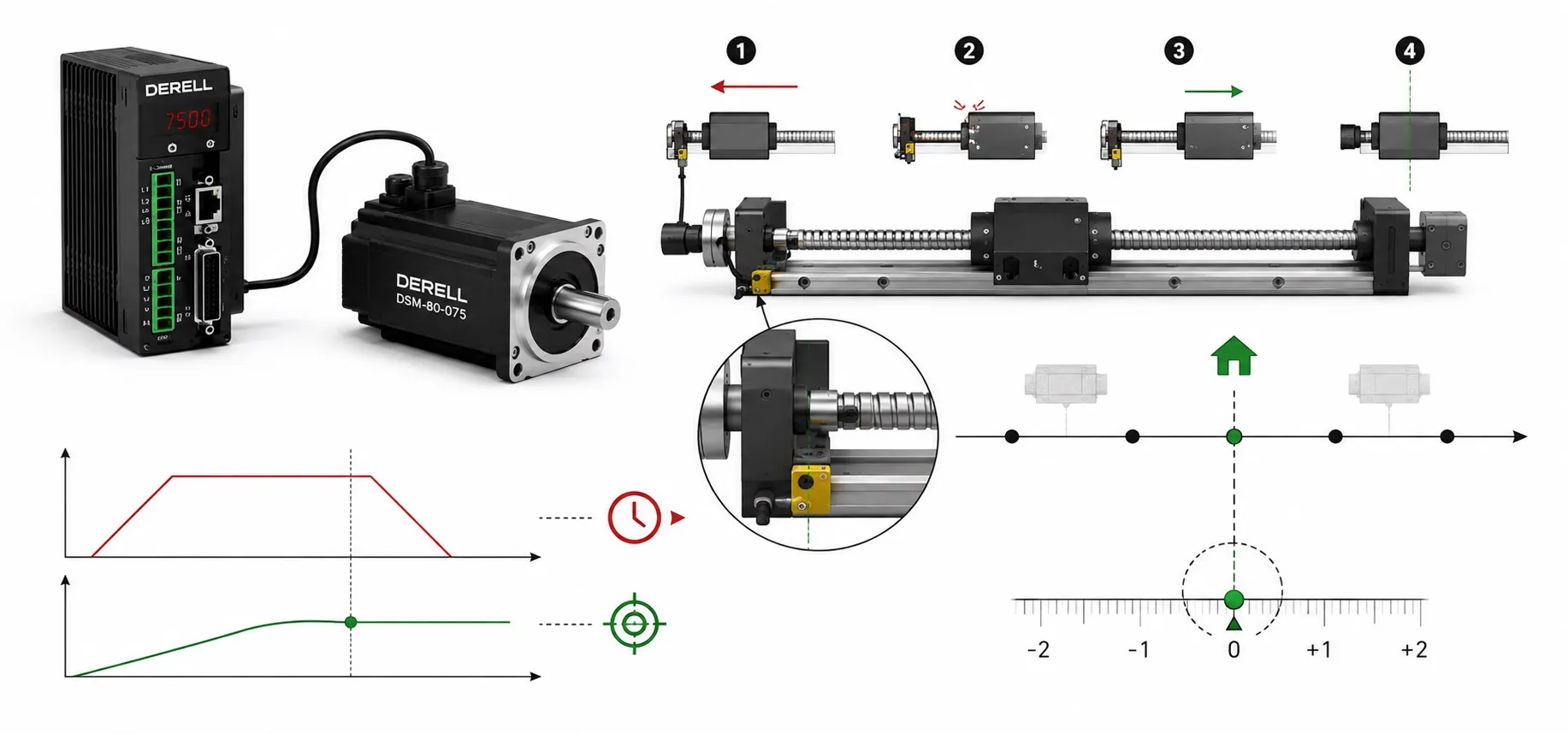
Connecting axis coordinates to the physical machine
A home reference connects a known physical axis location to a coordinate value in the control system. Homing establishes that relationship. In a servo system, knowing the motor's rotational position is not necessarily the same as knowing where the carriage is within its travel. This reference lets position control associate an absolute target with the intended physical location.
Homing means more than moving the motor to a position labelled zero. A reference event can be assigned a nonzero coordinate, and the axis may finish the sequence at a separate waiting position. Running a servo motor in velocity or torque mode does not, by itself, require a machine position reference; the application determines whether one is needed.
Home reference, machine zero and workpiece zero
The home switch transition, machine zero and workpiece zero need not coincide. Machine zero defines the axis coordinate origin. In CNC applications, work offsets such as G54 establish a separate origin associated with the workpiece location. A home offset relates the detected reference to the required coordinates. Its sign convention and whether it commands an additional movement depend on the controller.
For example, the physical location detected by a sensor could be assigned X = −10 mm. Machine zero would then lie 10 mm farther in the positive direction. This is a conceptual example: detecting the sensor does not necessarily mean assigning X = 0, and the final homed position need not be zero.
How is the reference detected?
Switch-based homing: The axis searches for a configured rising or falling input edge. An inductive sensor can detect a metal target; a suitable photoelectric sensor or mechanical switch may serve other arrangements. Sensing distance, target geometry, mounting stiffness and PNP/NPN compatibility must be considered together.
Switch plus encoder index: The sensor identifies the correct mechanical region, after which a supported system captures the encoder's Z/index mark as the more precise reference event. A rotary encoder index normally repeats once per revolution, so it cannot identify the correct revolution across a multi-revolution stroke by itself. An unstable relationship between the switch edge and the index can cause the wrong index event to be selected.
Homing using a limit switch: Some controllers support separate home and limit switches; others allow a shared input. Reference detection and end-of-travel limiting have different purposes. Sharing requires an explicitly supported method and an appropriate machine design. Torque-based homing against a mechanical stop is another specialised method; it does not mean driving an ordinary axis into an arbitrary hard stop.
Does an absolute encoder need homing at every startup?
Not necessarily. An absolute encoder can eliminate a startup search movement if it provides a unique, valid position throughout the required travel range, has been correctly aligned with the machine, and retains that relationship. Single-turn absolute feedback alone may not locate a leadscrew axis spanning several motor revolutions; multiturn information or another position-identification method is then needed. Direct linear encoders must likewise be assessed according to their measurement type.
In battery-backed systems, battery alarms, encoder replacement or lost multiturn information may require the reference to be re-established. After removing a motor, belt, gearbox or coupling, a preserved encoder value does not prove that the physical machine reference is still correct. Initial alignment and verification after mechanical changes are separate from a routine startup homing search.
A practical commissioning sequence
Verify inputs and direction first. Observe the actual home and limit input states through the PLC/HMI. Check how the selected method behaves if the home sensor is already active. Use low-speed initial movements to confirm the relationship between mechanical travel, feedback counting and command direction. In both pulse/direction and EtherCAT servo systems, establish which device controls homing and how completion is reported.
Separate the search from the final reference approach. A common sequence approaches the switch, stops, moves clear and captures the selected edge again at a lower speed. An index-search stage follows where required. Search distance, timeout, acceleration and stopping clearance must suit the available travel. Use the relevant servo drive programming and configuration documentation for the exact sequence and parameters.
Require a valid reference before automatic positioning. A stopped motor alone does not indicate successful homing. Evaluate the controller's completion, error and reference-valid states, and check when software limits tied to machine zero become effective. Standard homing is not a safety function; safety relays and other protective functions are assessed separately within the machine's safety design.
Why does the home position vary?
A consistent displacement suggests checking offsets and coordinate definitions first. A different displacement on successive attempts calls for examining sensor mounting, backlash, approach direction, encoder couplings and connections, and input signal quality. An occasional error corresponding to one motor revolution particularly warrants checking the switch/index relationship.
When position is captured only through cyclic input sampling, the distance associated with a delay is approximately velocity × time: at 20 mm/s, 5 ms corresponds to 0.10 mm of travel. This is not a total-error specification; hardware latching, sensor repeatability and mechanical backlash affect the result. Assess signal noise and filtering as well. Increasing position loop gain will not correct an incorrectly defined reference, and the reference should be verified after mechanical maintenance.
Editor's note: Making the display read “0” and verifying that the axis occupies a known physical location are different operations. Assigning a coordinate at an arbitrary location does not automatically recover a lost machine reference. Repeat homing several times from the same approach direction and compare the result with an independent measurement. Assess repeatability separately from absolute accuracy: an axis can return consistently to the wrong location.
Related servo and motion control topics
Explore servo systems, servo operating principles, position control, velocity versus position control, velocity, torque and position modes, EtherCAT servos and motion control products for the broader control context.
Supporting topics from other categories
Encoders, absolute encoders, inductive sensors, photoelectric sensors, limit switches, PNP/NPN selection and PLC/HMI systems are directly involved in detecting the reference and communicating it to the controller.
References
Beckhoff: Homing principles, reference cams and encoder index marks
Schneider Electric: Reference movements and position setting
Rockwell Automation: Motion Axis Home and reference status
Renishaw: Absolute and incremental encoders; accuracy and repeatability
LinuxCNC: Machine coordinates and work coordinate offsets