
What is the maximum length of an Ethernet cable?
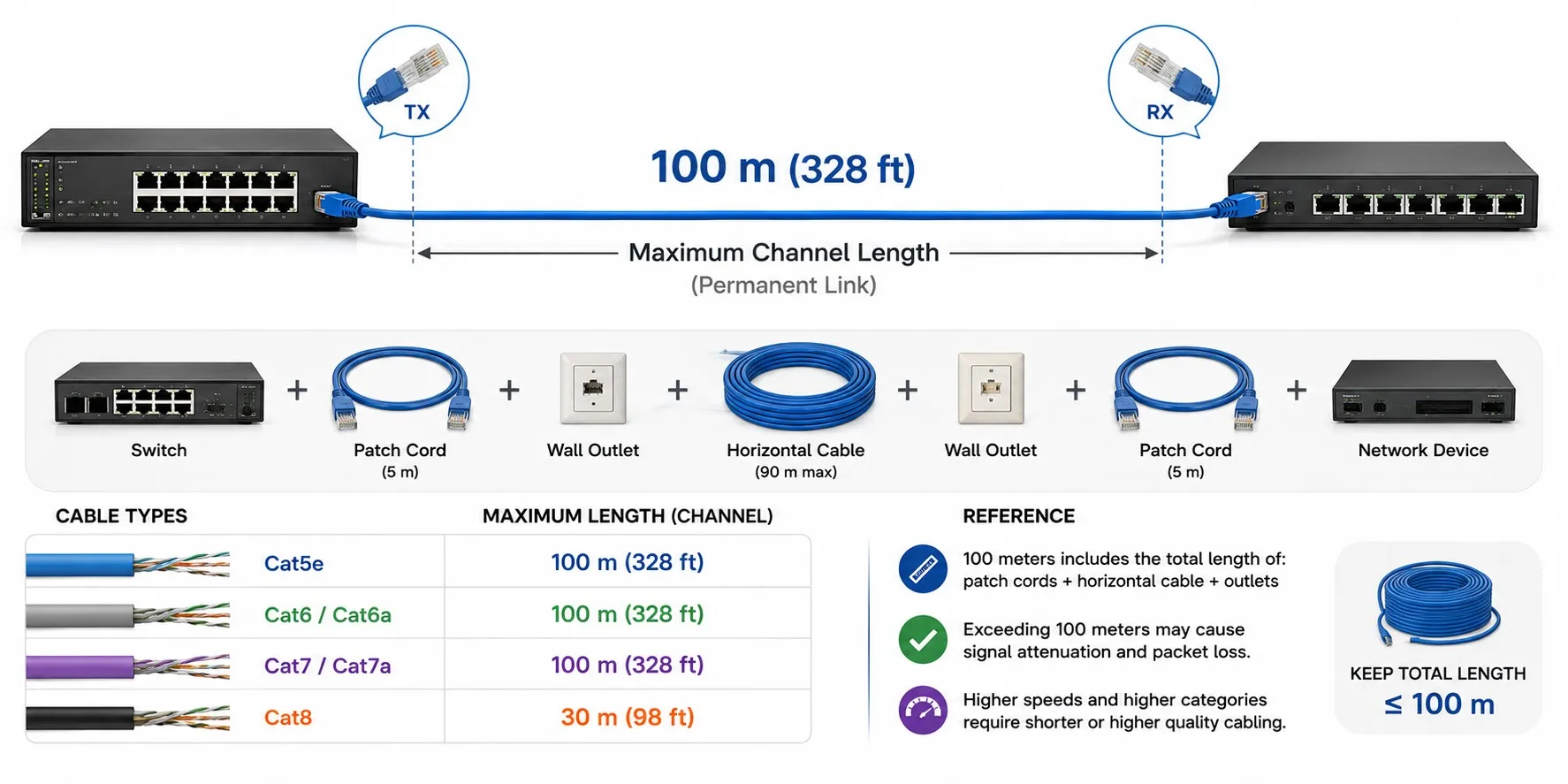
There is no single maximum Ethernet cable length. The familiar 100-metre limit applies to many common twisted-pair technologies such as 10BASE-T, 100BASE-TX and 1000BASE-T, but it is not a universal Ethernet rule. 10GBASE-T reach changes with cabling category, fiber PHYs range from hundreds of metres to tens of kilometres, and 10BASE-T1L Single Pair Ethernet is designed for point-to-point links up to 1000 metres. [1] [8]
The better engineering question is therefore not “How many metres does Ethernet go?” but “Which PHY, which rate, which copper/fiber medium, which connectors and what installation environment?” The word Cat6 or “fiber” on a cable is not enough to determine the link distance by itself.
Where does the familiar “100 metres” come from? A common structured-cabling channel model is:
| Device PLC / HMI / PC |
≤ 5 m patch cord | ≈ 90 m permanent link solid horizontal cable |
≤ 5 m patch cord | Switch / device |
| Total channel: 100 m class — only when the selected PHY and cabling category support that reach. | ||||
Cisco's current multigigabit cabling guidance describes the familiar 100 m channel as approximately 90 m of fixed horizontal cabling plus no more than 10 m total patch cable. [2] This is why installing 100 m of permanent cable and then adding patch cords can exceed the intended channel.
Common copper-Ethernet distances
| Ethernet PHY | Typical medium | Common maximum link/channel | Note |
|---|---|---|---|
| 10BASE-T | Twisted-pair copper | 100 m class | Legacy 10 Mb/s twisted-pair Ethernet. |
| 100BASE-TX | Cat5 or better, 2 pairs | 100 m | IEEE 802.3u/Cisco physical limits specify a 100 m segment. [3] |
| 1000BASE-T | Cat5e or better, 4 pairs | 100 m | Shown as a 100 m twisted-pair reach in IEEE comparisons and current industrial-switch guidance. [1] |
| 2.5GBASE-T | Cat5e or better | 100 m class | Part of the 802.3bz family; installed-cabling quality still matters. |
| 5GBASE-T | Cat5e/Cat6/Cat6A | Up to 100 m depending on cabling and bundle conditions | Do not assume unconditional 100 m on every existing Cat5e plant. [2] |
| 10GBASE-T | Cat6A | 100 m | Cat6A is the normal choice for full-channel 100 m 10GBASE-T. [4] |
| 10GBASE-T | Cat6 | Typically 37–55 m class, conditional | Depends on alien-crosstalk environment; “Cat6 always reaches 55 m” is not a guarantee. [5] |
The cable category and Ethernet PHY are different concepts. Cat6 is not an Ethernet speed. It is a cabling-performance category; the link may run 100BASE-TX, 1G, 2.5G, 5G or, under suitable conditions, 10G. See Ethernet speeds and Ethernet cable types together.
Why is “55 metres on Cat6” not a universal 10G guarantee?
10GBASE-T is more sensitive than 1G Ethernet to alien crosstalk from neighbouring cable channels. The often-quoted “55 m” figure therefore is not a simple guaranteed label. Fluke's summary of TIA TSB-155 says Cat6 is expected to support up to 37 m, while operation from 37 to 55 m depends on the alien-crosstalk environment, and longer channels may need mitigation or analysis. [5]
For a new 100 m 10GBASE-T installation, Cat6A is the more appropriate design target. CommScope explicitly describes Cat6A support for 10GBASE-T across the full 100 m standards channel. [4]
What happens if a copper link is longer than 100 m?
Ethernet does not hit a physical wall at metre 101. Some out-of-spec links may still establish link beyond the standard reach. The problem is that the installation is then outside the designed and testable channel budget; temperature, insertion loss, return loss, NEXT, alien crosstalk and endpoint tolerance can turn a “working” link into CRC/FCS errors, downshift, packet loss or total loss of link.
So “we installed 130 m of Cat5e and it works” is not evidence that 130 m is a standard 1000BASE-T channel. Working today and operating with a guaranteed margin are different things.
Does adding a switch make a 200 m cable?
If an active Ethernet switch sits between two 100 m copper links, the end-to-end path can be 200 m or more. But it is not one 200 m cable segment. The switch receives the frame and starts a new physical link on the output port.
For example:
PLC → 90 m cable → Switch → 90 m cable → HMI
is two separate link segments, each of which must meet its own PHY and cabling requirements.
Is a repeater the same as a switch?
No. Legacy half-duplex Ethernet repeaters regenerated physical signals while extending the same collision domain. Modern networks normally extend reach using switches or media converters. A switch performs Layer-2 frame forwarding and can create separate full-duplex link segments on each port. Historical network-diameter rules should not simply be copied onto switched Ethernet.
How far can fiber Ethernet run?
There is also no single “40 km maximum” for fiber Ethernet. Reach depends on PHY/transceiver type + MMF/SMF fiber + wavelength + fiber grade + connector/splice loss + optical power budget.
| Example fiber PHY | Fiber | Typical standard/product reach | What it shows |
|---|---|---|---|
| 1000BASE-SX | Multimode | About 220–550 m depending on fiber grade | “Multimode” does not imply one fixed distance. [6] |
| 1000BASE-LX | Single-mode | 5 km standard class; some product optics reach 10 km | Check the actual transceiver implementation. [6] |
| 10GBASE-SR | Multimode | OM3: 300 m, OM4: 400 m | Fiber grade directly changes reach. [7] |
| 10GBASE-LR | Single-mode | 10 km | A standard long-reach 10G optical example. [7] |
| 10GBASE-ER | Single-mode | 40 km | Longer reach through a larger optical budget. [7] |
Vendors also offer 70–80 km optics labelled ZX/ZR or similar. These should not automatically be described as the mandatory reach of one IEEE BASE-X standard. Check the product datasheet for launch power, receiver sensitivity and the actual optical budget.
Why is fiber reach more than a kilometre calculation?
On copper, insertion loss and crosstalk dominate channel certification. On fiber, the key engineering limit is the optical power budget. Fiber attenuation, connector loss and splice loss are added and compared with the transmitter/receiver budget of the selected SFP/SFP+ module.
A catalogue entry that says “10 km LR” therefore does not mean any 9.8 km installed path must work. Dirty connectors, too many patch points, poor splices or the wrong fiber can consume the margin. Conversely, some long-reach optics may need attenuation on very short paths to avoid overdriving the receiver.
How does Single Pair Ethernet break the 100 m rule?
Single Pair Ethernet is a good example of why Ethernet does not always mean four-pair Cat5e/Cat6 at 100 m. According to the Ethernet Alliance 10SPE brief, 10BASE-T1L supports point-to-point communication up to 1000 m, while 10BASE-T1S is intended for short-reach links of at least 25 m and can support multidrop operation. [8]
In 2026 IEEE also completed IEEE 802.3dg-2026, 100 Mb/s Long-Reach Single Pair Ethernet. [9] This is another reason the shorthand “Ethernet = RJ45 + four pairs + 100 m” is no longer sufficient in industrial networking.
Does PoE change the maximum distance?
Power over Ethernet carries power together with data over the copper channel, but PoE does not automatically extend the data reach of a PHY such as 100BASE-TX or 1000BASE-T. Resistance loss, cable-bundle temperature and usable power at the PD must be checked separately.
Especially at higher PoE power levels, patch-cord quality, conductor size, bundle density and ambient temperature can become important. A data link that comes up at 100 m does not by itself prove that the power-delivery design is acceptable.
Why is “under 100 m” not enough in an industrial plant?
In machinery and factories, EMC, shielding, routing and mechanical construction matter as much as distance. An Ethernet cable run in parallel with a VFD motor cable, poor shield termination, unsuitable M12/RJ45 connectors, oil exposure or elevated temperature can reduce the available link margin.
A drag-chain cable on a moving axis also has different mechanical requirements from fixed horizontal cabling. “The run is under 100 m, so the cable cannot be the problem” is therefore not a sound troubleshooting assumption. See Ethernet cable types for shielding and moving-cable selection.
Does EtherCAT also have a 100 m total limit?
EtherCAT can use standard Ethernet physical layers, but total EtherCAT topology length is not the same thing as one physical link segment. Each SubDevice in a chain can form a new physical segment. Therefore, a 100 m twisted-pair limit should not be interpreted as the maximum length of the complete EtherCAT line.
How should a factory link beyond 100 m be designed?
| Distance / environment | Usually more sensible approach | Why? |
|---|---|---|
| 120–180 m between panels | Industrial switch in between or a fiber uplink | Creates two compliant link segments instead of forcing one copper channel out of spec. |
| 200–500 m plant backbone | Multimode or suitable single-mode fiber | Reach and EMI immunity. |
| 1–10 km campus / buildings | Single-mode fiber + suitable LR/BX optics | Much more appropriate optical budget than chained copper Ethernet. |
| Long field-sensor run | 10BASE-T1L / SPE where the application supports it | Field-level Ethernet over one pair up to the 1000 m class. |
| High EMI / ground-potential difference | Fiber | Galvanic isolation and electromagnetic immunity. |
How do you suspect a cable-length problem in the field?
1. Is the link negotiating below the expected rate?
2. Are RX/TX CRC/FCS, alignment or symbol-error counters increasing?
3. Does the problem disappear with a short test cable?
4. Does the permanent-link/channel certification pass?
5. Are pair map, return loss, NEXT and alien-crosstalk results acceptable?
6. On fiber, is received optical power inside the transceiver budget?
7. Are there too many patch panels, couplers or splices?
8. Is the data cable routed too close to VFD/motor power wiring, or is shielding poorly terminated?
A lit link LED does not prove that the cabling meets the standard. Error counters and certification measurements are far more useful, particularly for 5G/10G links and noisy industrial environments.
In one paragraph
For common twisted-pair Ethernet, 100BASE-TX and 1000BASE-T normally use a 100 m limit, commonly understood as a 90 m permanent link plus up to 10 m total patch cabling in structured systems. 10GBASE-T reaches 100 m on Cat6A, while Cat6 reach is shorter and depends on alien crosstalk. Fiber examples range from hundreds of metres for 1000BASE-SX to 10 km for 10GBASE-LR and 40 km for 10GBASE-ER. Single Pair Ethernet 10BASE-T1L can reach up to 1000 m. The correct maximum distance is therefore determined by PHY + medium + channel conditions + transceiver/link budget, not by the word “Ethernet” alone.
Related Ethernet guides
What is Ethernet? • How does Ethernet work? • Ethernet cable types • Ethernet speeds • Gigabit Ethernet • Ethernet protocol • Ethernet card / NIC • Switch vs. hub • Ethernet frame structure • MAC address • Ethernet data transmission • Power over E