
What is Power over Ethernet (PoE)?
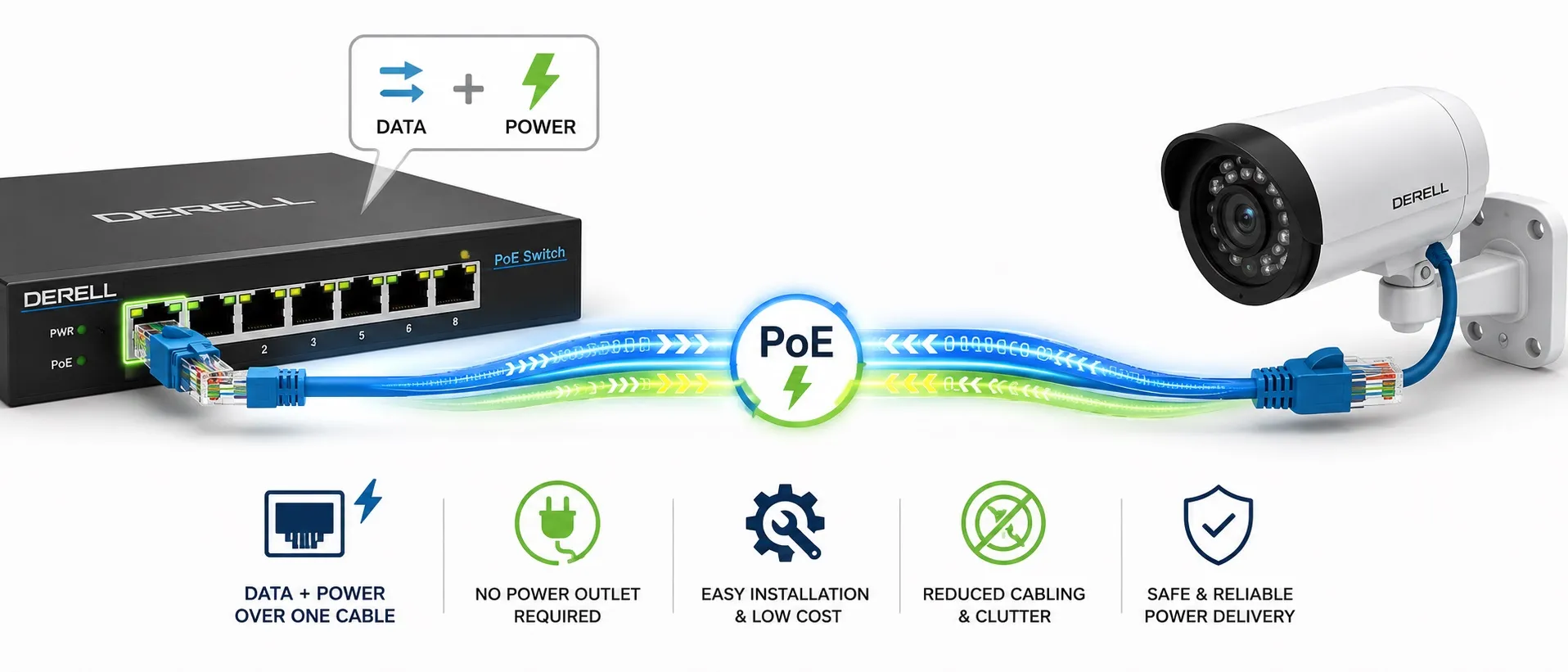
Power over Ethernet (PoE) is a technology that allows one Ethernet cable to carry both data and electrical power at the same time. Instead of running a separate power adaptor or separate DC wiring to the device, the network link can also provide power when the right PoE equipment is used. That is why PoE is so common with IP cameras, wireless access points, VoIP phones, access-control devices and selected industrial network endpoints.[1]
The practical way to think about it is simple: in a normal Ethernet connection the cable carries data; with PoE, the same Ethernet infrastructure is also used to feed power. So PoE is not a different communication protocol that replaces Ethernet. It is a power-delivery method built on top of Ethernet cabling.
How does PoE work?
A PoE system has two core roles: PSE and PD. PSE (Power Sourcing Equipment) is the side that delivers power, typically a PoE switch or a PoE injector. PD (Powered Device) is the device that receives that power, such as a camera or access point. In a standards-based PoE installation, the PSE first detects whether the far-end device is PoE-capable and then applies power according to the required class.[2]
This matters in the field because PoE is not the same as “putting voltage on an RJ45 cable and hoping it works.” A standards-based PoE port is controlled. Especially around industrial PLC, HMI and edge devices, you should confirm whether the device is actually designed as a PoE PD instead of assuming that every Ethernet port accepts PoE input.
Why is PoE so popular?
The biggest advantage is obvious: one cable does two jobs. The same cable can carry data traffic and electrical power, which simplifies installation and reduces separate field wiring. That is especially useful for devices mounted on ceilings, poles, walls or remote points where pulling mains or DC power can be awkward or expensive.
In industrial and building-automation work, the benefit is not only fewer cables. When endpoints are powered from a central PoE switch, remote restart, structured power budgeting, central backup strategy and port-by-port management can also become easier. That is useful in SCADA, data logging and IIoT environments where many small edge devices must be deployed and supervised.
What are the main PoE standards?
The most familiar standards are IEEE 802.3af, IEEE 802.3at and IEEE 802.3bt. In practice they are usually discussed like this:
| Standard | Common name | PSE output | Usable power at PD | Typical use |
|---|---|---|---|---|
| 802.3af | PoE | 15.4 W | 12.95 W | VoIP phone, basic camera, small access point |
| 802.3at | PoE+ | 30 W | 25.5 W | Higher-power AP, PTZ camera, terminal |
| 802.3bt Type 3 | PoE++ | 60 W | 51 W | Advanced camera, stronger AP, thin client |
| 802.3bt Type 4 | PoE++ / 4-pair PoE | 90 W | 71.3 W | Digital signage, higher-load endpoints, special terminals |
The key engineering point is that a product label saying “30 W PoE” often refers to the source-side rating. The endpoint does not necessarily receive that full amount. Cable losses and the defined PoE class matter, so selection should always consider PSE output and usable PD power together.[3]
What kinds of devices can run on PoE?
The classic examples are IP cameras, access points, VoIP phones and access-control terminals. In industrial settings the range can include small gateways, environmental monitoring nodes, data-collection terminals and selected communication devices. The important question is not simply “Does it have Ethernet?” but “Is it designed as a PoE-powered device?”
For example, a PLC family may support Ethernet communication without accepting power through that Ethernet port. The same logic applies to HMI panels, network cameras and some sensor devices. Look for phrases such as PoE, IEEE 802.3af/at/bt, PD class or PoE input in the datasheet instead of making assumptions from the connector alone. Depending on the project, the decision also links naturally with the wider sensors and power-supply branches inside OtomasyonAVM.
PoE switch vs PoE injector
A PoE switch combines switching and power delivery in one central device. A PoE injector adds power into an existing Ethernet line as a separate inline unit. If you have several field devices and want one clean central platform, a PoE switch is usually the neater solution. If you already have a standard Ethernet switch and only need PoE for one or two endpoints, an injector can be the simpler retrofit choice.
This should not be confused with the usual switch-versus-hub question. Traffic forwarding is one function; power delivery is another. A non-PoE switch may handle Ethernet data perfectly while delivering no electrical power at all.
Why do cable quality and cable length still matter?
Because PoE still depends on Ethernet cabling, cable quality and channel length remain important. In many twisted-pair copper Ethernet installations, the familiar design limit is 100 metres, but the real outcome also depends on cable category, conductor quality, temperature, connector quality and power draw. So it is possible to have a link that still passes data while the power margin becomes poor at the far end. That is why PoE should be considered together with the Ethernet cable types and maximum cable length topics.
Outdoor camera runs and industrial edge installations make this even more relevant. PoE may work on Cat5e, but longer runs, tougher environments or higher power classes can justify better cable choice and better installation discipline.
Does PoE work with every Ethernet device?
No. Having an Ethernet port does not automatically mean the device can be powered by PoE. A PLC, HMI or network terminal may use Ethernet only for communication while taking power from a separate adaptor, 24 VDC line or internal supply. PoE requires both sides to support the relevant power-delivery arrangement.
Two field mistakes are common here. The first is assuming that “Ethernet port = PoE power input.” The second is using passive adaptors carelessly. Passive arrangements may not follow the standard detection and classification process, so using them with the wrong device can lead to unreliable or unsafe results. A standards-based IEEE PoE design is the safer path in most cases.
Is PoE the same as EtherCAT P?
No. They are different ideas. PoE is a general Ethernet power-delivery method. As shown in the EtherCAT vs traditional Ethernet discussion, EtherCAT builds a different real-time process-data model for industrial control. EtherCAT P is an EtherCAT-specific concept that combines communication and power distribution in the EtherCAT ecosystem. It should not be treated as the same thing as PoE.[4]
For the same reason, PoE should not be mixed conceptually with EtherCAT security or with real-time motion performance. PoE is a power-delivery method; it is not a real-time control feature or a functional-safety mechanism.
When is PoE the right choice, and when is it not?
PoE is a very good choice when a small endpoint must be mounted at a remote or awkward location: ceiling-mounted APs, corridor cameras, access terminals or data-collection nodes are classic examples. It reduces wiring complexity and can make maintenance cleaner.
But it is not something to force into every project. High-power drives, standard panel equipment and systems that already have a robust local DC distribution do not automatically benefit from PoE. In some cases, insisting on PoE just because it sounds neat can make the design more expensive and more restrictive than it needs to be.
Quick field checklist
| Question | Why it matters | What to check |
|---|---|---|
| Is the device a PoE PD? | An Ethernet port alone is not enough. | Datasheet, device label, manual |
| How much power is required? | This decides whether PoE, PoE+ or PoE++ is needed. | Watt rating, power class |
| Is the cable run suitable? | Voltage drop and link quality both matter. | Cable category, channel length, connector quality |
| PoE switch or injector? | The project layout and scale affect the best choice. | Endpoint count, central-management need |
| Standards-based or passive? | This affects compatibility and safety margin. | IEEE 802.3af/at/bt support |
| Was network security considered? | Easy field access should not mean uncontrolled field access. | Segmentation, port access, cabinet security |
Conclusion
PoE is a practical way to strengthen Ethernet installations. Carrying both data and power over the same cable can reduce installation effort and simplify endpoint deployment. It is especially valuable for cameras, wireless access points, terminals and other distributed edge devices. But not every Ethernet device is PoE-ready, and the correct design depends on power class, cable quality and real product compatibility.
The right engineering habit is to verify PoE compatibility, check the required power, review the cable route and use standards-based equipment. Inside OtomasyonAVM, this topic becomes more useful when read together with the main Ethernet guide, cable types, network security, EtherCAT comparison, remote data access and industrial cybersecurity pages.
Related OtomasyonAVM guides
• What is Ethernet?
• How does Ethernet work?
• Ethernet cable types
• Maximum Ethernet cable length
• Ethernet speeds
• Switch vs hub
• Ethernet network security
• Protocols operating over Ethernet
• EtherCAT vs traditional Ethernet
• What is a datalogger?
• Remote access to datalogger data
• Industrial communication
Technical references
[1] IEEE 802.3 Ethernet Working Group — PoE standard family overview. IEEE 802.3
[2] Cisco — What is PoE? General overview of PSE/PD and detection logic. Cisco PoE
[3] FS glossary — summary of PoE, PoE+ and PoE++ power levels. PoE Overview
[4] EtherCAT Technology Group — EtherCAT technology and the distinction around EtherCAT P. ETG Technology