
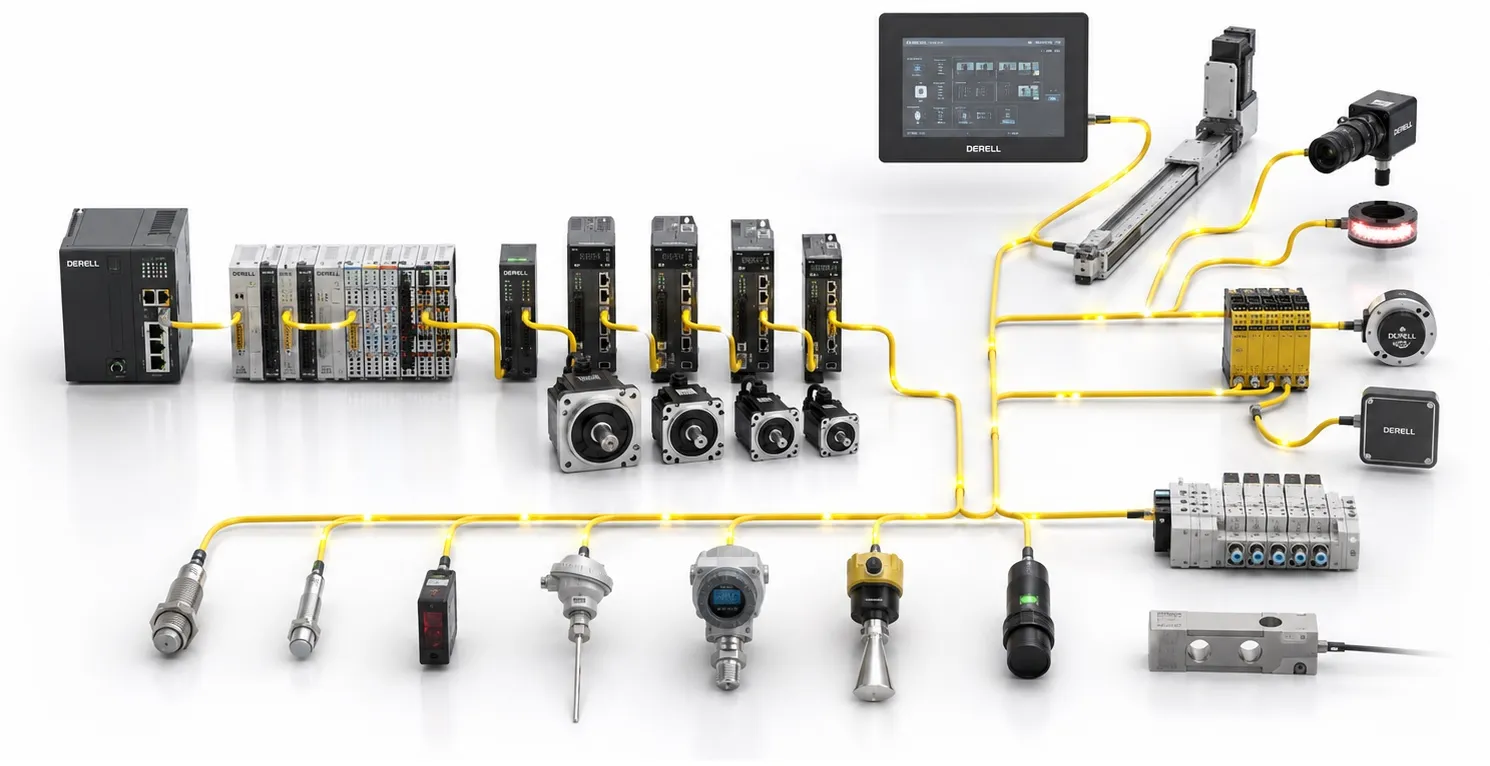
Which devices and sensors can be integrated with EtherCAT?
A useful answer is much broader than a list of products with an EtherCAT connector. Servo drives, remote I/O, encoders, measurement instruments, safety devices, robots, gateways and many other device classes can participate in an EtherCAT system. Standard industrial sensors can participate too, even when they have no EtherCAT interface of their own. A 24 V proximity switch, 4–20 mA pressure transmitter or Pt100 normally reaches EtherCAT through an appropriate I/O or measurement terminal.[1]
Start with the signal, not the bus name. An NPN/PNP sensor needs a digital input. A 4–20 mA transmitter needs a current-input channel. A Pt100 needs an RTD input. An incremental encoder needs a counter/encoder interface. Only a native EtherCAT device is described directly by ESI, PDOs, EtherCAT states and optional DC/FSoE functions.
Three integration paths cover most real machines
| Path | Typical device | What the EtherCAT MainDevice sees |
|---|---|---|
| Native EtherCAT SubDevice | Servo drive, remote I/O, EtherCAT encoder, measurement unit, safety I/O | ESI, PDOs, ESM state, WKC and optional DC/FSoE functions |
| Via EtherCAT I/O | NPN/PNP sensor, 4–20 mA transmitter, Pt100, thermocouple, pulse encoder | The I/O terminal is the EtherCAT SubDevice; the sensor remains a conventional field device |
| Via gateway / another fieldbus | Modbus, CANopen, IO-Link, AS-i or proprietary device | The gateway appears as the EtherCAT SubDevice; downstream devices keep their original protocol |
The current ETG Product Guide contains more than 1000 submitted entries and explicitly separates product families such as servo drives, VFDs, I/O systems, sensors, encoders, gateways, operator interfaces and functional-safety devices. ETG also notes that the guide still does not contain every available EtherCAT product.[2]
Servo and motion systems are a natural EtherCAT use case
Servo systems are one of the clearest examples of native EtherCAT integration. Cyclic PDOs can carry command and feedback values while Distributed Clocks can align multiple axes. That makes EtherCAT attractive in industrial robotics, CNC, packaging, printing, winding and synchronized motion systems.
OtomasyonAVM also has a concrete product branch rather than only theory: its INVT EtherCAT servo systems section lists EtherCAT-capable DA200 configurations, and the 750 W DA200 EtherCAT servo set is a model-level example. The point is not that every servo is EtherCAT-compatible; it is that compatibility should be proven at the exact series and product-code level.
Remote I/O is what connects most ordinary sensors to EtherCAT
Most sensors in a machine do not need their own EtherCAT controller. A remote I/O or modular EtherCAT terminal turns conventional field signals into the distributed process image. Digital input modules accept 24 V switching signals; analog modules accept voltage or current; dedicated terminals read RTDs, thermocouples, encoder pulses and other measurement interfaces.
This is where the breadth of OtomasyonAVM's sensor content becomes useful. The same EtherCAT controller can receive data from pressure sensors, inductive sensors, temperature sensors, capacitive sensors, linear position sensors and encoders—provided the I/O interface matches the actual electrical signal.
Proximity and switching sensors usually enter through digital I/O
A conventional inductive, capacitive or photoelectric sensor typically produces an NPN/PNP, NO/NC or two-wire switching signal. It does not plug into the EtherCAT cable. It connects to a 24 V digital input channel; the EtherCAT network carries the state of that input channel in the process image.
This distinction makes troubleshooting much cleaner. If the sensor LED changes but the PLC bit does not, check sensor supply, output type, terminal wiring, PDO mapping and WKC in sequence instead of calling every failure an “EtherCAT problem.”
Pressure, flow, level and other transmitters usually use analog I/O
A pressure transmitter with 4–20 mA or 0–10 V output can be brought into EtherCAT through a matching analog input terminal. The same architecture works for flow, level, humidity, force and many other process measurements. The OtomasyonAVM guide to 0–10 V and 4–20 mA signals is therefore directly relevant to an EtherCAT design even though the sensor itself may have no EtherCAT interface.
Converting the signal into an EtherCAT PDO does not automatically make the measurement accurate. Input range, terminal resolution, sensor scaling, engineering units, isolation and sample timing still have to be engineered.
Pt100 and thermocouples need measurement terminals, not EtherCAT connectors
The temperature-sensor family includes RTDs and thermocouples that are normally wired to dedicated input hardware. The terminal converts resistance or thermoelectric voltage into a digital process value and the EtherCAT network transports that value to the controller.
This keeps the layers clear: sensor physics, measurement electronics, EtherCAT communication and the temperature-control application are four separate parts of the chain. The controller or process-control layer should not be blamed for a cold-junction, wiring or calibration error.
Encoders can be native EtherCAT devices or conventional feedback devices
The official ETG product guide includes native EtherCAT absolute and multiturn encoders, position transducers and other measurement products. Conventional encoders, however, may produce A/B/Z, SSI or another feedback format and enter the EtherCAT system through an encoder terminal or a servo drive. Both are valid architectures.[3]
That is especially relevant when reading OtomasyonAVM's encoder catalog: a standard incremental encoder does not have to be a native EtherCAT SubDevice to be useful in an EtherCAT machine. The correct question is which interface reads the encoder and how its value is mapped into the process image.
PLCs, motion controllers and IPCs normally sit on the MainDevice side
A PLC, motion controller or industrial PC can act as the EtherCAT MainDevice, but an ordinary Ethernet port is not sufficient evidence. The actual CPU, interface option or runtime must provide the EtherCAT MainDevice stack and the required device-count, timing, DC, mailbox and diagnostic functions.
The separate programming languages and tools guide explains how TwinCAT, CODESYS, SOEM, EtherLab and commercial stacks fit that role. The MainDevice is responsible for far more than sending frames: it configures devices, manages ESM states, schedules process data and validates transactions.
HMI and SCADA often belong above the EtherCAT field segment
An HMI or SCADA system does not have to be an EtherCAT SubDevice. In many machines, the PLC/IPC runs the EtherCAT field network while visualization and reporting access the controller through standard Ethernet, OPC UA, ADS or another supervisory protocol. Native EtherCAT operator interfaces exist, but they are a specific product choice rather than a rule.
This separation is usually sensible: motion and fast I/O remain in the deterministic field network, while visualization, recipes, files and reports use a higher-level data network.
VFDs, steppers, valve islands and pneumatic systems can also be native SubDevices
ETG's product categories explicitly include variable-frequency drives, stepper systems, I/O and valve systems. So a VFD, stepper drive or pneumatic valve manifold can join EtherCAT directly when the exact model implements an EtherCAT interface. Otherwise it can be controlled through I/O or a gateway.[4]
The exact suffix and option matter. A drive family can contain a standard serial/Modbus version and a different EtherCAT version under a very similar model name.
Safety devices use FSoE when safety communication is required
E-stops, light curtains, guard switches, safe encoders, safety I/O and safe drive functions can participate through Safety over EtherCAT (FSoE). A standard safety switch does not need to be an FSoE device itself; it may be wired to an FSoE safety-input terminal. Conversely, some scanners, drives and safe encoders implement FSoE directly.[5]
FSoE is functional-safety communication, not general cybersecurity and not an automatic SIL/PL rating for the whole machine. The distinction is covered in the EtherCAT security and industry-standards guides.
Vision systems need a more careful definition of “integration”
High-bandwidth camera images are often better carried on a dedicated standard-Ethernet vision network. EtherCAT can still handle trigger signals, encoder position, lighting control and inspection results with deterministic timing. Where EoE is supported, standard Ethernet frames can be tunnelled through EtherCAT mailbox communication, but the camera does not thereby become a cyclic EtherCAT SubDevice.[6]
So when a specification says “vision integrated with EtherCAT,” determine whether that means native EtherCAT, deterministic trigger I/O, a gateway, or ordinary Ethernet access through another layer.
Gateways keep existing machines useful
The ETG product guide lists EtherCAT gateways for Modbus, CAN, AS-i, IO-Link and many other networks. The gateway is the EtherCAT SubDevice; the downstream equipment remains on its original bus. This can be a practical migration path when a machine contains valuable legacy devices that do not justify replacement.[7]
A gateway does not erase the timing limits of the slower side. A Modbus polling interval, serial response delay or IO-Link cycle still contributes to end-to-end response time.
OtomasyonAVM can be read as an integration map, not just a product list
The site already separates the engineering problem into useful branches: controller-side content under PLCs, operator-side content under HMI and SCADA, motion under servo/step/CNC, and sensing under separate pressure, inductive, temperature, capacitive, encoder and linear-position sections.
That makes the EtherCAT design path concrete: physical quantity → sensor output → suitable I/O/drive/gateway → EtherCAT PDO → PLC or motion application. The protocol page can therefore lead naturally into the site's deeper measurement and control material instead of becoming an isolated definition.
Six checks before calling a device “integrated”
1) Is the device native EtherCAT or connected through I/O/gateway? 2) For a native device, do the ESI, Product Code and Revision match? 3) Does the MainDevice support the required PDO/mailbox profile? 4) If synchronization matters, is the required DC mode actually supported and configured? 5) If safety is required, is FSoE genuinely implemented? 6) For conventional sensors, are signal type, scaling, resolution and sample timing correct?
An EtherCAT logo without those answers is not enough. Official conformance testing is valuable evidence, but application compatibility still has to be verified for the exact product and required function.[8]
Related EtherCAT and OtomasyonAVM guides
• What is EtherCAT?
• How does EtherCAT work?
• EtherCAT MainDevice–SubDevice communication
• EtherCAT topology
• EtherCAT real-time performance
• EtherCAT technical specifications
• EtherCAT programming languages and tools
• Sensors
• Servo systems
• PLCs
• Industrial communication
Technical references
[1] EtherCAT Technology Group — EtherCAT implementation and SubDevice architecture. Implementation
[2] EtherCAT Technology Group — Product Guide; more than 1000 listed entries across drives, I/O, sensors, gateways, safety and other product classes. EtherCAT Product Guide
[3] EtherCAT Technology Group — native EtherCAT encoders, position sensors, flow/pressure instruments and other sensor products in the Product Guide. Sensors / Encoders
[4] EtherCAT Technology Group — Product selection categories include servo drives, VFD/VSD, stepper, I/O, valves and gateways. EtherCAT Product Selection
[5] EtherCAT Technology Group — Safety over EtherCAT (FSoE). FSoE
[6] EtherCAT Technology Group — Ethernet over EtherCAT (EoE) tunnels standard Ethernet frames through EtherCAT mailbox communication. EoE
[7] EtherCAT Technology Group — gateway products for integration with multiple industrial networks. Gateways
[8] EtherCAT Technology Group — conformance testing and official EtherCAT Test Centers. Conformance