
What versions of EtherCAT are available?
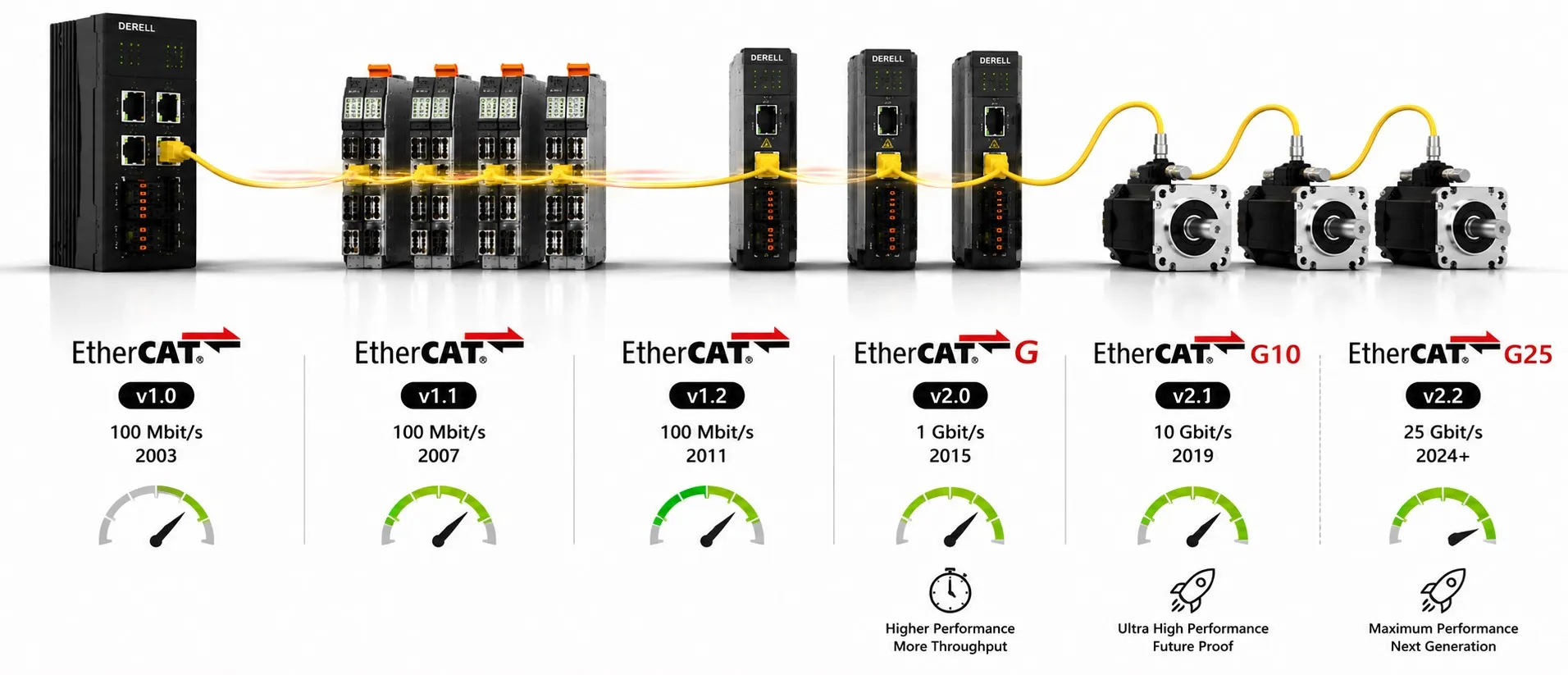
What versions of EtherCAT are available? The word version is slightly misleading here. EtherCAT has not progressed through a consumer-style sequence such as “EtherCAT 1, EtherCAT 2, EtherCAT 3”. The core protocol remains EtherCAT, while ETG has added speed extensions, a powered physical layer, functional-safety communication and factory-networking specifications. In practical engineering terms, the important names are classic 100 Mbit/s EtherCAT, EtherCAT G, EtherCAT G10, EtherCAT P, Safety over EtherCAT (FSoE) and, for a different network level, EtherCAT Automation Protocol (EAP).[1]
That classification avoids a common mistake: EtherCAT G/G10 are extensions of the core protocol; EtherCAT P changes the physical layer to add power; FSoE adds safety-related communication; EAP addresses controller/machine networking. They are not interchangeable “releases” of one product generation.[2]
| Technology | Rate / purpose | What actually changes? | Should it be called a new EtherCAT version? |
|---|---|---|---|
| EtherCAT | 100 Mbit/s | Core real-time EtherCAT technology | Baseline technology |
| EtherCAT G | 1 Gbit/s | Higher-rate extension; branch architecture for mixed-rate networks | Better described as a technology extension |
| EtherCAT G10 | 10 Gbit/s | 10-Gbit/s level of the EtherCAT G architecture | Extension, not “EtherCAT 3.0” |
| EtherCAT P | 100 Mbit/s + power | Physical layer adds two 24-V supplies to the same four-wire cable | No; protocol technology is the same as EtherCAT |
| FSoE | Functional safety | Safety-related communication layer | No; it is not a speed generation |
| EAP | Controller / machine networking | Services for MainDevice-to-MainDevice and factory networking | No; it serves a different network level |
Classic EtherCAT is still the baseline, not a retired first generation
The established EtherCAT field network commonly uses 100BASE-TX at 100 Mbit/s full duplex. Its defining behavior is not simply that line rate; SubDevices process data on the fly, Distributed Clocks provide precise timing, and the logical process image is handled through EtherCAT mechanisms such as FMMUs and SyncManagers.[1]
Calling it “EtherCAT v1” suggests that it has been superseded. It has not. A large current ecosystem of servo drives, I/O, encoders and control equipment continues to use 100 Mbit/s EtherCAT. G/G10 extends the architecture without making that installed base obsolete.
EtherCAT G raises bandwidth to 1 Gbit/s
EtherCAT G carries the EtherCAT communication concept to 1 Gbit/s. ETG describes it as an extension of standard EtherCAT in which the protocol itself and its main features are retained. It targets applications where process-data volume per participant is high, such as machine vision, high-end measurement and complex motion.[3]
Its branch concept is just as important as the faster link. EtherCAT Branch Controllers can attach independent 100 Mbit/s EtherCAT segments to the gigabit network and process those branches in parallel. Existing standard-rate SubDevices therefore remain useful instead of forcing a plant-wide hardware replacement.[3]
EtherCAT G10 takes the same extension to 10 Gbit/s
EtherCAT G10 provides the 10-Gbit/s level of the same architecture. ETG and Beckhoff describe G and G10 together: on-the-fly processing, flexible topology, diagnostics and Distributed Clocks remain part of the EtherCAT system. A G10 backbone does not silently convert a legacy 100 Mbit/s SubDevice into a 10-Gbit/s endpoint.[3]
That point matters when reading latency or performance figures: the speed benefit is strongest where serialization time and large data volumes matter, while device conversion time and control-loop dynamics remain separate.
There is no official G25 generation in the current ETG material reviewed for this page
Current ETG technology material and the EtherCAT G documentation reviewed for this article identify EtherCAT G at 1 Gbit/s and EtherCAT G10 at 10 Gbit/s. They do not list an official EtherCAT G25 technology generation. For that reason this page does not present “G25 / 25 Gbit/s” as a released EtherCAT version.[3]
The same caution applies to labels such as “EtherCAT v1.0, v1.1, v1.2, v2.0”. ETG documents do have version numbers, but those numbers identify document revisions. They are not a public device-generation ladder comparable to USB 2.0/3.0.
EtherCAT P changes wiring, not the EtherCAT protocol
EtherCAT P combines 100 Mbit/s EtherCAT communication with power on the same four-wire cable. ETG is explicit that EtherCAT and EtherCAT P are identical in protocol technology; the addition is confined to the physical layer. Two electrically isolated, switchable 24-V supplies can feed system/sensor and peripheral/actuator loads.[4]
So EtherCAT P should not appear in a table as “the next faster version”. It solves cabling and power-distribution problems. For distributed sensors, I/O or actuators, that can be more valuable than increasing bandwidth.
FSoE is a safety layer, not a protocol generation
Safety over EtherCAT (FSoE) carries safety-related communication and is defined in the ETG.5100 family and IEC 61784-3 CPF 12. ETG continues to maintain enhancement documents for FSoE; for example, its current download list shows a 2026 release of ETG.5120 protocol enhancements.[5]
That still does not make FSoE “EtherCAT Safety version 2”. It is a functional-safety protocol layer. Nor is it a replacement for industrial cybersecurity, and its presence alone does not establish the SIL of the complete machine.
EAP belongs to factory networking rather than the SubDevice cycle
EtherCAT Automation Protocol (EAP) defines communication services for MainDevices and Ethernet-based devices on a standard Ethernet network. ETG lists uses such as MainDevice-to-MainDevice communication, configuration-tool interfaces and monitoring. The timing requirements are weaker than the high-performance SubDevice field cycle and can target millisecond-range plant communication.[6]
EAP is therefore a different architectural tool, not a drop-in “new EtherCAT fieldbus version”. It belongs in the wider industrial communication picture.
Document versions matter — but they are not network generations
ETG's current 2026 download index shows the core ETG.1000 EtherCAT Specification as release v1.0.4. The complementary ETG.1020 EtherCAT Protocol Enhancements is listed as v1.6.0, released June 5, 2026. The ETG.2200 SubDevice Implementation Guide is listed as v3.2.3, released March 6, 2026.[7]
These numbers track specification and guidance documents. They do not mean that a machine “runs EtherCAT 3.2.3”. Device capabilities are determined by the actual ESC, firmware, ESI, product revision and supported feature set.
| Official document | Release visible in 2026 | Purpose |
|---|---|---|
| ETG.1000 | v1.0.4 | Core EtherCAT specification, Parts 1–6 |
| ETG.1020 | v1.6.0 — 2026-06-05 | Protocol enhancements complementary to ETG.1000 |
| ETG.2200 | v3.2.3 — 2026-03-06 | SubDevice implementation guidance |
| ETG.5100 / 5120 | FSoE family; ETG.5120 v1.4.0 — 2026-08-21 | Safety over EtherCAT and safety-protocol enhancements |
Can a 100 Mbit/s SubDevice be used in an EtherCAT G machine?
Yes, provided the network is designed with the appropriate EtherCAT Branch Controller and MainDevice support. The G/G10 branch concept was created specifically so established 100 Mbit/s EtherCAT segments can coexist with higher-rate trunks. The SubDevice itself remains a 100 Mbit/s device; it does not negotiate up to gigabit speed.[3]
Real projects still need to check the MainDevice gigabit port, the chosen EBC, engineering-tool support and topology. The general device and sensor integration rules remain relevant.
Choose by requirement, not by the “newest” label
For most machine I/O and motion tasks, classic 100 Mbit/s EtherCAT remains the natural baseline. G/G10 becomes attractive when very large cyclic payloads, machine vision, high-end measurement or very large networks make serialization and propagation dominant. EtherCAT P is selected when wiring and distributed power are the problem. FSoE is selected when the safety function requires safe communication.
The engineering choice should therefore be based on data volume, cycle target, wiring, safety, installed equipment and cost. The neighboring guides on advantages, constraints and licensing and cost answer those parts separately.
How do you identify what an installed product actually supports?
Do not infer it from the EtherCAT logo alone. Check the product code, ESI XML, device revision, physical ports, mailbox protocols, Distributed Clocks support, FSoE capability and minimum cycle time. For G/G10 systems, also verify the gigabit port and branch-controller architecture.
This is particularly important in retrofit work. Two products can both be EtherCAT devices and still expose different PDOs, profiles or firmware behavior. The diagnostic guide and the page on industry standards provide the next checks.
Related EtherCAT guides
References
[1] EtherCAT Technology Group, EtherCAT Technology: https://www.ethercat.org/en/technology.html
[2] Beckhoff, EtherCAT technology and extensions: EtherCAT, FSoE, EtherCAT P and G/G10
[3] EtherCAT Technology Group, EtherCAT G – Communication at gigabit levels: EtherCAT G Technology Basics
[4] EtherCAT Technology Group, EtherCAT P: https://www.ethercat.org/en/ethercat-p.html
[5] EtherCAT Technology Group, Safety over EtherCAT / FSoE: ETG.5100 / FSoE resources
[6] EtherCAT Technology Group, ETG.1005 EtherCAT Automation Protocol (EAP): EAP specification
[7] EtherCAT Technology Group, Downloads / current specification releases: ETG.1000, ETG.1020, ETG.2200 and FSoE document revisions