
What is dynamic braking?
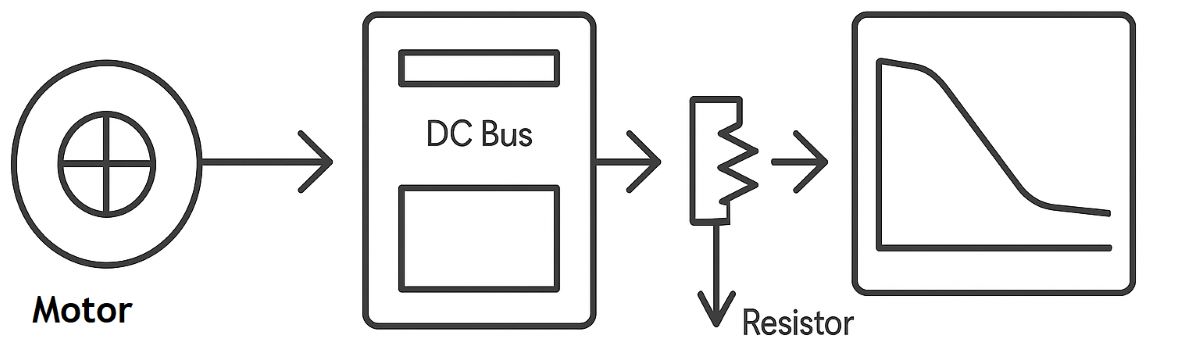
Dynamic braking, particularly in the context of AC motor systems and Variable Frequency Drives (VFDs), refers to a method used to slow down or stop a motor by converting the kinetic energy of the motor into another form, typically heat, which is then dissipated.
Here's how dynamic braking generally works in the context of AC motors and VFDs:
Deceleration: When a VFD needs to decelerate a motor faster than it would naturally coast to a stop, the VFD can use dynamic braking.
Regenerative Energy: During rapid deceleration, the motor can act as a generator. This means the motor (acting as a generator) produces electrical energy. This generated energy, instead of being sent back to the power source, needs to be dissipated or handled in some way, especially if the power source cannot absorb it.
Braking Resistor: One common method to handle this regenerative energy is to send it to a braking resistor, where the electrical energy is converted to heat. This braking resistor is sized appropriately to dissipate the generated heat without overheating. This method is known as "resistor-based dynamic braking."
Regenerative Drives: Another approach, particularly useful when energy recovery is beneficial, is to use a regenerative drive. These drives can feed the regenerative energy back to the mains (power source), instead of dissipating it as heat.
DC Injection Braking: This is another form of dynamic braking, where DC current is injected into the AC motor's windings to create a stationary magnetic field, which provides a braking force. This method is effective for short durations and can bring the motor to a near stop, but not a full stop.
In real-world applications, the critical factor in dynamic braking is the proper management of regenerative energy. If this energy is not dissipated or redirected correctly, it can cause DC bus overvoltage faults in the drive, potentially damaging both the VFD and the motor. This makes the braking circuit not just a performance feature, but a necessary protection mechanism.
When selecting a braking resistor, engineers must consider not only its resistance value but also its peak power rating and continuous thermal capacity. An undersized resistor may overheat quickly, leading to failures or fire hazards. Proper resistor sizing ensures that the generated energy is safely converted into heat without compromising system safety.
Typical applications that heavily rely on dynamic braking include high-inertia fan systems and downhill conveyor belts. In such scenarios, the motor frequently enters generator mode. Without a braking circuit, the motor could accelerate uncontrollably, posing serious mechanical and safety risks.
For systems aiming at energy efficiency, the use of regenerative drives is preferred. Instead of dissipating energy as heat, these drives feed it back to the grid. This not only reduces wasted energy but also lowers the thermal stress on the braking components, extending the overall lifetime of the system.
Finally, DC injection braking should only be applied for short-term stopping. Prolonged use can overheat the motor windings and reduce insulation life. From practical experience, for applications requiring frequent or heavy braking, resistor-based dynamic braking or regenerative solutions are the most reliable and sustainable methods.
Your shopping cart is empty!