
what is Analog to digital converter ?
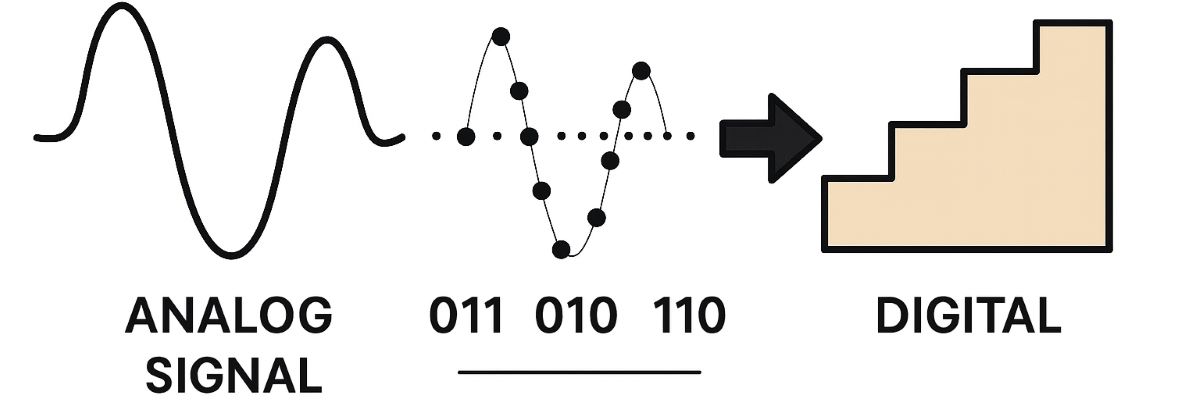
An analog-to-digital converter (ADC) is a device that converts an analog signal, such as a sound or voltage, into a digital representation, typically a binary code. This digital representation can then be processed by a computer or other digital device. ADCs typically work by sampling the analog signal at regular intervals, and then quantizing the amplitude of the signal at each sample point into a digital code. The process of converting analog to digital signals is called digitization. ADCs are widely used in electronic devices such as phones, computers, and audio equipment to convert analog signals into a form that can be processed by digital circuits.
What is analog-to-digital converter give examples?
An analog-to-digital converter (ADC) is a device or circuit that converts an analog input signal, such as a sound or voltage, into a digital output signal. This digital output can then be processed by a digital device, such as a computer.
Some examples of applications that use ADCs include:
Digital cameras: The sensor in a digital camera captures an analog image, which is then converted to a digital image by an ADC before being processed and stored.
Audio recording: An ADC converts the analog audio signal from a microphone into a digital signal that can be stored and processed on a computer.
Data acquisition systems: ADCs are used to convert the analog signals from sensors, such as temperature, pressure, or flow sensors, into a digital form that can be processed and analyzed by a computer.
Communications systems: ADCs are used to convert the analog signals in a communications system, such as a telephone system, into a digital form that can be transmitted over a digital network.
Examples of devices that use ADCs:
- Smartphones
- Computers
- Audio equipment
- Measurement instruments
- Scientific instruments
- Medical imaging systems
These are some examples, ADC can be found in many electronic devices that need to process analog signals.
What is ADC and its types?
An analog-to-digital converter (ADC) is a device or circuit that converts an analog input signal, such as a sound or voltage, into a digital output signal. This digital output can then be processed by a digital device, such as a computer.
There are several different types of ADCs, which can be classified based on the conversion method they use, their resolution, and their speed. Some common types of ADCs include:
Flash ADC: This type of ADC uses a large number of comparators, one for each possible digital output code. The input voltage is applied to all comparators simultaneously, and the comparator with the highest threshold that is still less than the input voltage produces the digital output. Flash ADCs are fast and have high resolution, but they are also relatively large and power-hungry.
Successive approximation ADC: This type of ADC uses a binary search algorithm to determine the digital output code. The input voltage is compared to the midpoint of the input range, and the next comparison is made to the midpoint of the range where the input voltage lies, and so on, until the digital output code is determined. Successive approximation ADCs are slower than flash ADCs, but they are also more compact and consume less power.
Sigma-delta ADC: This type of ADC uses a high-frequency signal to oversample the input signal, and a digital filter to reduce the signal back to its original frequency band. Sigma-delta ADCs have high resolution and relatively low power consumption, but they are also relatively slow.
Dual slope ADC: This type of ADC works by integrating the input signal for a fixed period of time, then applying a known reference voltage to discharge the integrator, and measuring the time required to do so. Dual slope ADC are often used in measurement application where high accuracy is required.
Pipeline ADC: This type of ADC uses multiple stages of conversion for the input signal. Each stage performs a lower resolution conversion of the input, allowing for a higher overall resolution. Pipeline ADC are also relatively slow due to the multiple stages involved.
These are just some examples of different types of ADCs, there are more kind of ADC depending on the specific application, such as integrating ADC, ramp type ADC, etc.
Analog-to digital converter circuit
Analog-to-digital converter (ADC) circuits typically consist of several main components: an input stage, a clock generator, a comparator or quantizer, and a digital output stage.
Input stage: The input stage is typically a differential amplifier or a buffer amplifier that amplifies the analog input signal to a level that can be handled by the ADC. This stage also provides impedance matching between the input signal and the ADC.
Clock generator: The clock generator produces a high-frequency clock signal that is used to control the sampling rate of the ADC. This clock signal is used to synchronize the different stages of the ADC and to determine the conversion time.
Comparator or quantizer: This is the heart of the ADC, the comparator or quantizer compares the amplified input signal to a set of reference voltages, and assigns a digital code to the input signal.
Digital output stage: This stage converts the digital code generated by the comparator or quantizer into a parallel or serial digital output signal, depending on the specific ADC design.
Depending on the type of ADC, the circuit may also include additional components, such as a sample-and-hold circuit, a reference voltage generator, or a digital filter.
For example, in a flash ADC, the input signal is applied to a large number of comparators, one for each possible digital output code. The comparator with the highest threshold that is still less than the input voltage produces the digital output.
In a successive approximation ADC, the input signal is compared to the midpoint of the input range using a comparator, if the input signal is greater than midpoint, the upper half of the range is eliminated and the process repeated again with the lower half of the range. This process is repeated until the digital output is determined.
A sigma-delta ADC uses a high-frequency signal to oversample the input signal, and a digital filter to reduce the signal back to its original frequency band.
In general, the exact circuit for an ADC will vary depending on the specific type of ADC and the requirements of the application it is being used for.
Your shopping cart is empty!