
what is Carrier frequency for vfd?
Dear colleagues, hello
A variable frequency drive (VFD) is a type of electronic device that is used to control the speed of an electric motor. It does this by adjusting the frequency of the power supplied to the motor. The frequency of the power supplied to the motor is known as the "carrier frequency."
The carrier frequency of a VFD is typically in the range of 0.5 to 16 kHz. This frequency range is chosen because it allows the VFD to control the motor speed over a wide range, while minimizing losses due to the skin effect and eddy currents.
The carrier frequency of a VFD can be adjusted to optimize the performance of the motor for a given application. For example, a higher carrier frequency may be used to achieve higher speed or torque, while a lower carrier frequency may be used to reduce losses and increase efficiency.
In an inverter, the carrier frequency is the frequency of the pulse width modulated (PWM) signal that is used to control the switching of the inverter's power transistors. The carrier frequency determines the switching speed of the inverter, and it is usually in the range of several kilohertz to several tens of kilohertz.
The carrier frequency of an inverter is an important parameter because it determines the efficiency and performance of the inverter. A higher carrier frequency allows the inverter to switch the power transistors faster, which can improve the dynamic response. However, a higher carrier frequency also generates more switching losses and electromagnetic interference (EMI), which can reduce reliability.
Therefore, the carrier frequency must be carefully chosen to balance performance and efficiency.
What is the difference between fundamental frequency and carrier frequency?
The fundamental frequency is the lowest frequency of a periodic waveform, also called the base frequency or first harmonic. It is the frequency at which the waveform repeats itself, and it defines the pitch of a sound wave.
The carrier frequency, on the other hand, is the frequency of a radio wave that is used to carry information. It is typically much higher than the highest frequency of the information signal. The carrier frequency is modulated with data (voice or signal) and acts as the reference for the modulation process.
In short: the fundamental frequency is a characteristic of the waveform, while the carrier frequency is a characteristic of the transmission medium. One defines the signal itself, the other defines how it is delivered.
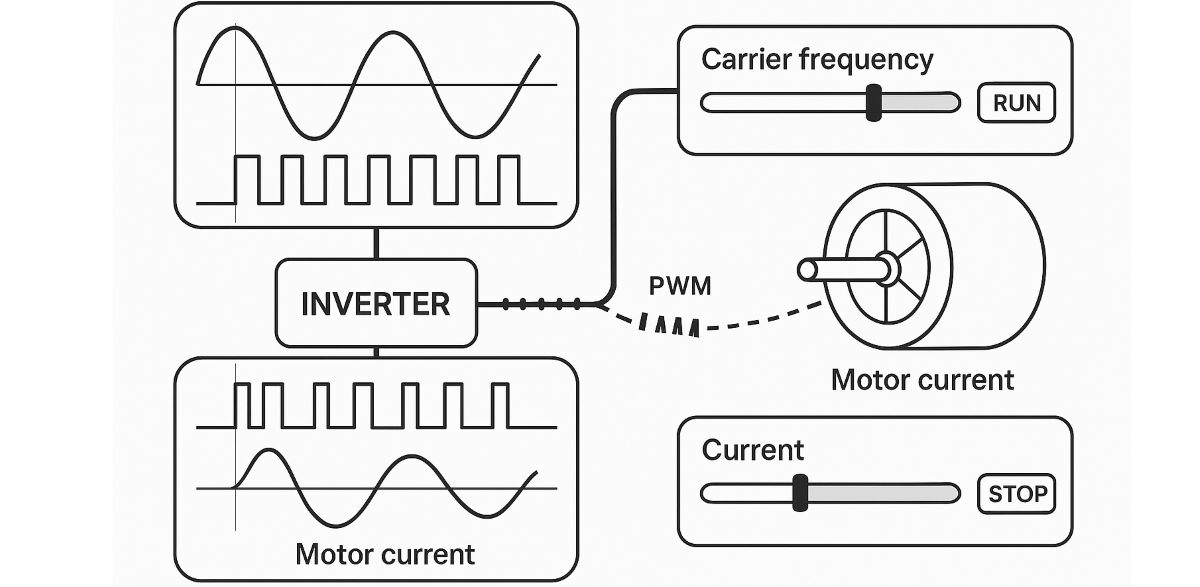
When setting carrier frequency in VFDs, always consider the impact on thermal management. Higher switching frequency means more heat. If the drive cooling is insufficient, the system will fail over time.
Another factor is acoustic noise. At low carrier frequencies, motors often emit a distinct whining sound. By raising the carrier frequency, this noise can be pushed out of the human hearing range, providing silent operation.
With higher carrier frequencies comes stronger EMI. This can affect nearby sensors and communication systems. Engineers must pay attention to shielding and filtering when choosing high frequencies.
Most industrial setups run at a mid-range carrier frequency to balance efficiency, noise reduction, and system stability. Too low causes noise, too high increases losses. The best choice is usually the balance point.
My final advice: don’t only rely on datasheet values. Test your VFD under real load conditions. The right carrier frequency is the one that provides stable operation, acceptable noise, and long-term reliability for your specific system.
Your shopping cart is empty!