
What is Capacitive Sensor?
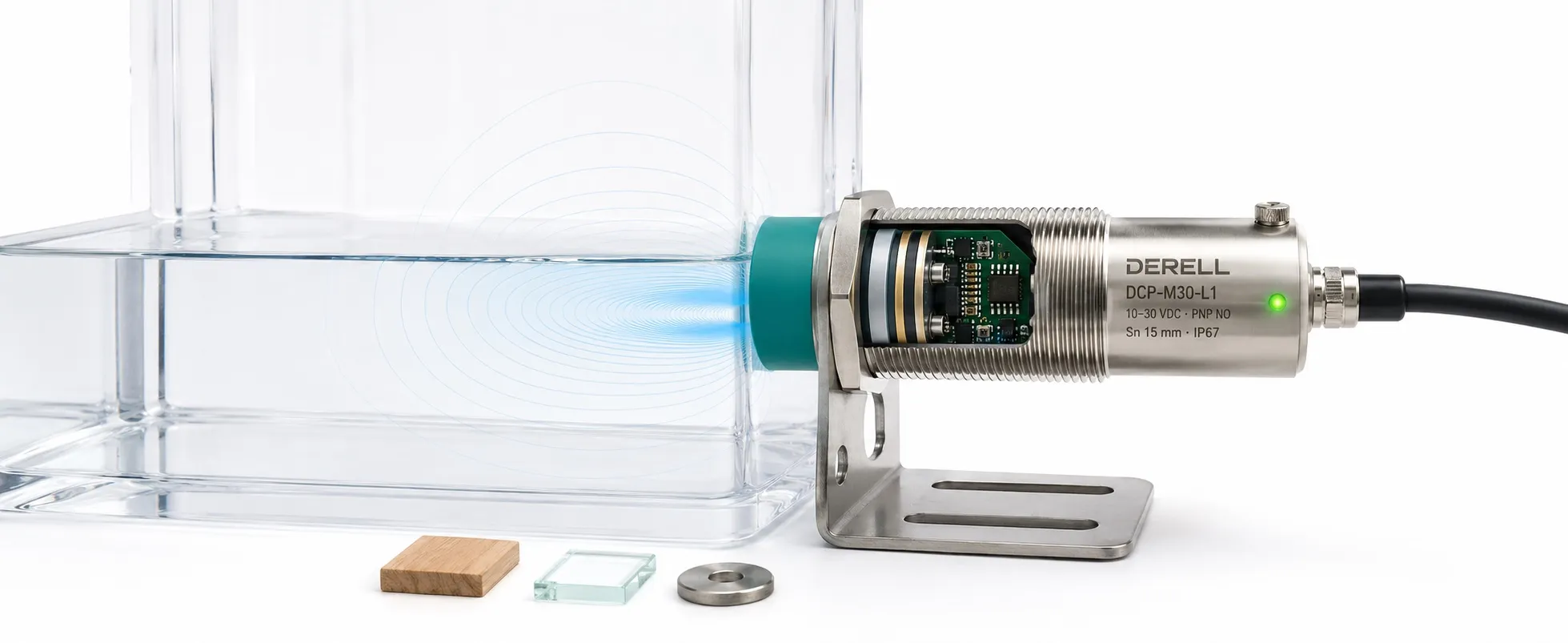
Detecting more than metal without contact
Capacitive sensors detect objects or a particular fill level by evaluating changes in electrical capacitance around their active face. Common targets include plastic, glass, wood, paper, powders, granules and liquids. They can detect metals too. Where the task is simply to detect metal, an inductive sensor is often a more suitable starting point.
How does a change in the electric field produce an output?
The sensing electrode and its surroundings behave like a capacitor. An approaching target changes the capacitive coupling; the electronics evaluate this change and switch the output when the set threshold is crossed. A conductive target can be understood as a counter-electrode, while an insulating target changes the dielectric conditions within the field. A plastic target does not have to conduct electricity to be detected.
In an ideal parallel-plate capacitor, capacitance increases with area and relative permittivity and decreases as plate spacing increases. A proximity sensor does not have that same ideal field geometry. This relationship is not a direct distance calculation for every target. Selecting the right method involves comparing sensing technologies.
What determines the sensing distance?
Target material, size, position and mounting surroundings all matter. Dielectric properties are particularly important for insulating materials; changing moisture content in wood or granules can change their detection behavior. The nominal distance in a datasheet applies to the stated reference target and test conditions. There is no universal 4 cm maximum for all capacitive sensors. Establish the working distance from the selected model's specifications and an application test.
Editor's note: “It does not detect at 2 mm but does at 1 cm” is not a general rule of capacitive sensing. If that happens, check target alignment with the active face, adjustment, nearby metal and electrical connections. The responses of two targets with different sizes or materials cannot be compared by distance alone. Start by testing the same target along the same approach direction with an unchanged setting.
Detecting liquid through a plastic tank wall
A suitable sensor can detect liquid from outside an electrically insulating tank wall. Its adjustment must distinguish the empty vessel wall from the additional effect of the liquid. Wall thickness, wall material, the liquid and deposits affect the result. This does not mean an ordinary capacitive sensor can see through a metal tank.
The sensor stays fixed in this diagram. As the liquid reaches its sensing height, the example normally open output becomes active. Start runs the demonstration; Stop returns it to the initial state. This is point level detection, not continuous measurement of the entire tank level. The diagram is not to scale and does not represent a particular model's response time.
Sensitivity adjustment and PLC connections
Models with a potentiometer or teach-in function should be adjusted using the actual target and final mounting arrangement. Excessive sensitivity can make moisture, dirt or nearby objects cause unwanted switching. Hysteresis means that the operate and release thresholds differ, reducing repeated output changes close to the switching boundary.
PNP and NPN outputs must match the receiving input circuit. NO/NC describes the output logic when a target is detected; it is a separate choice. With two-wire sensors, leakage current and voltage drop also require consideration. Before connecting to a PLC input, check the model's wiring diagram, supply range and output load, then select a suitable power supply. An appropriate interface relay may be needed for a higher load.
Switching and precision measurement are different tasks
Common capacitive proximity switches provide presence or absence information; their outputs do not directly report a distance in millimeters. The wider capacitive sensing family also includes analog devices and dedicated displacement measurement systems. Their calibration and measuring ranges cannot be applied to ordinary proximity switches. A fixed claim such as “every capacitive sensor changes by 1 V per 100 micrometers” is incorrect.
Selection should consider mounting clearances, switching frequency and environmental conditions as well as housing size and sensing distance. Assess the IP protection rating, temperature limits and chemical resistance together. During commissioning, compare the sensor indication with the receiving input state. Test both target-present and target-absent conditions, including the contamination and material variations expected in production.
Related sensor topics
Photoelectric detection; ultrasonic sensors; fiber optic sensing; laser sensors; sensor types; NAMUR sensors and their interfaces.
Control and electrical connections
How a PLC works; remote I/O connections; smart relay applications; industrial power supplies; how relays work; IP protection ratings.