
Faq for Memory
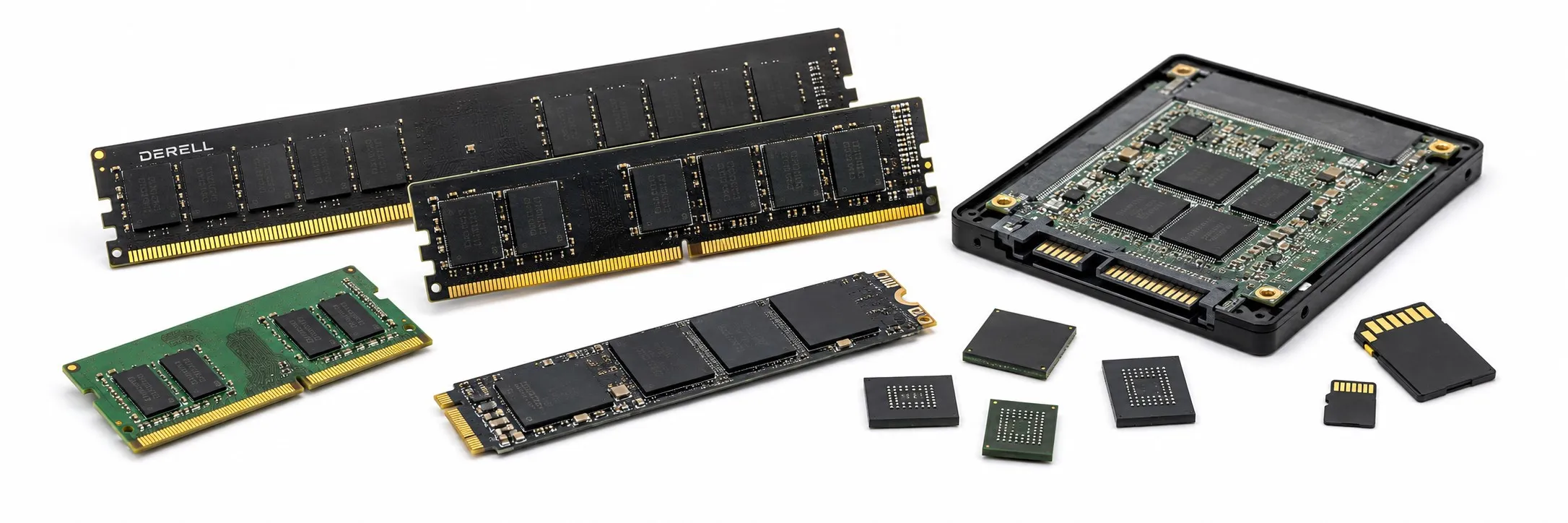
Choose memory around the data it must hold
Firmware, live measurements, settings and event logs place different demands on electronic memory. Choosing a technology means asking how long the data must survive, how often it changes and how quickly it must be accessed. This guide connects those requirements to the main memory families.
Volatile memory needs power to preserve its contents; ordinary SRAM and DRAM are examples. Non-volatile memory, including flash, EEPROM, FRAM and MRAM, retains data without continuous power. That does not mean unlimited storage life: retention depends on the device and its operating conditions.
Start with RAM and ROM if you are learning the basics. For stored settings, compare flash with EEPROM. For frequently updated counters and logs, explore endurance and data-loss mechanisms. Capacity alone does not determine whether a memory device suits the job.
Working memory: RAM, DRAM and SRAM
What is RAM and how does it work?
Addressable reads and writes for working data.
How do DRAM and SRAM differ?
Refresh requirements, cell structure, speed and density.
ROM technologies and rewritable storage
What is ROM, and which types exist?
Read-only memory and different ways of programming it.
What is mask ROM?
Memory whose contents are established during manufacture.
What is PROM, and how is it programmed?
User-programmable memory that cannot subsequently be erased.
What is one-time programmable memory?
Non-erasable cells and permanent configuration data.
What distinguishes EPROM from other memory types?
UV erasure and reprogramming in windowed EPROM devices.
How does flash memory differ from EEPROM?
Erase granularity, small-data updates and write operations.
What separates NOR flash from NAND flash?
Addressing, code execution and high-density storage.
Other approaches to retaining data without power
What is MRAM, and what advantages does it offer?
Magnetic data storage and application-specific characteristics.
What is ferroelectric RAM, or FRAM?
Ferroelectric storage, write energy and endurance.
What is NVRAM, and where is it used?
A non-volatility concept covering more than one cell technology.
An industrial example: firmware, settings and counters
A controller's firmware may change rarely, a calibration setting only during service, and a cycle counter continuously. Those values do not necessarily need the same non-volatile write schedule. Counter storage must balance save frequency, endurance and acceptable loss after an interruption. A PLC's retained-variable behaviour also depends on its hardware, configuration and the kind of restart or power interruption.
Selection, reliability and future developments
Where are different memory technologies used?
Program code, settings, working data and logs.
How do capacity and speed trade off?
Latency, bandwidth and interfaces as well as capacity.
How can memory power consumption be reduced?
Active operations, standby behaviour and retention conditions.
How are memory endurance and reliability assessed?
Write endurance, data retention and temperature conditions.
What causes memory data loss?
Power loss, interrupted writes and other failure mechanisms.
Where is memory technology heading?
Density, energy, endurance and emerging cell technologies.
You may share this content with attribution to Otomasyon AVM. For a specific device, check capacity, voltage, interface, endurance and retention in the manufacturer data sheet.
Technical references: Microchip — Memory features · Microchip — EEPROM endurance (PDF) · Texas Instruments — FRAM and data integrity
Refine Search
- How are the durability and reliability of memory types evaluated?
- How is power consumption optimized in semiconductor memory types?
- How is the balance between storage capacity and speed maintained in memory technologies?
- What are the differences between DRAM and SRAM?
- What are the general applications of different memory types?