
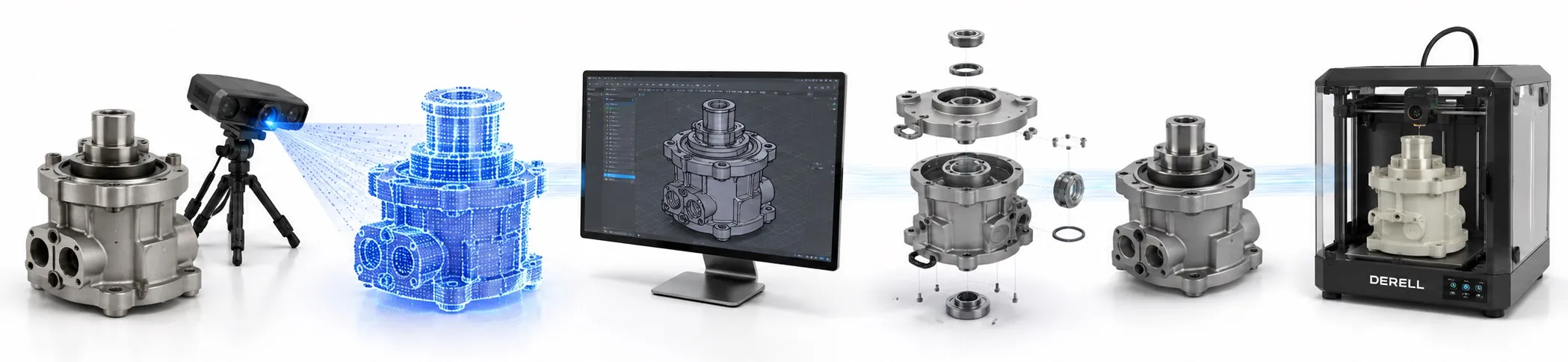
Working backwards from a product to its design
Reverse engineering examines an existing device, circuit, mechanism or program to establish how its parts fit together and how it works. Conventional development moves from requirements to a design and then a product. Reverse engineering starts with the product and reconstructs useful technical knowledge. Missing documentation is a common reason to do it, but not a requirement.
The result might be a schematic, connection list, interface description or functional specification. Taking photographs or identifying components is only a starting point. The value lies in an explanation that can be checked against the real system. Understanding a product and making a copy are separate objectives.
What problems does it solve?
Keeping older equipment serviceable. When a manufacturer no longer supports a board, documenting its inputs, outputs and behaviour can help a team choose between repair and replacement. For a PLC system, first look for program backups, electrical drawings and manufacturer manuals. Existing evidence can save substantial investigation time.
Understanding interfaces and failures. A legacy sensor output or undocumented device interface may need investigation. Reverse engineering asks how the system works; failure analysis asks why it stopped working. The two can support one another, but a repair does not always require reconstruction of the entire design.
Examining software behaviour. Analysts may investigate data flows, file formats and unexpected functions. In an authorised industrial cybersecurity assessment, this can help explain defects and identify behaviour that warrants further investigation.
Making sense of an electronic board
Record the board before changing it. Capture both sides, component markings, connector orientation and revision identifiers. Identify the power, processing, input, output and communication sections. Match integrated circuit markings to manufacturer datasheets. Two parts sharing a package are not necessarily interchangeable.
Build a connection map. Visible tracks and continuity measurements help establish connections. A reading from a multimeter can be affected by components elsewhere in the circuit; apparent conductivity does not always prove a direct copper connection. Internal layers of a multilayer PCB are hidden from ordinary surface inspection. Specialist investigations may use X-ray imaging or computed tomography to examine them.
Establish what the components do. Resistors may form a divider, diodes may provide rectification or protection, and capacitors may filter a supply. An optocoupler may transfer a signal; a MOSFET or IGBT may switch power. These are possible roles. A component name alone does not prove the circuit function.
Check behaviour under suitable test conditions. Record which relay responds to an input, the timing involved and what happens when power is lost. An appropriately selected oscilloscope or logic analyser can provide voltage and timing information. Energised measurements require equipment and competence appropriate to the hazards. Resistance and continuity tests belong on de-energised circuits with stored energy safely removed.
Evidence has limits
| Observation | What it establishes | What remains unknown |
|---|---|---|
| Visible PCB tracks | Some of the connections. | Hidden layers and all component values. |
| An RS-485 interface | Information about the physical communication layer. | The protocol, addresses and meaning of the data. |
| Matching output in one test | Similar behaviour under that condition. | Equivalence and reliability elsewhere. |
Communication and firmware are different investigations
RS-485 does not establish that a device uses Modbus. The physical interface, serial settings, message structure and data meanings are distinct layers of information. In an authorised investigation, compare messages with controlled input changes and confirm the relationship at several values. One captured packet cannot establish an entire protocol.
Firmware is the software running inside the device. Program code may reside in Flash memory, while parameters may use EEPROM or another type of non-volatile memory. The arrangement depends on the product. Obtaining memory contents does not necessarily recover the original source code or an editable development project.
Disassembly represents processor instructions. Decompilation attempts to produce a higher-level, source-like representation. Compilation may discard comments, names and other information about the designer's intent. An analysis output is not a complete restoration of the original project.
Example: Replacing an undocumented input board
Suppose an investigation traces part of a connection from a terminal, through an optocoupler and towards a processor. That still leaves the operating voltage, switching threshold, filtering delay and response to a broken wire unresolved. A functional replacement needs these characteristics measured and recorded in a specification.
If the board works intermittently, investigate physical faults such as a cold solder joint. Keep intended operation separate from faulty behaviour, otherwise a replacement could reproduce the wrong behaviour. Boards that look identical may also have different hardware or firmware revisions.
The role of AI and intellectual property
AI and machine learning can assist with reading markings, organising images and classifying analysis notes. They cannot establish a hidden connection from a photograph that does not show it. An AI-generated schematic remains a proposal until measurements verify it.
The legal position depends on the jurisdiction, product, licence and contractual obligations. WIPO distinguishes information acquired through independent development or reverse engineering from the unlawful acquisition of confidential information. That distinction does not itself authorise manufacturing a patented product, copying protected code or disregarding a contract.
Technical references: NIST — software reengineering · ISTFA — PCB analysis and X-ray tomography · NSA — Ghidra software analysis · WIPO — trade secrets and contracts