
What is an integrated circuit?
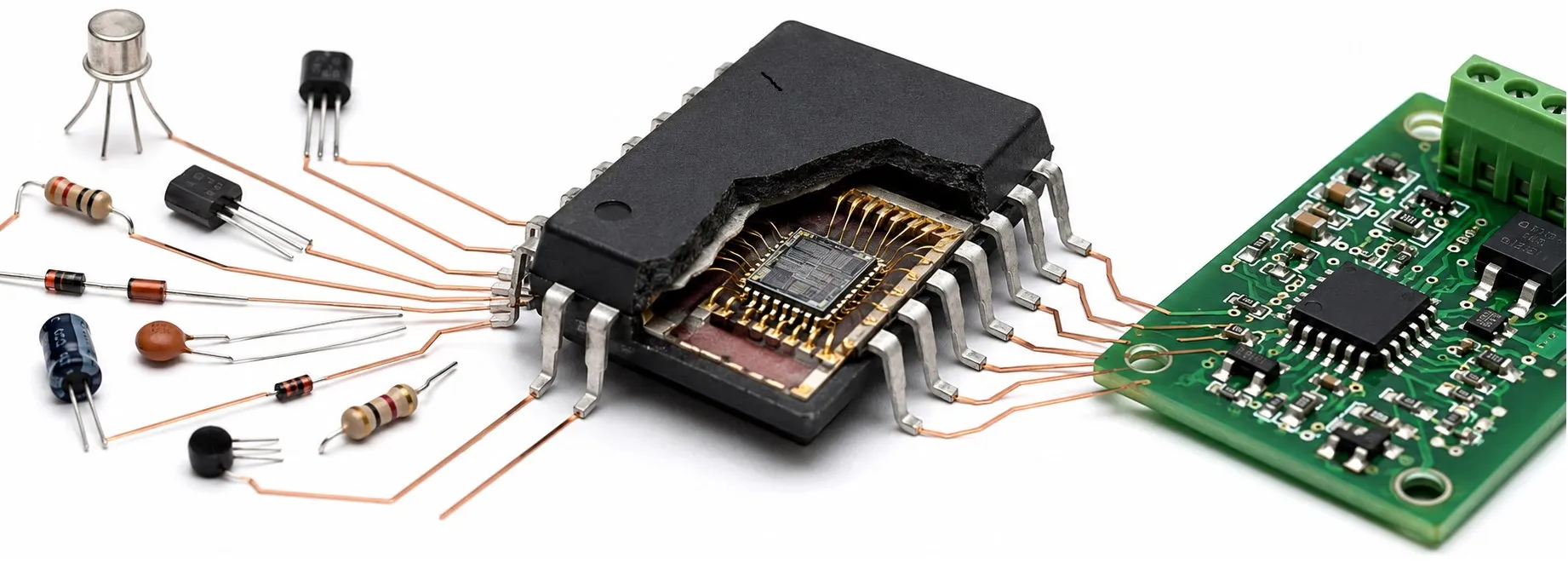
What is an integrated circuit?
An integrated circuit, abbreviated IC, brings electronic circuit elements and their interconnections together on a very small semiconductor structure. The everyday terms chip and microchip refer to this technology. Silicon is the most common base material, although other semiconductors are also used for different applications.
An IC can contain transistors, diodes, resistors and capacitors. These are generally formed on the semiconductor during manufacturing and connected through conductive layers, rather than assembled as separate components side by side. Amplification, computation, data storage and power management can therefore take place within a compact structure.
An integrated circuit does not have to be a processor. A small voltage regulator, a logic gate and an advanced processor containing many processing units can all be integrated circuits.
Analog, digital and mixed-signal ICs
ICs are classified by the signals they handle and the functions they perform. Analog signals can take continuously varying values within an operating range. Digital circuits process information using defined logic states; in the common binary system, these are represented as 0 and 1.
| Type | Main function | Example |
|---|---|---|
| Analog | Amplifies or processes continuously varying signals. | Operational amplifier, voltage reference. |
| Digital | Performs logic operations, processes or stores data. | Logic gate, memory, processor. |
| Mixed-signal | Combines analog and digital functions. | ADC, DAC, some sensor interfaces. |
| Power and driver | Regulates a supply or drives a load. | Regulator, motor driver, LED driver. |
An ADC converts analog information into digital numbers; a DAC converts digital values into an analog output. These categories can overlap: Power management describes a function, and a power IC may contain analog, digital or mixed-signal circuitry.
Chip, package and module: what is the difference?
The semiconductor die is the small piece of material on which the circuit is manufactured. The package protects the die, provides connections to the external circuit and helps remove heat. The body visible on a circuit board is usually this package. A package may contain one die or multiple dies.
A module often combines ICs, supporting components and connections on a board or within a subsystem. For example, an RF module may include an antenna connection and passive components alongside its communication IC. A chip, a package and a module describe different levels of a product's construction.
How is an integrated circuit manufactured?
Manufacturing begins on a semiconductor disc called a wafer. Thin material layers are formed, and photolithography transfers patterns into a light-sensitive layer. Processes such as etching, controlled doping and the formation of conductive interconnect layers are repeated as required by the circuit structure. Photolithography is an important manufacturing step, rather than the name of the entire process.
Many dies can be produced on one wafer. After electrical testing, the dies are separated, assembled with suitable packages and connections, and tested again. The process depends on the material, circuit type and manufacturing technology. A power IC and an advanced digital processor have different manufacturing requirements.
What do DIP, SOIC, QFN and BGA mean?
These names generally describe the package format. DIP is common in through-hole assembly, while SOIC and QFP are examples of surface-mount packages with protruding leads. Packages such as QFN have connection pads underneath or at the edges. BGA uses solder balls on the underside. Consequently, not every IC has long metal leads visible outside its body.
The pinout, pin-one orientation and any underside thermal pad must be checked in the datasheet. Two ICs with the same dimensions and pin count may have different functions and connection arrangements. The package name alone does not tell you what a component does.
Microcontrollers, microprocessors and SoCs
A microcontroller combines a processor core with memory and peripherals such as timers, communication interfaces and input/output circuits. It can read a sensor, control a motor or manage a device's operating sequence.
A microprocessor focuses on processing and often works with external memory and other supporting circuits. A system on chip — SoC integrates a processor and various subsystems more extensively. The terms can overlap depending on the product; a microcontroller can technically be a form of SoC.
“System on chip” does not mean that no surrounding components are needed. Additional parts may still be required for power, connections and timing. For example, a crystal oscillator, or a ceramic resonator in a suitable design, may be used in the clock circuitry. Clock frequency affects timing, but processing speed depends on more than this value.
What do ICs do on automation boards?
Preparing sensor signals: The small current from a photodiode can be converted into a measurable voltage by an amplifier IC. An ADC digitizes that value, and the control circuit makes a decision from the result. Sensing, measurement and processing can therefore be shared across different ICs.
Managing inputs and outputs: Inside a PLC, input interfaces, a processor, memory and output drivers work together. Optocouplers can provide electrical isolation where required. An appropriate driver stage is used to operate components such as a relay or an external MOSFET; a processor pin cannot directly supply every type of load.
Controlling supplies and loads: Switching regulator ICs can convert voltages with suitable inductors and capacitors. LED drivers manage lighting current, while motor drivers control motor current through an appropriate power stage. An IC's function should be understood together with its surrounding circuit.
A brief history and Moore's Law
Jack Kilby demonstrated a working integrated circuit at Texas Instruments in 1958. At Fairchild Semiconductor, Robert Noyce developed an approach integrating circuit elements and their interconnections on silicon in 1959. These developments played a foundational role in smaller electronic systems and the growth of mass production.
In 1965, Gordon Moore projected a trend in the increasing number of components on integrated circuits; the version associated with a two-year period became widely known later. This observation, called Moore's Law, is not a physical law requiring every IC's transistor count to double every two years. Transistor count alone does not determine processing speed, energy efficiency or suitability for an application.
Selecting or replacing an IC
Consider the complete part number, its variant suffix, pinout, supply range, input/output levels and operating temperature together. Even devices within the same family may have different memory, communication or output features. When replacing a programmed microcontroller, the ability to load the required firmware into the new device also matters.
The datasheet's recommended operating conditions and absolute maximum ratings mean different things. Maximum ratings are not targets for normal operation. Load current, power dissipation and the board's ability to remove heat must also be considered. A suitable replacement meets the required electrical and functional conditions, as well as fitting the package footprint.