
What is a voltage drop and why does it occur?
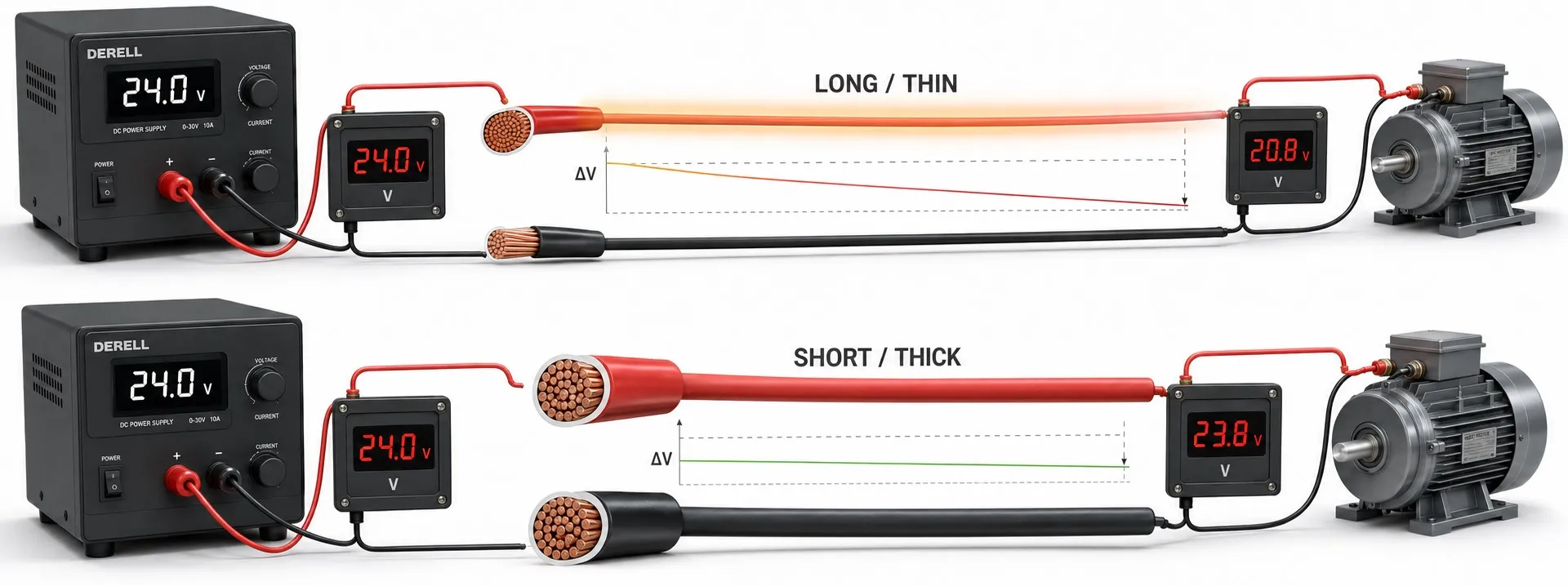
What causes undervoltage?
Undervoltage occurs when the voltage available at a supply point is below what the equipment or system requires. A reading of 180 V on a nominal 230 V supply is a clear example. The cable is only one possible cause: the incoming supply, transformer loading, motor starting and poor connections can also matter. Locate the problem and establish when it occurs before choosing a remedy.
Separate undervoltage from voltage drop
Voltage is an electrical potential difference. Undervoltage describes the level available at a point, while voltage drop along a feeder describes the difference between the source and the load. A short, generously sized cable cannot restore voltage that is already low at its source. If the source is normal and only a distant load is affected, the local circuit becomes a focus of investigation.
Nominal voltage is a reference value. The acceptable range depends on voltage standards, supply conditions and equipment specifications. One reading cannot establish the duration or cause of a disturbance. A brief voltage sag and a sustained low supply call for different assessments.
Illustration: normal supply, low voltage at the load
Select Start to cycle between two illustrative conditions; Stop / Reset restores the initial view. The lamp represents an incandescent load. Its colour change is symbolic, not a calibrated brightness curve. The 230 V and 180 V readings are examples, not a circuit calculation or a model for every lighting technology.
Where low voltage comes from
Long or undersized conductors: Cable resistance, and total impedance in AC circuits, combine with load current to create voltage drop. Voltage and current are distinct quantities. With fixed cable resistance, increasing current increases the drop immediately; the cable does not first need to heat up. A temperature-related rise in resistance is an additional effect.
Heavy loading and motor starts: Large loads sharing a supply, or the starting current of a directly connected motor, can depress voltage across source and feeder impedance. Loose, corroded or damaged connections can add both voltage drop and local heating. Installing a regulator does not repair the defective contact.
Upstream supply conditions: An inadequate supply, heavily loaded distribution feeder or transformer issue may affect several circuits. On a three-phase system supplying line-to-neutral loads, a broken neutral can cause some loads to receive low voltage and others excessive voltage. Lights dimming in one area while becoming unusually bright elsewhere warrant urgent investigation of the neutral.
Voltage fluctuations and harmonic distortion belong in a power-quality assessment, but harmonics are not the explanation for every low-voltage complaint. Recommending a harmonic filter without establishing the cause can leave the actual fault unresolved.
The response depends on the load
For a fixed resistive load, reducing voltage reduces both current and power; the power relationship is approximately P = V² / R. For an induction motor, starting torque is approximately proportional to voltage squared at the same frequency. A 20% voltage reduction leaves about 64% of the original starting torque. The motor may struggle to accelerate, prolonging the start and increasing the risk of overheating.
An electronic power supply may draw more input current to maintain output power within its permitted input range. Outside that range it may shut down or repeatedly restart. LED behaviour depends on the driver. Always check the equipment’s operating-voltage requirements before claiming that every device overheats on a low supply.
Find the location and timing of the fault
A qualified electrician compares voltage measurements at the incoming supply and the load using a suitable multimeter, noting load state and event timing. Current measurements require an appropriate ammeter or clamp instrument. Brief disturbances may need a recording power-quality analyser. Oscilloscope measurements on mains circuits require a suitable, safe measurement arrangement.
Normal input, low load voltage: Investigate the feeder, connections and load current. Low input voltage too: Investigate the upstream supply. Low voltage only during starting: Examine starting demand and source capacity together. Stop using a circuit showing burning smells, scorching or abnormal heating; do not tighten live connections.
Match the remedy to the cause
Correcting cable size or routing, repairing a connection, redistributing loads or choosing a suitable motor-starting method may address the problem. Assess the resulting circuit voltage distribution. A voltage regulator works within its specified input range and capacity; a UPS serves a different purpose. Neither repairs a loose connection or an open neutral.
Undervoltage does not mean a circuit is safe to touch. Low-voltage hazards and the risk of electric shock can remain. A durable solution comes from identifying the cause and restoring the supply conditions the equipment needs.