
What is a battery?
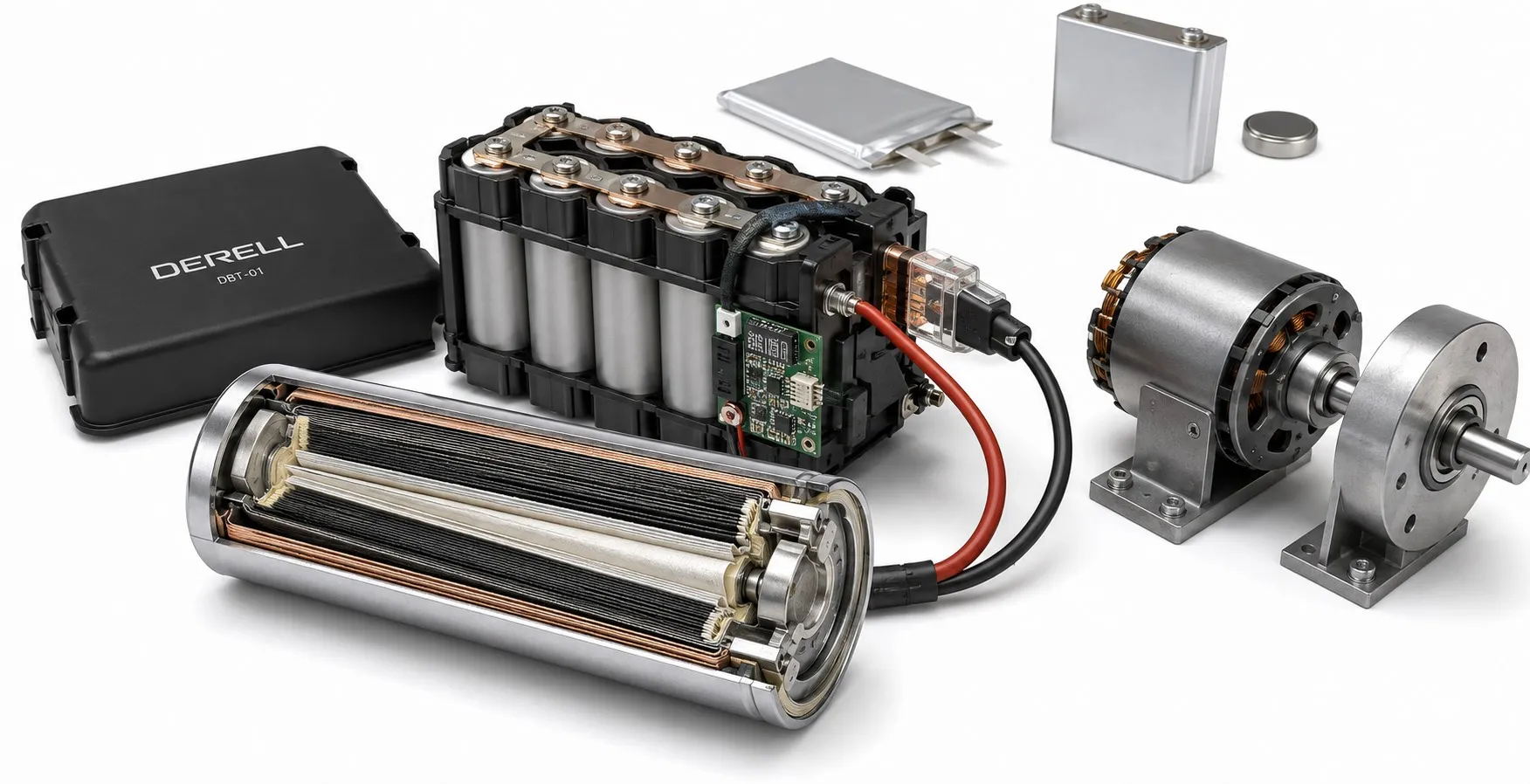
Cells that turn chemical energy into electrical power
A battery supplies electrical energy through electrochemical reactions that convert stored chemical energy. It does not store an electric current waiting to flow; energy is stored in the chemical state of its materials. Connecting a load allows suitable reactions to drive current through an external circuit. Battery types differ in chemistry, rechargeability, voltage and physical construction.
In everyday Turkish, the terms pil, akü and batarya overlap. A product name alone does not establish its cell count, voltage or rechargeability. When assessing batteries and chargers, use the chemistry, model identification and manufacturer's specifications on the product label.
Cells, accumulators and battery packs
A cell is the basic electrochemical unit. The Turkish term akü, or accumulator, refers to a rechargeable cell or assembly; it does not necessarily mean multiple cells or exclusively lead-acid chemistry. In common product usage, battery can describe both a single-cell product and an assembly of cells. Rules such as “a pil cannot be recharged” or “every battery must contain multiple cells” are therefore unreliable.
Describing a product as a cell, module or pack identifies its structural arrangement. In battery packs, cell interconnection, protection and terminals also matter. For example, a nominal 12 V lead-acid battery typically contains six cells of approximately 2 V nominal voltage each; this arrangement is not a universal template for all batteries.
How does a cell produce electricity?
A cell contains a positive electrode, a negative electrode and an electrolyte. In common constructions, a separator prevents direct electrode contact while allowing ions to pass. During discharge, electrons move through the external circuit and ions through the electrolyte. The chemical processes inside the cell and the electrical circuit supplying the appliance operate together.
During discharge, the negative electrode is the anode and the positive electrode is the cathode. In electrochemical terminology, oxidation occurs at the anode and reduction at the cathode. The reactions reverse during charging, although battery literature often retains the electrode-material names defined by discharge operation. When discussing both charging and discharging, positive and negative electrode are therefore clearer terms.
Primary and rechargeable batteries
Primary batteries are not designed for recharging in normal use. Common alkaline batteries, zinc-carbon batteries and many primary lithium batteries, such as CR2032 cells, belong to this group. The word “lithium” does not mean a product is rechargeable. Do not attempt to recharge a non-rechargeable battery.
Secondary batteries are designed to be recharged using a suitable method. NiMH and NiCd cells are examples. The absence of cadmium in NiMH does not make it environmentally harmless; service life and performance must be assessed against operating conditions.
Lithium-ion (Li-ion) cells are also rechargeable. Lithium iron phosphate, LiFePO4 or LFP, is a cathode chemistry within the lithium-ion family; it is not a completely separate top-level category. Differences between LFP and other lithium-ion chemistries matter for voltage and charging compatibility. Lead-acid batteries use different designs for engine starting, stationary backup and cycling applications; identical nominal voltage does not make every model interchangeable.
What do V, Ah, mAh and Wh tell you?
Volts (V) indicate voltage, Ah or mAh indicate electrical charge capacity, and Wh indicate energy. One Ah equals 1,000 mAh. Comparing batteries at different voltages without distinguishing Ah from Wh can be misleading. Approximate nominal energy is calculated as Wh ≈ V × Ah.
For example, a product rated at 3.6 V and 2 Ah represents approximately 7.2 Wh, while one rated at 12 V and 2 Ah represents approximately 24 Wh of nominal energy. Both being rated at 2 Ah does not mean they store the same energy. An Ah rating is not a maximum current rating. Continuous and short-duration current limits are specified separately; usable capacity depends on load, temperature and cutoff voltage.
With matched cells, series connections increase voltage and parallel connections increase Ah capacity. This does not mean arbitrary batteries can be combined. Chemistry, capacity, age, state of charge and protection compatibility are part of pack design.
Charging, battery management and operating conditions
Charging converts electrical energy supplied from outside the cell into chemical energy. The battery charger must suit the chemistry, number of cells in series, and voltage and current limits. Matching connectors or similar adapter voltage markings are insufficient. Rechargeability does not imply unlimited life: cells experience both use-related and calendar ageing.
Depending on its design, a battery management system (BMS) can monitor cell voltages, current and temperature, and provide protection and balancing. A BMS does not replace a suitable charger. Not every pack includes the same functions. For swollen, leaking or damaged products, seek the manufacturer's guidance instead of continuing use or charging. Send used batteries through a collection channel appropriate to their chemistry and prevent terminal short circuits during transport and storage.
Editor’s note: Equal size does not mean equal voltage. A 1.2 V AA NiMH cell and a 3.6/3.7 V lithium-ion cell of similar dimensions are not direct substitutes. When replacing a battery, check its chemistry, voltage, current limits, polarity and the model permitted by the equipment manufacturer, as well as its dimensions.
Related battery topics
Explore battery accessories, battery and accumulator standards, batteries used in electric vehicles, alkaline versus zinc-carbon and rechargeable batteries, and the difference between 1.2 V and 1.5 V cells.
Related topics in other categories
See uninterruptible power supplies (UPS) for backup systems, power inverters for supplying AC loads from DC energy, DC fuses for circuit protection, measuring battery voltage with a multimeter for checks, and the power supplies main page for other supply options.
Technical references
U.S. Department of Energy — battery operation, ion and electron movement.
Energizer — cell, battery, capacity and rechargeability terminology.
FAA — primary lithium-metal versus lithium-ion batteries.
U.S. Department of Energy — LFP cathode chemistry in lithium-ion batteries.
U.S. EPA — battery types, used batteries and separate collection.