
What are the limitations and challenges in current robotics technology?
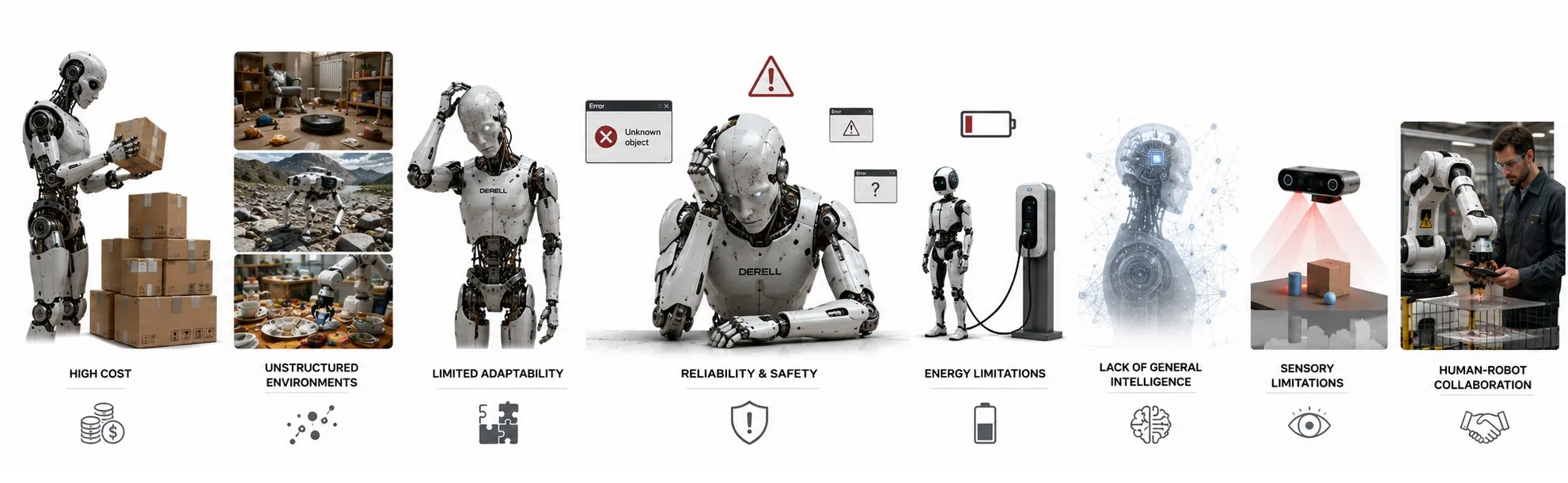
What makes reliable robotics difficult?
A robot can repeat a well-defined factory operation with impressive speed and consistency. The harder challenge is maintaining that performance when parts, surroundings and task conditions change. A fixed production cell and an untidy home place very different demands on a machine. The limitations of robotics therefore depend on the job, the hardware and the environment.
Successful operation requires perception, decisions and motion to work together. A strong individual component does not guarantee a reliable system. A better camera cannot correct an unsuitable gripper, and sophisticated software cannot eliminate mechanical play. The robot's components need to be assessed as an integrated whole.
1. Perception can fail under ordinary conditions
Reflective metal, transparent packaging, shadows, contamination and overlapping objects can make recognition and position measurement difficult. The effect depends on the sensing technology. A sensor's range, resolution and latency also matter. Correct recognition can still produce a missed target if camera-to-robot calibration is wrong.
2. Contact is more demanding than free movement
Picking up a rigid block is quite different from threading a flexible cable into a connector. Slippery, deformable or fragile objects require control of force, friction and changing shape. Too much gripping force can damage a product; too little can let it slip. Suitable sensing and actuation can help, but no single gripper suits every object and process.
3. Learned skills do not transfer automatically
A robot using artificial intelligence may perform well during training and struggle after the lighting, camera viewpoint or object arrangement changes. This is a generalisation challenge. Collecting representative data for robot learning is expensive. Simulation can reduce the burden, but imperfect models of friction, deformation and delay create a simulation-to-reality gap.
Understanding an instruction is another part of the problem. “Clear the table” leaves questions about which objects to move, where they belong and what must remain untouched. Turning an ambiguous request into dependable physical action requires perception and planning as well as language processing.
Why a successful action is not a successful mission
A simple illustration: Suppose a task requires 20 steps, each with a 99% probability of success. If the outcomes are independent and there are no retries, the probability of completing every step successfully is 0.9920 ≈ 81.8%. Raising individual step success to 99.9% gives 0.99920 ≈ 98.0%.
These are hypothetical calculations, not measured robot performance. Real failures can be correlated. The example shows why detecting mistakes, recovering safely and requesting assistance matter when a robot performs longer sequences.
4. Mechanical performance has several different limits
Repeatability describes how closely a robot returns to the same position. Absolute positioning accuracy describes how closely its actual position matches the requested coordinates. A machine can consistently return to the wrong point. Tool calibration, installation, loading and mechanical condition all deserve attention. Servo motors and feedback control do not remove the underlying mechanical constraints.
Payload capacity involves more than the product's mass: the gripper, centre of gravity, wrist moments and inertia limits also matter. Arms face reach and joint limits; humanoid robots must maintain balance; mobile systems must handle floors, access routes and localisation. For battery-powered robots, useful operating time depends on workload, travel, computation and charging arrangements.
5. Safe operation can constrain throughput
A robot designed for collaborative use does not automatically make an application safe. Sharp tools, workpieces and trapping points introduce their own hazards. Robot safety requires an application-specific risk assessment, appropriate protective measures and validated safety functions. The chosen safeguards may require reduced speed or force, which affects the achievable cycle time.
6. Deployment involves much more than the robot
The robot must work with the PLC, conveyors, cameras and production software. Programming and commissioning must address lost communication, failed picks and restart behaviour. Maintenance, spares, calibration, training and downtime contribute to total operating cost. Connected equipment also needs managed access and updates. Where cameras capture people, privacy and ethical responsibilities become part of deployment.
Technical references: NIST — Robot performance and validation · RSS — Generalisation under changing conditions · RSS — Contact and tool manipulation · Universal Robots — Application safety