
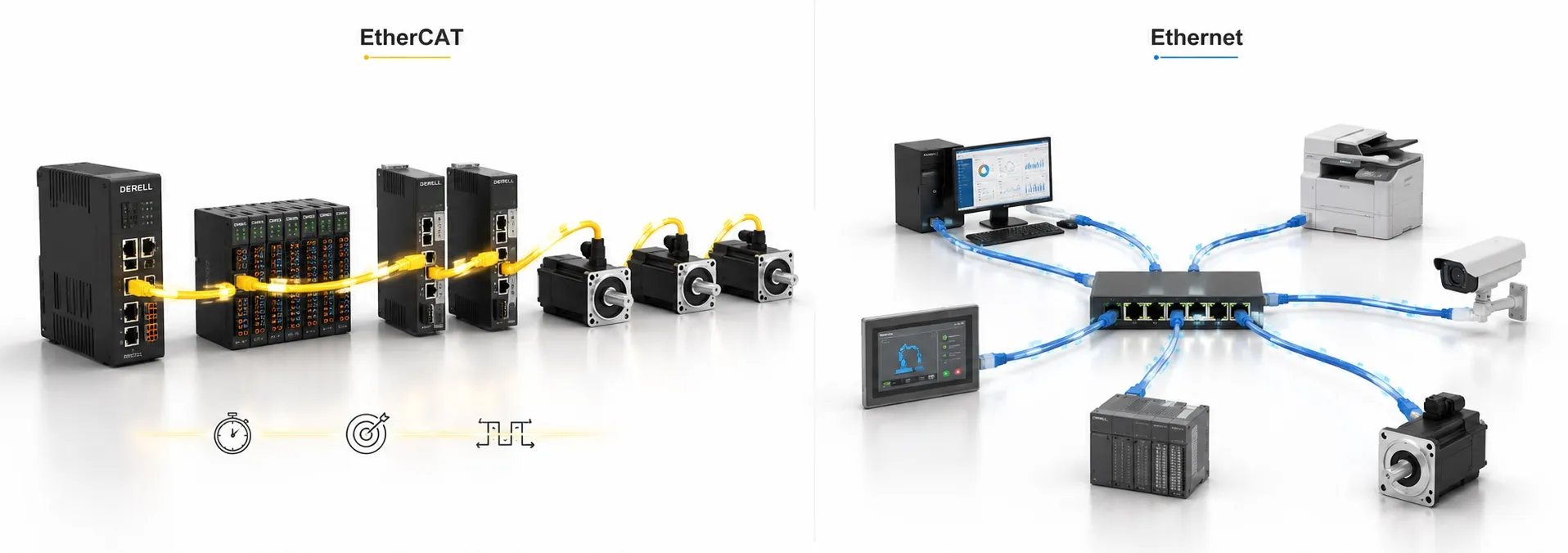
What are the differences between EtherCAT and traditional Ethernet?
EtherCAT and Ethernet are not two unrelated physical technologies. EtherCAT uses the standard Ethernet frame and Ethernet physical-layer technology, but it uses them with a communication model built for real-time machine control. Classic cyclic EtherCAT traffic can run directly in Ethernet frames identified by EtherType 0x88A4, while SubDevices process their assigned data as the frame passes. A general-purpose Ethernet LAN, by contrast, provides MAC-based frame transport between endpoints; IEEE 802.3 itself does not define a cyclic hard-real-time control schedule.[1][2]
A common comparison gets the layers wrong: it is not accurate to say that “Ethernet uses IP addresses while EtherCAT does not.” Ethernet itself uses MAC addressing at Layer 2. IP is a separate network-layer protocol that may run over Ethernet. Cyclic EtherCAT process data normally does not need an IP/TCP/UDP stack; EtherCAT uses its own station and logical addressing mechanisms. The MAC address and an IP address therefore answer different questions.
1. Different jobs: a general data network and a control network are optimized for different problems
Standard Ethernet is the foundation for general communication among computers, servers, cameras, printers, HMIs and many other devices. IEEE 802.3 defines MAC operation, Ethernet frame transport and a large family of physical layers. IP, TCP, UDP, HTTP, OPC UA, EtherNet/IP and countless other protocols can run on top of it.[3]
EtherCAT takes that Ethernet foundation and optimizes the field communication model for short control cycles, predictable process-data exchange and synchronized automation. An office LAN is therefore not simply a “slower EtherCAT,” and EtherCAT is not merely “faster normal Ethernet.”
2. Frame handling: forwarding packets versus processing a travelling process-data frame
In a general switched Ethernet network, a switch forwards frames according to destination MAC addresses. An endpoint receives the frame and its protocol stack or application processes the payload. Different switches may use store-and-forward or cut-through techniques, so it would be equally misleading to describe all ordinary Ethernet as software waiting for a complete packet at every device.
EtherCAT's cyclic field path uses a different model. One EtherCAT frame can contain process data for many SubDevices. The EtherCAT Slave Controller reads the bytes assigned to the local device and can insert response data while the frame is travelling through the node. ETG calls this processing on the fly. The design is particularly efficient when many devices exchange small amounts of cyclic I/O or motion data.[4]
3. A small process-data example
Consider an illustrative machine with 12 devices, each using 8 bytes of outputs and 8 bytes of inputs per cycle. The application payload is 12 × 16 = 192 bytes. EtherCAT can map the devices into datagrams carried by one or a small number of shared EtherCAT frames. A general Ethernet application that exchanges a separate small message with every endpoint can spend much more of the wire time on per-message headers and packet handling.
This does not mean an ordinary Ethernet application must send exactly 12 packets. Software can aggregate data, use multicast or choose a different application protocol. The real distinction is that multi-device cyclic process-data exchange is a first-class part of the EtherCAT architecture.
4. Determinism: “Ethernet is random, EtherCAT is exact” is too crude
EtherCAT is designed around a controlled cyclic exchange. The MainDevice manages the network, the process image is configured in advance, and timing can be engineered around cycle time, latency and jitter. With appropriate devices and configuration, Distributed Clocks provide a shared high-precision time base. That is why real-time performance is central to EtherCAT system design.[5]
IEEE 802.3 Ethernet by itself does not promise that a control message will arrive every 250 µs. But that does not mean deterministic systems cannot be built on Ethernet. TSN, IEEE 1588/PTP, real-time operating systems, controlled switch architectures and industrial protocols can add bounded timing behavior. The useful comparison is therefore EtherCAT's built-in real-time control architecture versus plain general-purpose Ethernet service, not EtherCAT versus every possible real-time Ethernet technology.
5. Synchronization: message arrival and physical action are different events
A normal Ethernet frame does not itself create a common high-accuracy execution time across distributed field devices. Extra synchronization mechanisms are needed when that matters. EtherCAT's Distributed Clocks (DC) use hardware support inside the ESC to align local clocks to a common system time. The capability still has to be used by the SubDevice application and configured correctly; the presence of a DC-capable controller does not make every application automatically synchronous.[6]
This distinction is especially important in multi-axis servo systems, synchronized measurement and high-speed machinery. For the timing budget itself, see the separate EtherCAT latency guide.
6. Topology: a switch-centered LAN versus a field network that can follow the machine
Modern general Ethernet LANs commonly use star or hierarchical-star layouts centered on one or more Ethernet switches. EtherCAT supports line, tree, star and combinations of these structures. Many field devices provide two or more EtherCAT ports, allowing the network to continue through the device, so a simple line does not require a separate Ethernet switch.[7]
This does not mean switches are forbidden in EtherCAT engineering. Junctions, dedicated EtherCAT branching devices and special layouts are available where required. The EtherCAT topology question is broader than a simple star-versus-line comparison.
7. Addressing: keep MAC, IP and EtherCAT station addressing separate
At the Ethernet data-link layer, normal Ethernet devices are identified by MAC addresses. If the network uses IP, each endpoint may also have an IPv4 or IPv6 address at a higher layer. EtherCAT cyclic communication can instead use its own auto-increment, configured station and logical addressing mechanisms to access SubDevices and process memory.
The accurate statement is therefore: cyclic EtherCAT process data normally does not require TCP/IP; Ethernet itself is not the same thing as IP.[8]
8. Hardware: the MainDevice and SubDevice sides are not the same
An EtherCAT MainDevice can use a standard Ethernet MAC/NIC. The timing-critical field processing is handled on the SubDevice side by the EtherCAT Slave Controller. That is why the statement “EtherCAT needs no special hardware” can be meaningful for some MainDevice implementations but is misleading when applied to every field device. A SubDevice must be able to process EtherCAT frames according to the EtherCAT communication model.[9]
Ordinary Ethernet equipment is not “software-only” either: NICs, PHYs and switch ASICs perform large amounts of frame processing in hardware. The important difference is what communication behavior that hardware implements.
9. Raw link speed is not the same as control performance
Classic EtherCAT commonly operates on a 100 Mbit/s field layer, while standard Ethernet exists at much higher Ethernet speeds. EtherCAT's control advantage is therefore not simply “more megabits per second.” It comes from efficient process-data handling, reduced infrastructure in many field layouts, predictable cyclic behavior and synchronization mechanisms.
EtherCAT G and G10 provide higher-bandwidth extensions for applications that need them, but this does not silently make every EtherCAT device gigabit-capable. The distinction is covered in the technical specifications and limits and constraints guides.
10. Can a normal Ethernet device be plugged directly into the EtherCAT field path?
A PC, IP camera or printer does not become an EtherCAT SubDevice simply because it has an Ethernet port. EtherCAT can, however, carry normal Ethernet frames through Ethernet over EtherCAT (EoE) where the required EoE capability is implemented. ETG describes EoE as tunnelling standard Ethernet frames through the EtherCAT system. The standard Ethernet endpoint remains a standard Ethernet endpoint; it has not become part of the cyclic EtherCAT process image.[10]
It is therefore very common for one machine to use both technologies: HMI, SCADA, engineering workstations, cameras and upper-level data links may use standard Ethernet/IP networking, while fast remote I/O and motion run on an EtherCAT segment. The protocols that operate over Ethernet and the EtherNet/IP guide help separate those layers.
11. Side-by-side comparison
| Topic | EtherCAT | General-purpose Ethernet |
|---|---|---|
| Primary job | Real-time industrial process and motion data | General LAN and data communication |
| Frame | EtherCAT datagrams inside standard Ethernet frames; direct EtherType 0x88A4 available | IEEE 802.3 frame; upper-layer protocol depends on the application |
| Field processing | SubDevices process assigned data as the frame passes | Normal switch forwarding and endpoint processing |
| Timing | Designed for cyclic control; DC option for precise shared time | IEEE 802.3 alone does not define a hard-real-time control schedule |
| Addressing | EtherCAT topological/fixed/logical addressing; IP not required for cyclic data | MAC at Ethernet layer; IP may be used above it |
| Typical topology | Line, tree, star; separate switches often unnecessary in the field path | Usually switch-centered star or hierarchical star |
| Raw link speed | Classic EtherCAT 100 Mbit/s; G/G10 extensions separately | Very broad IEEE 802.3 speed family |
| Typical role | Servo, robotics, fast I/O, measurement and synchronized control | HMI/SCADA, IT/OT data, cameras, files, web and general networking |
12. How can both be used in the same machine?
In an eight-axis packaging machine, for example, the PLC, eight servo drives and fast remote I/O may run on EtherCAT with a designed 500 µs or 1 ms control cycle. A second Ethernet interface on the controller can connect the HMI, SCADA system, maintenance laptop and factory network. EtherCAT does not replace standard Ethernet here; the control layer and the general data layer have different jobs.
So the practical engineering question is usually not “EtherCAT or Ethernet?” but which data must move between which devices, and with what timing guarantee? For tightly bounded field cycles EtherCAT is a strong candidate. For large files, video, web access, upper-level data collection or ordinary LAN traffic, standard Ethernet networking is often the natural fit. The separate guide on why EtherCAT is used in industrial automation continues that selection discussion.
Related guides
• What is Ethernet?
• What is EtherCAT?
• How does EtherCAT work?
• How does EtherCAT handle real-time performance?
• What is the topology of EtherCAT?
• What is the latency time of EtherCAT?
• EtherCAT versus other industrial Ethernet protocols
• How does EtherCAT comply with industry standards?
• How is security ensured in EtherCAT?
Technical references
[1] EtherCAT Technology Group — EtherCAT Protocol: standard Ethernet frame and EtherType 0x88A4. ETG Brochure
[2] IEEE — IEEE 802.3-2022, Standard for Ethernet. IEEE Standards Association
[3] IEEE — IEEE 802.3 scope: MAC operation, full-duplex Ethernet and physical-layer families. IEEE 802.3-2022
[4] EtherCAT Technology Group — processing on the fly and efficient use of Ethernet frames for process data. Industrial Ethernet Technologies
[5] EtherCAT Technology Group — real-time focus and Distributed Clocks. EtherCAT Implementation
[6] EtherCAT Technology Group — Distributed Clocks synchronization and application-level conditions. Distributed Clocks
[7] EtherCAT Technology Group — line, tree, star and integrated branch topology; switches are not generally required. Flexible Topology
[8] EtherCAT Technology Group — cyclic process data can use direct EtherCAT framing without TCP/IP. EtherCAT Protocol
[9] EtherCAT Technology Group — standard Ethernet MAC at MainDevice side; ESC-based processing at SubDevice side. Industrial Ethernet Technologies
[10] EtherCAT Technology Group — Ethernet over EtherCAT (EoE) for tunnelling standard Ethernet frames. EoE Knowledge Base