
What safety considerations matter in robotics?
Hello, colleagues,
Robot safety extends beyond the movement of a robot arm. The gripper, workpiece, conveyor, energy sources and tasks performed by workers must be considered together. Safe use of robotic systems starts with identifying hazards, reducing risks and verifying that protective measures work. A stationary robot can still present hazards in its working area.
Risk assessment should cover the whole application
Safety cannot be judged from a robot's size alone without understanding its main components and how it works. Normal production, teaching, setup, cleaning, troubleshooting and maintenance all need consideration. A gripper opening, a workpiece falling or another machine continuing to run can also create hazards. The first priority is to eliminate or reduce hazards through design; remaining risks require suitable safeguards and working methods. The assessment concerns the task and every interaction around the robot.
Collisions, trapping and workpiece hazards
Industrial robot applications may involve impact, crushing, trapping and ejected parts. A gap between a robot and a fixed surface may trap someone with no room to move away. A sharp workpiece in the gripper can remain dangerous at low speed. Speed, payload, reach and stopping performance must be assessed together.
Guards and sensors must suit the protective function
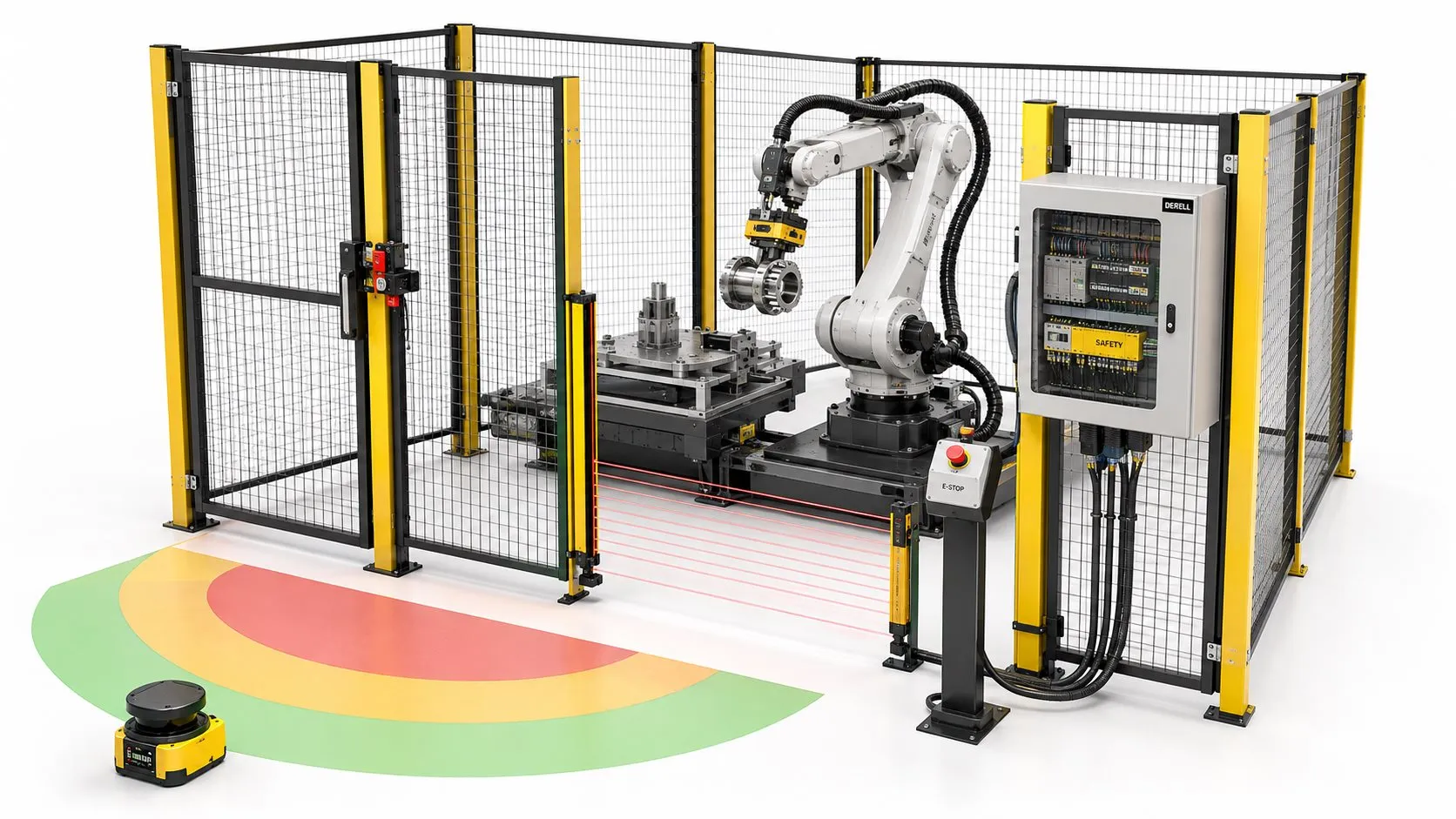
Fixed guards, interlocked doors, light curtains and safety laser scanners are selected according to the application's risks. A painted floor line alone does not prevent access to hazardous movement. When considering sensors and actuators, it is important to distinguish ordinary detection devices from equipment suitable for a safety function.
Safeguard positioning must account for the system's total response time and the distance traveled before the robot stops. Detecting a person and stopping hazardous movement may not happen at the same instant. Where someone can enter the cell completely, the design must also protect a person who remains inside when restarting is possible. Bypassing safeguards is not a substitute for a safe access method.
Normal stopping, safeguard stopping and emergency stopping
A normal stop is used to stop the production sequence. A program's stop command alone does not provide safe maintenance access or energy isolation.
A safeguard stop stops hazardous movement through an appropriate safety function, for example when protective equipment detects a person. Restart conditions depend on the application risk assessment and whether someone could remain inside the cell.
An emergency stop is a complementary protective measure intended to reduce danger in an emergency. It does not replace safeguards or energy isolation for maintenance. Controls should be accessible, and the equipment stopped along with the robot must be clearly defined. Resetting an emergency stop must not automatically restart the robot. The reason for the stop and the condition of the cell should be checked before operation resumes.
Electrical and stored energy: Stopping is not isolation
Protection against electric shock requires appropriate insulation, protective earthing and electrical protective measures. Switching off a control screen or pressing an emergency stop is insufficient for maintenance. All hazardous energy sources must be considered, including electricity, compressed air, hydraulic pressure and loads subject to gravity.
Energy isolation and lockout/tagout are carried out by competent people under the procedure established for the task. Stored energy must be managed safely, parts that could fall must be secured, and a safe condition must be verified before work begins. If removing power could cause a load to fall, that hazard must be controlled beforehand.
A safety function involves more than a software condition
A safety-related control system must be assessed as a whole, from detection to the final element that stops movement. Our EN ISO 13849 and IEC 61508 pages introduce control system safety and functional safety concepts. The required reliability depends on the application; one component's safety capability does not prove that the entire cell achieves the same performance.
Robot programming should clearly define operating modes, movement limits and fault responses. Using artificial intelligence or machine learning for detection does not remove the need to validate safety functions. Safety settings should be protected, changes assessed, and affected functions revalidated.
Does using a cobot make the whole application safe?
Among different types of robots, some offer features for working alongside people. However, the name “cobot” is not a safety guarantee. The gripper, workpiece, surrounding obstacles and task must be considered together. Approaches such as power and force limiting or speed and separation monitoring require suitable design and validation. A robot with collaborative capabilities does not make every task suitable for operation without guarding.
Teaching, maintenance, training and cybersecurity
Teaching and troubleshooting may require access to the working area. These tasks should be performed by authorized people using safe methods developed for the work. Appropriate operating modes, speed limits and measures such as enabling devices are determined through manufacturer instructions and the risk assessment. Low speed alone is not adequate protection.
Regular maintenance should cover connections, cables, grippers, guards and safety functions. Inspections and changes should be recorded, and equipment must not return to use with unresolved safety faults. When considering the impact of robotics on work, operator training, maintenance competence and workers' ability to report hazards also matter.
Connected systems require attention to industrial cybersecurity. Unauthorized program changes, remote access and network commands can have physical consequences. Access permissions, software updates and network connections should be managed in a controlled way.
Noise, process hazards and the scope of standards
Noise, vibration, hot surfaces, welding fumes and cutting hazards require separate consideration. Engineering measures and personal protective equipment should suit the work. ISO 10218-1:2025, covering industrial robots, and ISO 10218-2:2025, covering industrial robot applications and cells, are important references.
These standards should not automatically be treated as sufficient for medical robots or autonomous vehicles. Each application has its own requirements. Understanding the limitations of robotics technology and reviewing manufacturer instructions are part of choosing an appropriate safety approach.