
What is Overshoot?
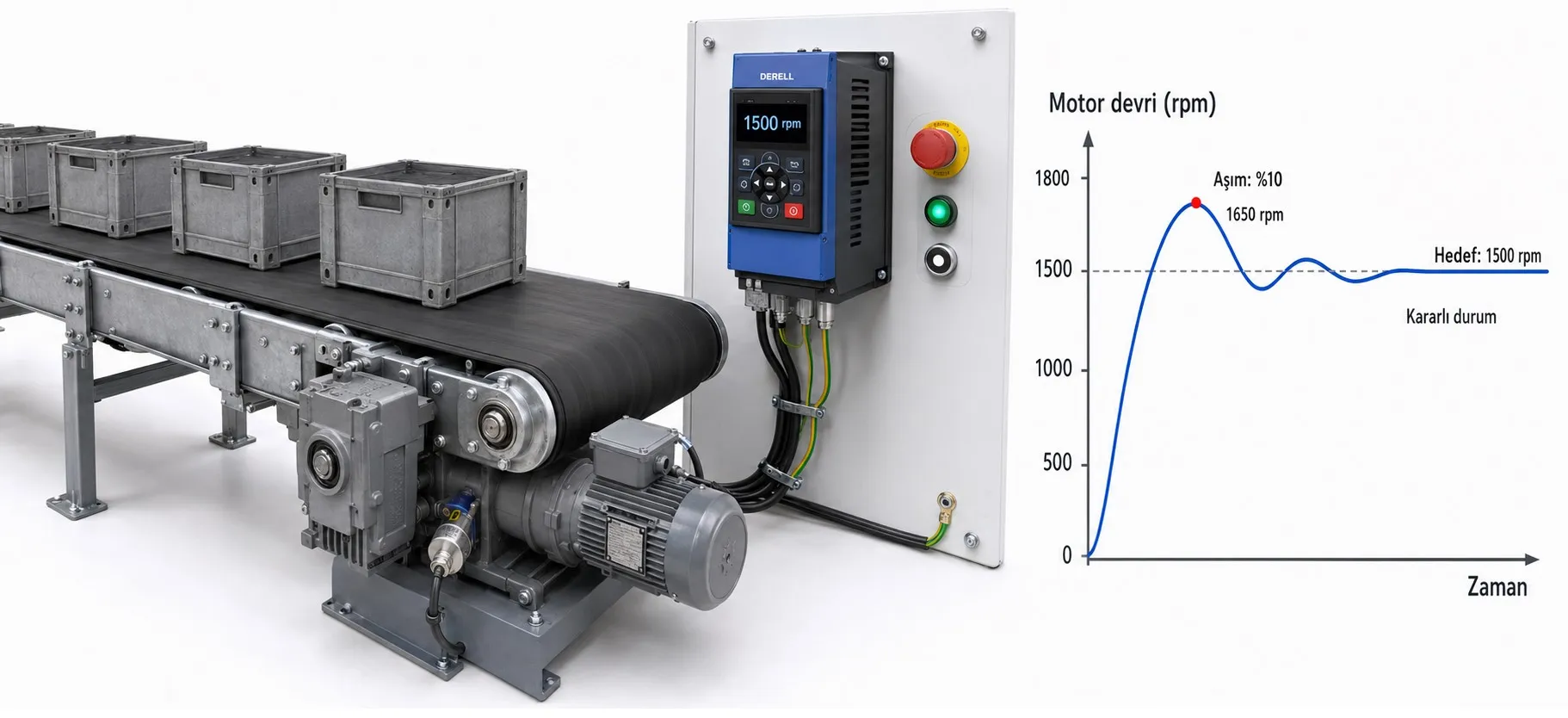
What Is Overshoot in a VFD / Motor Control System?
Overshoot occurs when the response of a control system temporarily moves beyond its target or final steady-state value.
For example, suppose the motor speed reference is:
1000 rpm
If actual motor speed rises to 1100 rpm and then settles back to 1000 rpm, the system has produced speed overshoot.
The key word is:
temporary.
If the motor simply remains at 1100 rpm, the problem is no longer just transient overshoot; reference scaling, feedback or speed regulation should be investigated.
Which variable is actually overshooting?
Overshoot should always be attached to a measured variable.
Speed overshoot: Motor speed exceeds the commanded speed.
Pressure overshoot: Pump pressure exceeds the PID setpoint.
Temperature overshoot: Process temperature rises above its setpoint.
Position overshoot: A servo passes the commanded position and returns.
Current overshoot: A current-control response temporarily exceeds its target.
This leads to a very useful troubleshooting question:
“What exactly is overshooting?”
Overshoot is not the same as Overcurrent or Overvoltage
Overshoot is a dynamic-response characteristic.
An overcurrent trip is a protection event in which drive current crosses a protection threshold.
An overvoltage trip is a protection event in which DC-link voltage crosses the drive's permitted limit.
A transient current response can technically overshoot its command without producing an OC fault.
Likewise, speed overshoot does not automatically mean an overspeed trip.
How is percentage overshoot calculated?
For a simple step from 0 rpm to 1000 rpm where peak speed reaches 1100 rpm:
Overshoot (%) = (Peak − Target) / Target × 100
Therefore:
(1100 − 1000) / 1000 × 100 = 10% overshoot
For a general control-system step that begins from a non-zero initial value, overshoot is normalized against the size of the commanded change.
Does overshoot mean the control loop is unstable?
No.
A stable underdamped system can overshoot and still settle correctly at the target.
The more serious condition is sustained or growing oscillation.
A useful distinction is:
One or two decaying peaks → transient overshoot.
Persistent cycling around the reference → hunting / oscillation.
Growing oscillation → possible instability.
Overshoot vs Overspeed
These terms are often confused.
Overshoot is measured relative to the commanded target.
Overspeed relates to an absolute safety or protection speed limit.
For example:
Speed reference = 1000 rpm
Peak speed = 1050 rpm
Overspeed protection = 1800 rpm
The system has 5% speed overshoot but has not reached the overspeed-protection level.
Overshoot vs Hunting
Overshoot can be a single transient event.
Hunting is repeated movement around the target.
For example:
1000 → 1080 → 1000 rpm
can be normal transient overshoot.
But:
1000 → 1080 → 930 → 1060 → 950 → 1040...
indicates a sustained oscillatory response.
Process PID and the motor speed loop are not always the same thing
This is an important VFD distinction.
A built-in process PID may operate like this:
Pressure Sensor → PID → Frequency Reference → VFD → Motor → Pump
The controlled variable is pressure, not motor rpm.
A high-performance vector drive may also contain a faster internal speed-control loop:
Speed Reference → Speed PI Controller → Torque-Producing Current → Motor
These are two different control loops.
A pressure overshoot therefore does not automatically mean that the motor speed loop is overshooting.
See PID with VFD for process-control applications.
How does proportional gain affect overshoot?
Increasing proportional gain generally makes the controller react more strongly to speed error.
This can improve response speed.
But excessive proportional gain can produce:
overshoot, oscillation, vibration and noise.
More gain is therefore not automatically better tuning.
Can integral action create overshoot?
Yes.
Integral action accumulates past error and is extremely useful for removing steady-state offset.
But if too much integral action remains stored as the system approaches its target, control output can continue pushing the motor after the target has been reached.
This can increase overshoot.
Output saturation can make this worse through integral windup.
Does derivative action always reduce overshoot?
No.
Derivative action can provide additional damping in suitable systems but is sensitive to measurement noise.
Many industrial drive speed regulators use a PI structure rather than a complete PID speed loop.
Therefore adding derivative action is not a universal fix for motor-speed overshoot.
Common causes of motor speed overshoot
Excessive speed-loop gain: The controller reacts too aggressively to speed error.
Excessive integral action: Stored integral output continues accelerating the motor near the target.
Incorrect motor tuning: An inaccurate motor model can reduce dynamic vector-control performance.
Incorrect load-inertia estimate: Particularly important in servo and high-performance drive systems.
Encoder problems: Wrong pulse count, wrong direction, noise, mechanical backlash or poor coupling can distort feedback.
Aggressive speed reference: A hard step or very short acceleration ramp can excite the system dynamics.
Mechanical resonance: Belts, shafts, couplings and flexible machines can interact with the speed loop.
Sudden load release: Motor torque can temporarily exceed the new load demand and accelerate the shaft above reference.
Excessive slip compensation: In some open-loop drive applications, excessive compensation can contribute to higher-than-expected motor speed.
Why can sudden load removal create overshoot?
Before the load is removed, the motor is producing enough torque to overcome that load.
If the mechanical load suddenly disappears, motor torque cannot change instantaneously.
For a short interval:
Motor torque > Load torque
and the shaft accelerates.
Actual speed can therefore rise above the target until the control loop reduces torque.
This shows why overshoot is not always simply “bad PID tuning.”
Can acceleration ramp affect overshoot?
Yes.
An excessively aggressive acceleration ramp demands high acceleration torque.
When the speed reference reaches its final target, system inertia and controller response can carry actual motor speed beyond the target.
A longer ramp or an appropriate S-curve can sometimes reduce excitation and mechanical jerk.
Why can S-curve acceleration help?
A straight linear ramp can introduce abrupt changes in acceleration at its beginning and end.
An S-curve changes acceleration more progressively.
This can reduce mechanical shock, flexible-machine resonance and some forms of overshoot.
Can overshoot occur in V/f control?
Yes, but measurement must be interpreted carefully.
Basic V/f control is generally open loop.
The drive may command 50 Hz without directly knowing the exact rotor speed.
The displayed output frequency therefore does not prove that actual mechanical speed perfectly matches the expected rpm.
Actual speed overshoot should be confirmed with suitable speed feedback, a tachometer or reliable estimated-speed monitoring.
Why is overshoot more obvious in vector and servo systems?
High-performance vector and servo drives can regulate torque and speed much more rapidly.
This higher control bandwidth gives excellent performance but also makes proper tuning more important.
Speed-loop gain, integral time, filters, torque limits, feedback quality and mechanical inertia all influence the final response.
See Vector Control for the motor-control principle.
How do you reduce overshoot?
There is no universal “overshoot parameter.”
Depending on the system:
Reduce excessive speed-loop gain.
Retune integral action.
Repeat motor auto-tuning when necessary.
Check encoder scaling, direction and wiring.
Review acceleration and deceleration ramps.
Use appropriate S-curve profiling.
Investigate mechanical resonance.
Review torque limits.
If the process variable is overshooting, tune the process PID rather than the internal speed loop.
A practical troubleshooting sequence
1. Identify the variable that is overshooting. Speed, pressure, position, current?
2. Trend reference and actual value on the same graph.
3. Measure peak value and settling behaviour.
4. Determine when it happens. Startup, load release, every reference change?
5. Identify the motor-control mode. V/f, sensorless vector, closed-loop vector or servo?
6. Separate process PID tuning from speed-loop tuning.
7. Verify motor auto-tuning and motor data.
8. Check encoder scaling, direction, coupling and noise.
9. Review acceleration/deceleration and S-curve settings.
10. Investigate mechanical resonance and load inertia.
11. Change one parameter at a time.
Editor's field note
When I see overshoot, I don't immediately open the PID menu.
I first ask:
“What did I command, and what am I actually measuring?”
A VFD display showing 50 Hz is not the same as an encoder proving the shaft speed.
A pump pressure rising above 6 bar may be process-PID overshoot even if motor speed perfectly follows its reference.
A motor reaching 1100 rpm after a 1000 rpm command is genuine speed overshoot.
Then I ask:
“Did it cross the target once and settle, or is it still fighting around the target?”
One transient peak is a tuning discussion.
Continuous cycling is a hunting, resonance or stability discussion.
Overshoot means going too far. Hunting means never quite deciding where to stay.
Overshoot FAQ
What is overshoot?
A temporary excursion beyond the commanded or steady-state target value.
If a 1000 rpm motor peaks at 1100 rpm, how much overshoot is that?
For a step from zero, approximately 10%.
Does overshoot mean instability?
No. A stable underdamped response can overshoot and then settle.
Is overshoot the same as overspeed?
No. Overshoot is relative to target; overspeed is relative to a protection limit.
Is overshoot the same as hunting?
No. Hunting is persistent oscillation around the target.
Can excessive P gain increase overshoot?
Yes. An overly aggressive loop can create overshoot and oscillation.
Can integral action increase overshoot?
Yes, especially when integral windup occurs.
Does every speed loop use PID?
No. Many industrial speed loops use PI regulation.
Can sudden load removal cause overshoot?
Yes. Existing motor torque can temporarily accelerate the shaft above the new load requirement.
Can a longer acceleration ramp help?
Sometimes, especially when inertia or mechanical excitation contributes to the problem.
Can pressure overshoot occur without speed overshoot?
Yes. Process PID and motor speed regulation are different control loops.
Related motor-control topics
Understanding VFDs · Acceleration / Deceleration Time · V/F Control · Vector Control