
Emergency Stop Error
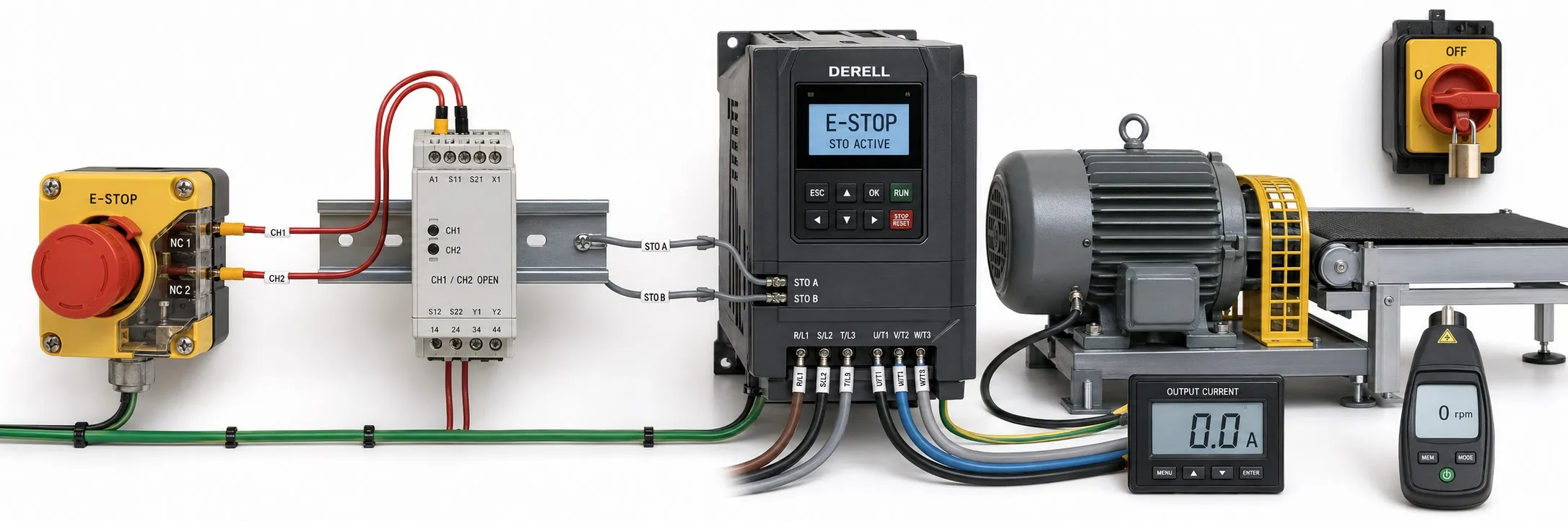
What Does an Emergency Stop Error Mean on a VFD?
A VFD Emergency Stop message generally means that the drive has received a stop or safety demand associated with the machine's emergency-stop circuit and is therefore not permitted to continue normal motor operation.
There is no universal VFD fault code called “Emergency Stop”. One manufacturer may display STP, another may show E-Stop, ESP, Emergency Stop, STO or a model-specific code. Depending on the drive, it may be recorded as a fault, alarm, warning or operating-status message.
This distinction matters because an Emergency Stop indication does not automatically mean that the VFD itself has failed. In many cases the drive is correctly responding to a command from the machine safety system.
For the wider troubleshooting tree, see the OtomasyonAVM VFD Fault Codes guide.
Common causes · Emergency Stop vs STO · How to reset · Diagnostic sequence · FAQ
What actually happens when Emergency Stop is activated?
There is no single answer that applies to every machine.
On one machine, the safety function may remove torque from the motor and allow the mechanical system to coast. On another machine, the drive may first perform a controlled deceleration before torque-producing energy is removed.
This is why Emergency Stop does not automatically mean an instantaneous mechanical stop.
A large fan, flywheel or centrifuge can continue rotating after motor torque has been removed because stored kinetic energy remains in the machine.
The correct stopping behaviour has to be selected from the machine risk assessment and the approved safety architecture.
Emergency Stop vs normal STOP
A normal STOP is part of everyday machine operation. The VFD may follow its ordinary deceleration ramp and stop the process in a controlled way.
An Emergency Stop is a machine safety function intended to reduce an existing or developing hazard as quickly as appropriate for that machine.
A useful beginner's distinction is:
Normal STOP: “Stop the process.”
Emergency Stop: “Apply the machine's defined emergency stopping function.”
Is Emergency Stop the same as STO?
No.
Emergency Stop is a machine-level safety function. It can involve an emergency-stop pushbutton, safety relay or safety PLC, wiring, drive safety inputs and other final control elements.
STO – Safe Torque Off is a specific drive safety function that prevents the drive from supplying energy that can generate motor torque.
A possible safety chain is:
Emergency-stop pushbutton → Safety relay / Safety PLC → STO channels → VFD → Motor torque disabled
That is only one possible architecture. A machine that must decelerate in a controlled manner before torque is removed may use another safety function such as Safe Stop 1.
Does STO stop a rotating motor instantly?
No.
STO removes the drive's ability to generate motor torque. It does not remove the mechanical energy already stored in a rotating fan, roll, spindle or flywheel.
The machine can therefore continue moving after STO has become active.
This is one of the most important reasons why Emergency Stop and STO should not simply be treated as interchangeable words.
What is a controlled emergency stop?
On some machines, immediately removing motor torque would not provide the safest stopping behaviour.
The machine may need to decelerate under drive control before the torque-producing output is safely disabled. Drive safety systems can implement this type of behaviour through functions such as SS1 – Safe Stop 1, depending on the equipment and validated machine design.
The safety function must be chosen from the actual hazard and machine behaviour rather than from the name of a VFD parameter.
What causes a VFD Emergency Stop message?
An emergency-stop pushbutton is still operated. This should always be checked first.
The safety relay has not reset. Releasing the pushbutton does not necessarily restore the relay outputs.
A safety PLC still sees a hazardous condition. A guard switch, light curtain or another safety device may still be requesting a stop.
One STO channel is open. Drives with dual-channel STO may inhibit operation if STO1 and STO2 do not both reach the required state.
The 24 V safety supply is missing or unstable. A control-power problem can make a healthy mechanical pushbutton look like an active safety demand.
A terminal or wire is loose. Vibration can intermittently open a normally-closed safety circuit.
A digital input is assigned incorrectly. A programmable terminal may have been configured as Emergency Stop, External Fault or Enable by mistake.
NO/NC input logic is incorrect. The drive may interpret a released switch as an active stop request if terminal logic does not match the actual circuit.
The safety circuit requires a manual reset. Releasing the actuator is not always the same as resetting the complete safety function.
Is Emergency Stop really a VFD fault?
Often, no.
The drive can be perfectly healthy while correctly reporting an active safety demand.
Some ABB drives, for example, provide a dedicated Emergency Stop alarm and stop according to a configured emergency-deceleration time. Older Yaskawa drives may display STP when an emergency-stop input becomes active.
This illustrates why troubleshooting should begin with:
“Where is the safety request coming from?”
rather than:
“Which part inside the VFD has failed?”
A practical Emergency Stop diagnostic sequence
1. Verify that the machine is safe. Do not clear a safety demand merely to make the machine run again.
2. Record the exact drive message. It may say Emergency Stop, STP, STO, External Fault or something manufacturer-specific.
3. Inspect all emergency-stop devices. A remote pushbutton elsewhere on the machine may still be latched.
4. Check the safety relay or safety PLC. Status LEDs can often show which channel or input is missing.
5. Check STO1 and STO2. If the VFD has Safe Torque Off, verify both channels according to the manufacturer's safety manual.
6. Verify the safety-control supply. Check the 24 V supply and common wiring under actual connected conditions.
7. Review digital-input assignments. Confirm which terminals are configured as Emergency Stop, External Fault, Enable or STO-related signals.
8. Read the exact manufacturer's fault description. Similar-looking codes can mean different things on different drive families.
9. Restore the safety circuit using the approved reset sequence.
10. Issue a separate start command. Resetting the safety function must not itself be treated as a normal RUN command.
How do you reset a VFD Emergency Stop error?
The exact procedure depends on the machine, but the logical sequence is normally:
Remove the hazardous condition → release the E-stop device → restore the safety circuit → perform the required safety reset → clear the VFD indication if necessary → issue a new RUN command.
A critical principle is that resetting the Emergency Stop function should not automatically restart the machine.
Reset should only make a subsequent restart possible.
Why does the Emergency Stop fault remain after the button is released?
The emergency-stop actuator may be released while another part of the safety chain is still preventing restart.
Common examples include a safety relay awaiting manual reset, one open STO channel, a guard switch that remains open, missing safety-control voltage, an active Safety PLC condition or a drive fault that needs a separate reset.
Some drives also require the previous RUN command to be removed before a new start can be accepted after a safety event.
Can I jumper the Emergency Stop or STO terminals?
A jumper may make an input electrically appear healthy, but bypassing a safety circuit simply to remove an alarm is not an acceptable troubleshooting method.
It can defeat the intended safety function and allow unexpected machine movement.
STO channels and emergency-stop circuits should be wired and tested according to the drive manufacturer's approved safety architecture.
Can a normal PLC or Modbus STOP command be used as Emergency Stop?
Not by itself.
A normal PLC output, standard fieldbus command or ordinary Modbus RUN/STOP command is part of normal machine control unless it is implemented within an appropriately safety-rated architecture.
Safety-related stopping requires the appropriate safety hardware, safety controller or certified drive safety functions for the required risk reduction.
Does Emergency Stop remove electrical power from the VFD?
Not necessarily.
The motor may be prevented from producing torque while the VFD control electronics and DC link remain energized.
Emergency Stop and STO therefore should not be treated as electrical isolation procedures for maintenance work.
Electrical work still requires the manufacturer's isolation, discharge-time and voltage-verification procedure.
Emergency Stop vs External Fault vs STO
Emergency Stop: relates to an emergency machine-safety stopping demand.
External Fault: is a general fault signal supplied by another device; it is not automatically a safety function.
STO: is a defined drive safety function that safely prevents torque generation.
All three may result in a motor that does not run, but their meanings and troubleshooting paths are different.
Which standards are related to Emergency Stop?
The OtomasyonAVM ISO 13850 Emergency Stop Function Design Principles page covers the dedicated emergency-stop design topic.
Depending on the machine and safety architecture, IEC 60204-1, ISO 13849, IEC 62061 and IEC 61800-5-2 can also become relevant.
These standards address different layers of machine safety and should not be treated as interchangeable documents.
For the wider structure, see Industrial Standards and Machinery Safety Standards.
VFD Emergency Stop FAQ
Does an Emergency Stop message mean the VFD is damaged?
Usually not. It commonly means that the drive is correctly responding to an external safety or stop request.
Must the motor stop instantly when Emergency Stop is pressed?
No. The required stop behaviour depends on the validated machine safety function.
Are Emergency Stop and STO the same thing?
No. Emergency Stop is a machine-level safety function; STO is one specific drive safety function that prevents torque generation.
Can the motor restart automatically when the E-stop is released?
The reset of an emergency-stop function should not itself restart the machine. A separate deliberate restart action should be required.
Can I bridge STO inputs to clear the fault?
Safety inputs should not be bypassed simply to remove an alarm. The reason the safety circuit is open should be identified.
Can an ordinary PLC STOP signal be used as an emergency stop?
An ordinary control signal is not automatically a safety-rated emergency-stop function.
Can dangerous voltage remain in the drive after Emergency Stop?
Yes. The DC link and other circuits can remain energized even when motor torque is disabled.
Does every manufacturer use the same Emergency Stop code?
No. Code names, stop behaviour and reset logic vary considerably between manufacturers and drive families.
What should I check if the Emergency Stop message keeps returning?
Check the pushbuttons, safety relay, STO channels, safety-control power supply, terminals, wiring, safety PLC inputs and drive input assignments.
Related VFD fault and safety topics
VFD Fault Codes · STO – Safe Torque Off
Related machinery-safety topics
Emergency Stop and Safety Control Devices · ISO 13850 · Machinery Safety Standards · Industrial Standards