
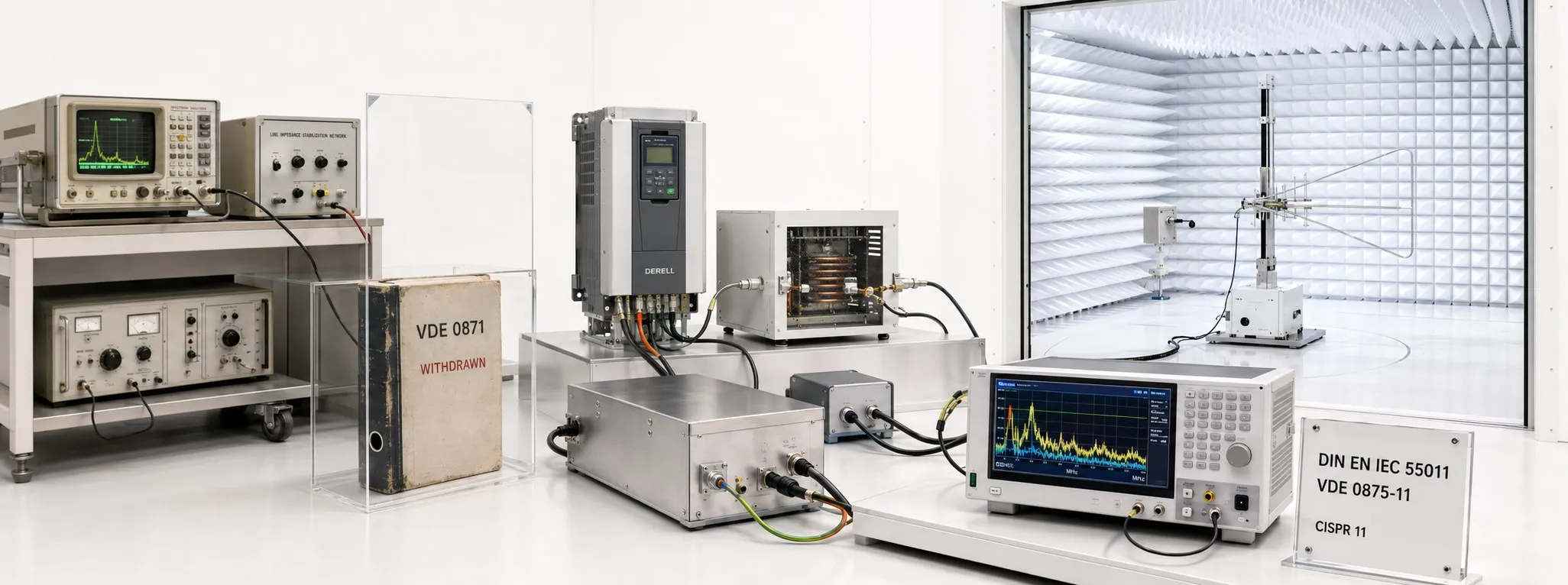
What Does VDE 0871 Mean?
VDE 0871 is a legacy German standards reference associated with limiting radio interference from high-frequency equipment. It still appears in older manuals, power-supply specifications and equipment documentation. Its subject is electromagnetic disturbance, not fuse current ratings or short-circuit interruption.
The DIN 57871:1978-06 / DIN VDE 0871:1978-06 edition addressed radio interference suppression for industrial, scientific, medical and similar high-frequency equipment. That edition has been withdrawn. A reference to it therefore needs to be read in its historical and technical context.
Was VDE 0871 only an IT equipment standard?
No. The main 1978 edition should not be described as applying exclusively to computers or data-processing equipment. Separate documents within the numbering family did address information technology equipment.
For example, DIN VDE 0871-2:1987-03 was replaced by DIN VDE 0878-3:1989-11, associated with the EN 55022/CISPR 22 route. This is why an undated statement such as “meets VDE 0871” is incomplete: the base number alone does not identify the precise requirements used.
Which standard replaced it?
DIN's replacement record identifies DIN VDE 0875-11:1992-07 as the successor to the main 1978 edition. The 1992 document was associated with the German adoption of EN 55011:1991. For ISM equipment, the historical development can therefore be followed through the CISPR 11 and EN 55011 family.
That replacement history does not mean every product carrying an old VDE 0871 reference should now be assessed under EN 55011. Present-day standard selection begins with the actual product, its intended environment and the scope of the relevant product-family requirements.
Emissions and Immunity Answer Different Questions
Emissions describe the electromagnetic disturbances a device produces. Immunity describes its ability to perform as intended when exposed to disturbances from elsewhere. Both contribute to electromagnetic compatibility.
A variable frequency drive, for example, can produce high-frequency currents through its switching operation. An unexpected transition at a nearby PLC input or a disturbed sensor signal may involve the source, the coupling path and the receiving circuit's immunity.
Passing an emissions test does not demonstrate immunity compliance. Likewise, a machine fault is not automatically an EMC problem. Supply interruptions, connection faults and software behaviour should also be considered during diagnosis.
Conducted versus radiated disturbance
Conducted emissions travel through power, control or communications connections. Radiated emissions reach the surroundings through electromagnetic fields associated with cables and equipment structures. Both mechanisms can be present in the same installation.
Cable length, shield termination, routing and enclosure construction affect these paths. A cable is therefore more than an electrical connection when high-frequency behaviour is being assessed.
Does “10 kHz to 30 MHz” describe the entire standard?
Not without further qualification. A frequency range must be tied to an edition, a particular port or measurement, and the relevant test method. A band shown on an old conducted-noise plot should not be presented as the complete scope of every document carrying the VDE 0871 number.
The same caution applies to a claim about “narrowband limits.” Meaningful comparison requires the detector, measurement bandwidth, test distance where applicable, units and operating conditions. A frequency range on its own is not a complete compliance criterion.
Choosing the Relevant EMC Standard Today
Start by checking whether a dedicated product or product-family standard applies. The following families address different equipment categories; they are not interchangeable replacements for every historical VDE 0871 reference.
| Equipment category | Relevant family | Principal subject |
|---|---|---|
| Multimedia equipment | CISPR 32 and EN 55032 | Emissions from equipment within their scope |
| Adjustable-speed electrical power drive systems | IEC 61800-3 | EMC requirements for the drive system |
| Measurement, control and laboratory equipment | IEC 61326-1 | Emissions and immunity for covered equipment |
Where no relevant dedicated product or product-family emission standard exists, generic requirements may apply. These include IEC 61000-6-4 for industrial environments and IEC 61000-6-3 for residential locations, subject to their scope conditions. Confirm the applicable edition and regional adoption separately.
What makes an emissions measurement valid?
A peak on a spectrum display is not, by itself, a failure. The measurement must use the required setup and method. CISPR 16-1-1 addresses the characteristics of radio-disturbance measuring equipment.
CISPR 16-1-2 covers coupling devices used for conducted-disturbance measurements, including relevant artificial-network arrangements. CISPR 16-2-1 addresses conducted measurement methods, while CISPR 16-2-3 addresses radiated methods.
The measurement method and the product's emission limits perform different roles. A useful report identifies the product standard and edition alongside the operating mode, cable arrangement and measurement procedure.
How to Evaluate Equipment Marked VDE 0871
Recover the complete reference. Record the model, approximate production period, standard edition, any class designation and the available test report. A class letter from one standard should not be mapped to another standard solely because the letter matches.
Check the tested configuration. The original claim may depend on an external filter, a specified cable length, shielding or a metal enclosure. Changes to those conditions can make the historical result unrepresentative of the present installation.
For example, a legacy drive may have been assessed with a short motor cable and a particular external filter. Moving it to another cabinet with a longer cable changes the installation. The presence of an EMC filter alone does not prove equivalent performance; its connections and the complete cable arrangement also matter.
Maintain protective earthing and follow the manufacturer's requirements for shielding and equipotential bonding. Disconnecting protective earth to reduce interference is not an acceptable remedy. Effective noise suppression in servo systems likewise requires examination of the source, coupling path and affected circuit.
Does an obsolete reference mean the equipment is faulty?
No. A legacy standard number is evidence about the equipment's documentation history, not proof of a defect. Its current performance and any present-day conformity claim require assessment of the actual equipment, intended use and supporting evidence.